“Cuban History” series · Season 2, episode 6
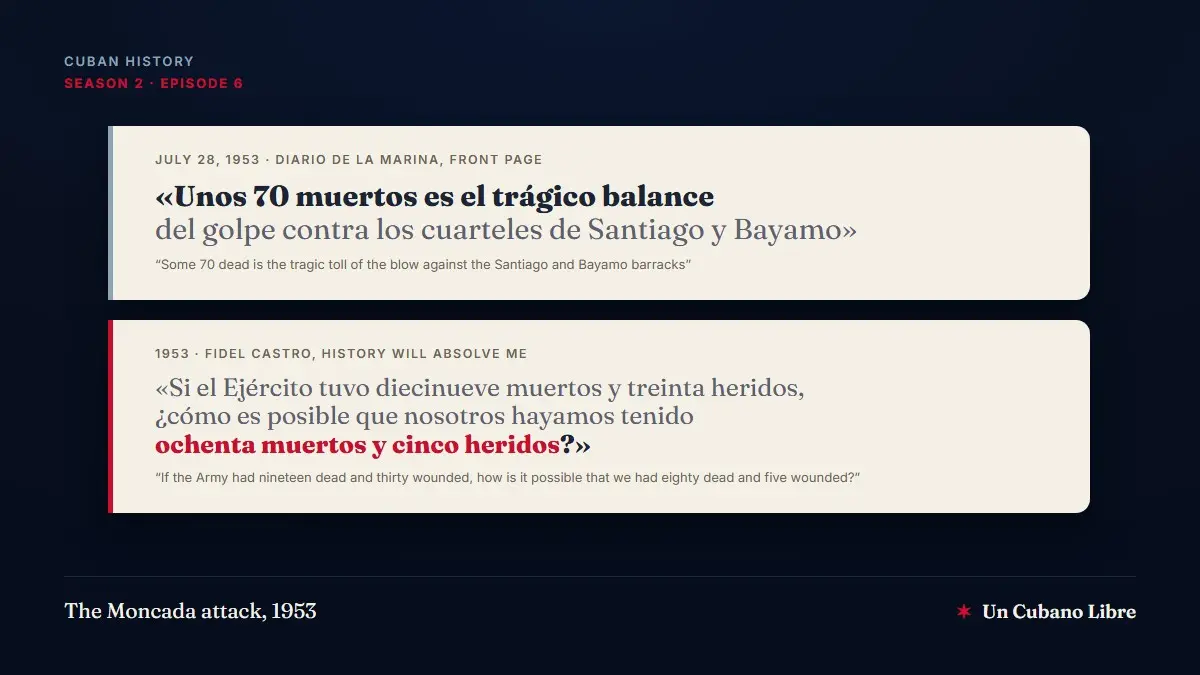
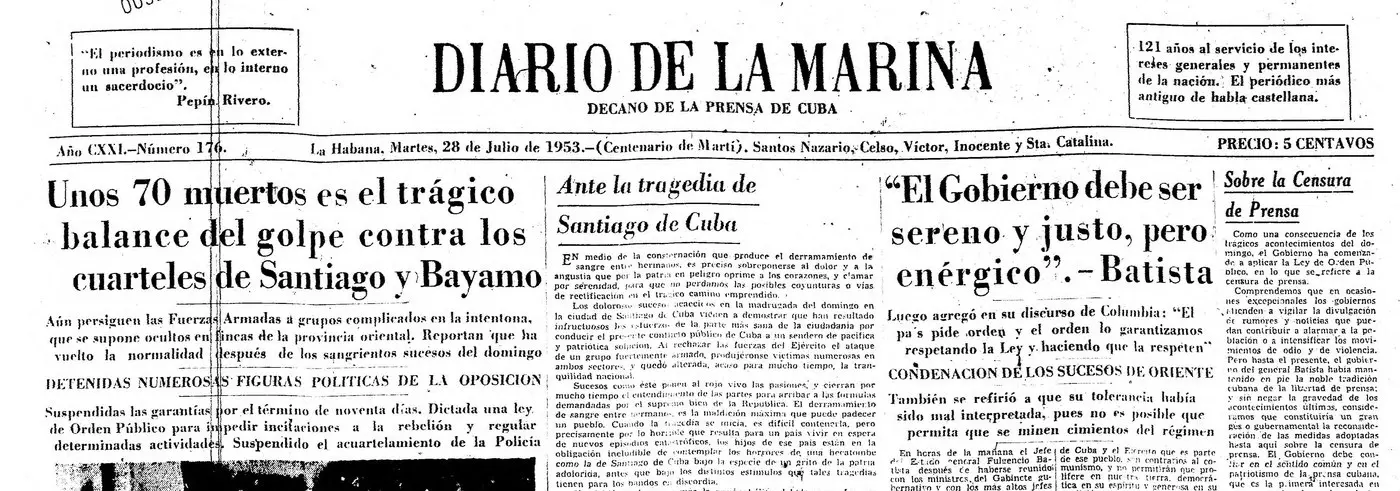
On Tuesday, July 28, 1953, two days after the attack, the Diario de la Marina led with this headline: “Some 70 dead is the tragic toll of the blow against the Santiago and Bayamo barracks” (in Spanish). On the same front page, to the right, Batista called for a government “calm and fair, but firm”; below came the suspension of constitutional guarantees for ninety days, further down the appointment of censors for four newspapers, and in the last column the paper protested “On press censorship.” The next day the censors were assigned to every newspaper and magazine in the country.
That front page holds almost everything worth knowing about July 26, 1953. There were dead, far more than a battle could explain. There was a government telling its version with the press gagged. And there was a figure, “some 70,” that added up the dead on both sides known “up to the time these lines are written” (in Spanish). It fell short, since in the end there were more than eighty, and it left out what mattered: how many had died fighting and how many as prisoners. For the Cuban regime that morning is where everything begins: it gives its name to the 26th of July Movement, it is a national holiday, and it produced Fidel Castro’s most famous speech. This episode, which closes the season, is about what the papers of 1953 say against what was built on top of them, by both sides.
What happened
Around five in the morning on Sunday, July 26, a carnival day in Santiago, sixteen cars carrying about 135 men in army uniforms left a rented farm in Siboney. The state encyclopedia, EcuRed, gives the figure with a detail the official story usually leaves out: “Of the 135 revolutionaries, 131 stepped forward” (in Spanish). Four backed out. In Bayamo, more than a hundred kilometers away, another 24 to 30 attacked the Carlos Manuel de Céspedes barracks at the same hour.
The plan depended on surprise. The vanguard took Post 3 of the Moncada barracks, but a run-in with a two-man foot patrol and the first shots raised the alarm. On top of that, part of the convoy, the best-armed part, got lost in the city streets and never arrived. Castro admitted it in his defense speech: “half of the bulk of our forces, and the best armed, by an unfortunate mistake went astray at the entrance to the city” (in Spanish). The official 1964 book Relatos del asalto al Moncada explains it differently: the group got lost “because the car leading it deserted” (in Spanish; page 25). The Cuban American historian Antonio Rafael de la Cova, who interviewed 115 witnesses from both sides for his 2007 book, estimates that of the ninety heading for Post 3 between sixty and seventy arrived (page 81), and that Castro ordered the retreat in under half an hour (page 251). At the civil hospital, which a group led by Abel Santamaría had occupied, the resistance lasted longer. In Bayamo, some ten or fifteen minutes.
Castro did not get into the barracks. His car, the second in the convoy, stopped in front of Post 3, and the attackers who saw him remember him in the street, giving orders and shouting the retreat. There is nothing dishonorable in that, because, according to what Mario Chanes saw, as De la Cova records it, no one from his car or from Castro’s got inside (page 92). But it is not the scene in the school posters either.
The count
On the government side there is a core of figures on which opposing sources agree: 19 soldiers and policemen died, 15 soldiers and 3 police officers in Santiago and one in Bayamo, and about 30 were wounded. The medical certificates in the court file, which can be read today, describe bullet and buckshot wounds (in Spanish). Castro gave the same figures in his defense speech, and so does De la Cova.
On the attackers’ side, the official Cuban list (in Spanish) has 61 dead. And here is where it matters. According to De la Cova’s reconstruction, only nine died fighting (page 119). EcuRed says six. Castro, in his “Message to Suffering Cuba” at the end of 1953, wrote “Dead in combat 8” (in Spanish). The number killed in combat runs from five to nine depending on who is counting. The other fifty-odd died afterward, already prisoners.
Castro himself summed it up with a question that still holds: “If the Army had nineteen dead and thirty wounded, how is it possible that we had eighty dead and five wounded?” (in Spanish). The question is good even though the figure of eighty is false. In no battle do three times as many attackers die as defenders, with almost no wounded left.
The army’s own reports give it away when read in sequence. On July 26, Colonel Alberto del Río Chaviano, the regimental commander, reported 37 attackers killed. The Diario de la Marina of the 28th put 33 at the Moncada and 4 in Bayamo, and added that “the rest of the casualties are due to the clashes between the security forces and the fugitives” (in Spanish). By August 1 the official figure was 60 rebels dead, 18 soldiers and two civilians (in Spanish), according to the EFE agency dispatch published by the Madrid daily ABC. In those five days of “clashes,” the army reported three wounded of its own. The count of the dead nobody saw fall in combat was made by its own reports.
The massacre
What happened to the prisoners has been documented since 1953, and not by the regime. On July 27 and 28, the Second Vacation Chamber of the Santiago Court of Appeals, presided over by Judge Manuel Urrutia Lleó, examined 34 bodies at the cemetery with four forensic doctors. The record is reproduced by the journalist Marta Rojas in her book on the trial, and it reads as a list of executions. Khaki shirts with no bullet holes over bodies with chest wounds: uniforms put on after death. White hospital trousers under the military ones: the men from the civil hospital. Shots to the back of the neck. And body number 31: “Has a bandage on the right leg, over thirteen bullet wounds” (in Spanish), plus two shots in the back of the head (page 97). A wounded man who had already been bandaged was finished off.
De la Cova, through interviews with soldiers, reconstructs the rest: the prisoners from the civil hospital were taken to the barracks firing range and shot with a machine gun, and the bodies were scattered outside to make it look as if they had died in combat. His conclusion leaves no room for nuance: army soldiers killed “more than fifty rebel prisoners” in four days, and “It was the largest mass killing of prisoners since the War of Independence” (page xxvii).
The army also kept the dead. The same Diario de la Marina reported on page 25 that the attackers were buried by the army, “the handing over of the bodies to the families having been refused” (in Spanish).
The killing stopped because of pressure from the city and the Church. On July 29 the archbishop of Santiago, Enrique Pérez Serantes, issued a pastoral letter titled “Peace to the dead,” asking for “Christian mercy for the defeated” and announcing: “We have the personal and formal promise of the Army commander of this region” (in Spanish). That a public promise not to kill those who surrendered was needed on July 29 says everything. Through his mediation dozens of fugitives turned themselves in alive.
Castro survived because of that and because of a lieutenant. At dawn on August 1 a patrol under Lieutenant Pedro Sarría caught him asleep in a hut. Sarría refused to hand him over to Major Andrés Pérez Chaumont, one of the officers blamed for the massacre, and took him to the city jail instead of the barracks. Castro, Sarría and De la Cova all tell it, with nuances, which makes three sources from different sides. According to Sarría, when he arrived, Chaviano rebuked him: “This man should never have gotten here alive” (in Spanish; page 43).
Batista’s lie
While it was killing prisoners, the government told another story. Batista spoke on radio and television on July 27. The next day a General Staff circular stated that the attackers entered the military hospital “treacherously attacking the sick soldiers there with knives,” and on July 30 Chaviano put it in his report to the court: “knife in hand, they slit open the bellies of three patients, two of them operated on the day before” (in Spanish; page 11). In the same report: that the attackers were mercenaries, some of them foreigners, paid by former president Carlos Prío, and that “the number of rebels is estimated at more than 400 or 500 men” (page 12).
All of it collapsed at the trial, brought down by the army’s own doctors. The director of the military hospital, Captain Edmundo Tamayo, a physician, testified that the orderly who died had bullet wounds, that a patient was hit by buckshot when he looked out of a window, and that “No patient fired; there was no fighting in the hospital” (in Spanish; page 214). De la Cova concludes that two people did die in the military hospital from the attackers’ fire, an orderly and a patient. Shot, not stabbed. The army doctors who signed the soldiers’ certificates had recorded not a single stab wound. The ballistics experts said the attackers had used no grenades. There were about 160 of them, all Cuban.
The Prío story did not hold either. The court acquitted the politicians who had been charged, and Batista’s ambassador in Washington, Aurelio Concheso, privately told the State Department on September 1 that the attack “had not been directly connected with the Prío group”, although he insisted Prío had supplied money for the arms. And the government’s other charge, that it had been a communist action, was denied by the communists themselves. The New York communist paper, the Daily Worker, carried the Popular Socialist Party’s statement on August 5, 1953: “We repudiate the putschist method, peculiar to bourgeois political factions…” And it went on: “But even more we repudiate the repression dictated by the Government…”
What was added later
The massacre was real and needed no embellishment. It got some anyway. In History Will Absolve Me, the defense speech Castro reconstructed in prison in 1954, we read of the prisoners: “They crushed their testicles and tore out their eyes” (in Spanish). And it is told that Haydée Santamaría was shown one of her brother Abel’s eyes. It is the most repeated scene of the Moncada: it is in the ninth-grade textbook, and in EcuRed it grew: Haydée’s entry says “they showed her one of Abel’s eyes and the remains of the genitals of her boyfriend Boris Luis Santa Coloma” (in Spanish).
The 1953 forensic record describes neither torn-out eyes nor castrations. It does describe a beating in one case, that of the attackers’ doctor, Mario Muñoz: “contusions with both molars caved in” (in Spanish) and a shot to the head (page 90). Haydée testified under oath at the trial, and what she recounted was what she heard the soldiers say: “If you were missing an eye for show, now you will be missing it for real” (in Spanish), and that she saw her brother with his face stained with blood (page 183). She did not say she was shown anything. The director of the funeral home that collected the bodies, Manuel Bartolomé, was asked in a 1993 interview whether he saw any body missing its eyes, and answered: “No, I did not see any body that showed signs of torture” (in Spanish). But he did not deny the torture: a little earlier he had said “I would not say it was not done, but I say I did not see it”. De la Cova puts it bluntly: “eyes and castrations in History Will Absolve Me never occurred” (page 165). And there is a telling detail: Castro never told the story of the eye again in any of the 41 July 26 speeches from 1959 to 2006 that I checked on the official site cuba.cu.
The same happened with the hour and the order. The official version says the massacre began after three in the afternoon, when General Martín Díaz Tamayo arrived from Havana with Batista’s order to kill ten prisoners for every soldier killed. De la Cova wrote in 2008 that “between 9 and 11 AM they had executed 34 captured rebels at the barracks firing range” (in Spanish), and in his book Díaz Tamayo reaches Santiago the next day. That the order came from Batista has no source other than Castro. That Batista’s army killed the prisoners has a judicial record.
And the number. In 1953 Castro wrote seventy, eighty and ninety dead, in different texts; in his defense speech he says that “ninety-five percent of our dead” (in Spanish) died after the fighting, and in the “Message to Suffering Cuba,” of the same year, that eight of sixty-two died in combat. Raúl Castro wrote in 1961 “more than 80” (in Spanish). The ninth-grade textbook (in Spanish) gives 69. Today’s official figure is 61. That there were 61, and that more than fifty of them were murdered, was enough.
The speech nobody transcribed
Castro was tried separately, on October 16, 1953, in a small nurses’ room at the civil hospital, because Chaviano had removed him from the main trial with a medical certificate declaring him ill, which Castro denounced in a letter to the court. The text itself describes the room: “They have let in only two lawyers and six journalists, in whose newspapers the censorship will not allow a word to be published” (in Spanish). He spoke for about two hours, according to Marta Rojas, who was there. No record or shorthand transcript of what he said is known.
The text that circulates as History Will Absolve Me is not what was said that day. Castro wrote it in the prison on the Isle of Pines, it was smuggled out in pieces, and it was printed clandestinely in 1954. I am not the one saying so: the official upper-secondary history textbook of Cuba’s Ministry of Education describes it as “reconstructed by Fidel from the prison on the Isle of Pines” (in Spanish; page 269). It is a political document written with months to think it over, not a trial record, and it has to be read that way, both for what it gets right and for what it adds.
From the other side, the claim circulates that its final line, “Condemn me, it does not matter. History will absolve me,” is copied from Hitler. The close of Hitler’s speech at his 1924 trial, published in English translation by the German Historical Institute, says: “You may pronounce us guilty a thousand times, but the Goddess who presides over the Eternal Court of History will with a smile tear in pieces the charge of the Public Prosecutor and the verdict of this court. For she acquits us.” The idea and the verb are similar. The wording is not. There is no proof Castro copied it, and the comparison is not needed to criticize the text.
The main trial ended on October 6 with 29 convicted, according to the front page of the Diario de la Marina the next day (in Spanish). Castro got fifteen years. He served twenty-one months. In May 1955 Congress passed a political amnesty, and on May 7 the same paper ran the headline: “Political amnesty signed by the President last night” (in Spanish). The president was Batista. Today’s high-school textbook tells it differently: “The people had won the battle” (in Spanish).
Raúl at the Palace of Justice
In the defense speech, Castro assigned his men this way: “Raúl Castro, with ten men, occupied the Palace of Justice” (in Spanish). That is the source of what EcuRed and the official textbooks repeat: that Raúl led the group that took the roof of the courthouse. The leader of that group was someone else, Léster Rodríguez, who in October 1953 was still at large; according to De la Cova, that is why Castro did not name him. De la Cova says so (page 76), and so does a 2017 version of Léster’s own EcuRed entry: “Léster was put at the head of a commando of men, among whom was Raúl Castro” (in Spanish).
At the September 1953 trial Raúl described himself differently. According to the chronicle of Marta Rojas, who was in the courtroom, he said he had taken responsibility for the movement at the city jail because he believed his brother was dead, and added: “I am a simple soldier who was assigned a position and a task” (in Spanish). He also said he had shot open the door to the roof and that his paraffin test came out negative. Over the years, and with Raúl in power, the soldier turned into a commander.
The ones Castro jailed
Several of the men who attacked the Moncada with Castro ended up as Castro’s prisoners. The best-known case is Mario Chanes de Armas, who was in the third car, was wounded in the hand, served prison time for the attack, came over on the yacht Granma and later broke with the government’s communist course. He was arrested at home on July 17, 1961, accused of plotting to kill Castro, which he always denied: he said he was punished for criticizing him. He was imprisoned for thirty years, until 1991, and in 1993 he was allowed to leave Cuba. Chanes was also erased from the photos in which he appeared beside Castro. On the fiftieth anniversary of the attack he told the St. Petersburg Times: “It’s like I never existed.”
Gustavo Arcos Bergnes, wounded in the attack and from 1960 Castro’s ambassador to Belgium, was arrested in 1966 while still holding the post and sentenced to ten years, according to Amnesty International; he went back to prison in 1981 and came out in 1988. Other Moncada veterans, such as Manuel Suardíaz and Jaime Costa, spent years in the prisons of the regime they helped found, according to the interviews De la Cova conducted with them. None of them appears in the July 26 posters.
| What is said | What the document says |
|---|---|
| Chaviano’s report, 1953: “the number of rebels is estimated at more than 400 or 500 men,” some of them foreigners | False. There were about 160, all Cuban (De la Cova). The report is in Rojas, page 12, in Spanish. |
| General Staff circular, 1953: the attackers entered the military hospital “treacherously attacking the sick soldiers there with knives” | False. No stab wounds in the certificates (court file, in Spanish); the hospital director denied it at the trial (Rojas, page 214). An orderly and a patient died, of gunshots. |
| Batista government, 1953: it was the work of Prío and the communists | False. The Communist Party repudiated it as “putschist” (Daily Worker) and Batista’s ambassador admitted it was not directly connected with Prío (FRUS). |
| Official version in the press, 1953: “the rest of the casualties are due to the clashes between the security forces and the fugitives” | False. Shots to the back of the neck, uniforms put on afterward, a bandaged wounded man finished off (forensic record, page 97). |
| Castro, 1953: 70, 80 or 90 attackers died | False. The official list has 61 (Rojas). |
| Castro, 1953: nearly all died after the fighting | True. Between 5 and 9 fell in combat; more than fifty were murdered as prisoners (De la Cova). |
| Regime: they showed Haydée one of her brother Abel’s eyes | No proof. Haydée did not say so under oath (Rojas, page 183) and the forensic record describes no mutilations. |
| Regime: Batista ordered ten prisoners killed for every soldier | No document. Only Castro says so (History Will Absolve Me, in Spanish). |
| Regime: Raúl Castro led the group at the Palace of Justice | False. Léster Rodríguez led it (EcuRed, 2017, in Spanish; De la Cova, page 76). |
| Regime: History Will Absolve Me is what Castro said at the trial | No. It was “reconstructed” in prison, according to the official high-school textbook (page 269, in Spanish). |
| Official high-school textbook, on the amnesty: “The people had won the battle” | Congress passed it and Batista signed it (Diario de la Marina, 1955). |
| Martí Noticias, 2018: at the trial “neither they nor the other defendants made accusations of torture of the prisoners” | False. The trial chronicle records the complaints (Rojas). The article: Martí Noticias, in Spanish. |
| Batista, 1962: Castro did not appear in the fighting | False. He was in front of Post 3, though he did not get inside the barracks (De la Cova, page 92). |
| Exile: History Will Absolve Me copies Hitler | The idea is similar; the wording is not, and there is no proof of copying (Hitler’s closing speech, 1924). |
| Regime: the bullet holes in the facade are from 1953 | They are a restoration (EcuRed, in Spanish). |
| Regime: the Moncada veterans, heroes of the Revolution | Some ended up Castro’s prisoners: Mario Chanes de Armas, thirty years (St. Petersburg Times); Gustavo Arcos, twice (Amnesty International). |
What has to be told even if I don’t like it
In this episode the awkward part for the exile starts with the dead: the Moncada massacre was carried out by Batista’s army, and it is better documented than almost anything the regime has said about it since. A 1953 judicial record, signed by a judge of the Republic, describes thirty-four bodies with shots to the back of the neck and uniforms put on afterward. Whoever wants to defend pre-1959 Cuba should stop here. There is no way to defend this.
Some exile myths fall to the same papers. Martí Noticias published in 2018 that at the trial “neither they nor the other defendants made accusations of torture of the prisoners” (in Spanish), and the trial chronicle records complaints from several prisoners, Haydée’s among them. Batista wrote in his memoirs, according to De la Cova, that Castro “did not appear at the tragic scene of the fighting” (page xi), and the attackers saw him in front of Post 3. Nor is it true that they were a band of mercenaries: they were about 160 young Cubans, only four of them Marxist sympathizers according to De la Cova, and the program Castro published afterward began with a law that “proclaimed the Constitution of 1940” (in Spanish).
And there is something the regime does not tell, which those who see only one side do not like to hear either. Castro saved his life in 1953 because a lieutenant in Batista’s army refused to kill him and because a Catholic archbishop negotiated with the colonel. The murders of his comrades were put on record because a judge of the Republic went to the cemetery to count them. And he got out of prison in 1955, twenty-one months into a fifteen-year sentence, because Batista signed an amnesty. Mario Chanes de Armas, who was with him at the Moncada and in the Isle of Pines prison, served the thirty-year sentence Castro’s government gave him, all but the last day, according to Human Rights Watch.
What was built
On July 26, 1959, the Council of Ministers met at the Moncada before dawn and agreed “to declare, every year, July 26 as the Day of National Rebellion” (in Spanish). In January 1960 Castro began knocking down the barracks walls from a tractor (in Spanish), and the building became the July 26 School City. The walls were later rebuilt and, according to the same EcuRed entry, the facade got back “the bullet marks on the wing corresponding to Post 3”. The holes tourists photograph today are a restoration.
From then on every anniversary served to announce something. Castro said it openly in 1961, about the attack: “it was not a victory of arms” (in Spanish). It was a victory of the story, and the story kept being used. Two weeks after the protests of July 11, 2021, the official site Cubadebate titled an anniversary piece “Patria y vida in the dungeons of the Moncada” (in Spanish): the slogan of the July 11 protesters, put in the mouths of the prisoners of 1953.
What remained
With the 1953 papers in hand, the Moncada was a badly planned attack that lasted minutes, in which nineteen soldiers and policemen and some nine attackers died, followed by the massacre of more than fifty prisoners by the army of a dictatorship, which that dictatorship tried to cover up with invented knives and censorship. On top of that, the winner built something else: he added dead men, torn-out eyes, an order nobody has seen in writing, a commander who was not one, a speech rewritten in prison and a museum with restored bullet holes. And he erased from the photos the men who were there and later said no.
This season was called “The false story,” and it has always been about the same thing: what happened, what was told, and the distance between the two. The UMAP, the Escambray, Huber Matos and Camilo Cienfuegos, the literacy campaign and pre-1959 Cuba: in each case the official story said one thing and the papers say another. The Moncada is the origin of all those stories, which is why it comes last: a real massacre, told by both sides with false numbers. The rest of the series is here.