“Some 70 dead is the tragic toll”: the Moncada attack
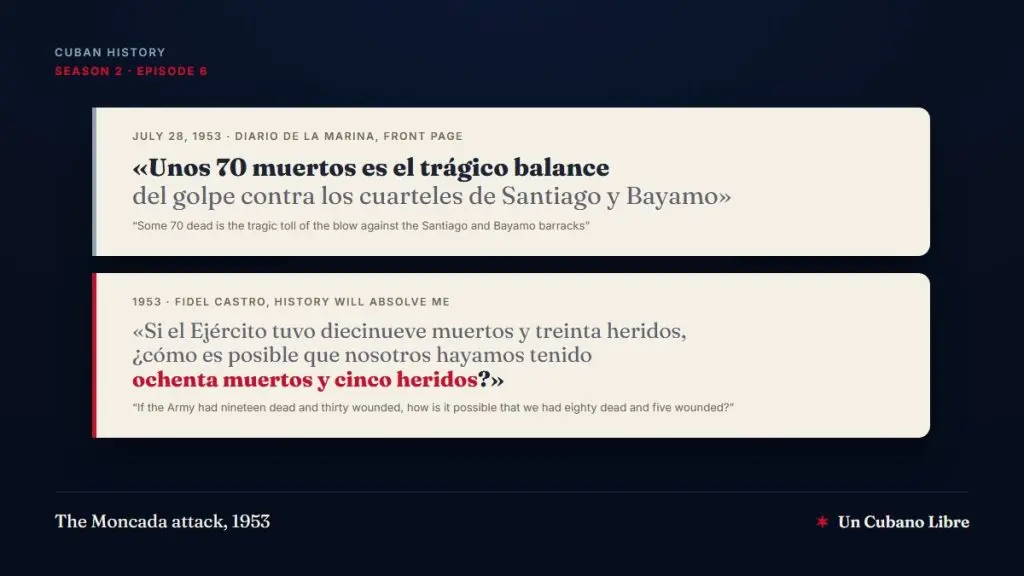
July 26, 1953, is the founding myth of the Cuban regime. With the papers of the time, the trial and the forensic records, what is left is something else: a fight that lasted minutes, a massacre of prisoners that Batista’s army tried to cover with lies, and a heroic story to which the winner kept adding dead men, torn-out eyes and commanders.
“Havana is living through a time of extraordinary prosperity”: Cuba before 1959
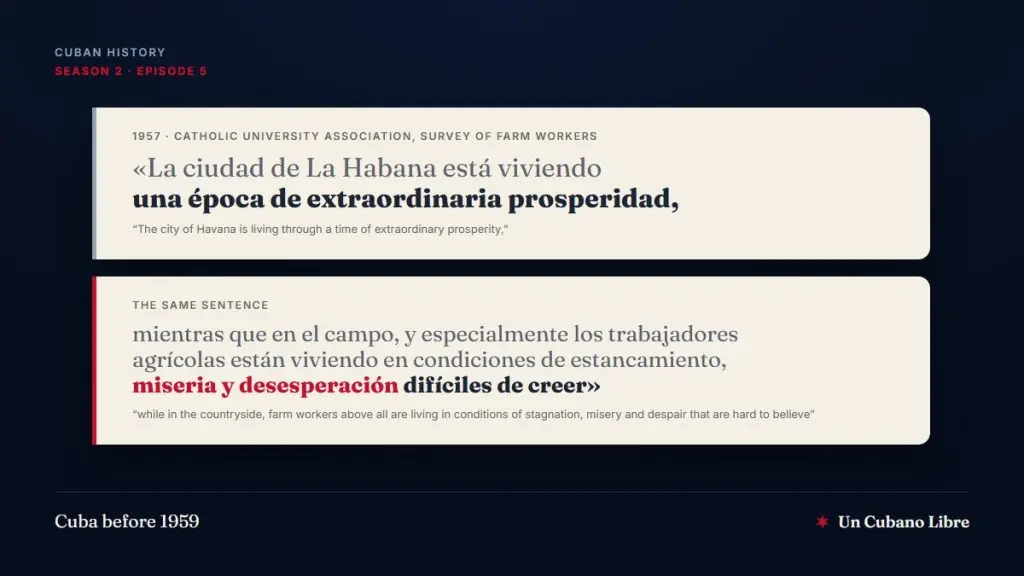
Both sides lie about Cuba before 1959. The regime paints a brothel with millions of illiterates; part of the exile, the richest country in Latin America. UN yearbooks, the World Bank and a 1957 Catholic survey say something else: an upper-middle-income country, stagnant since 1925, split between Havana and the countryside, and ruled by a dictatorship.
“I now understand the things of the Revolution”: Cuba’s 1961 literacy campaign
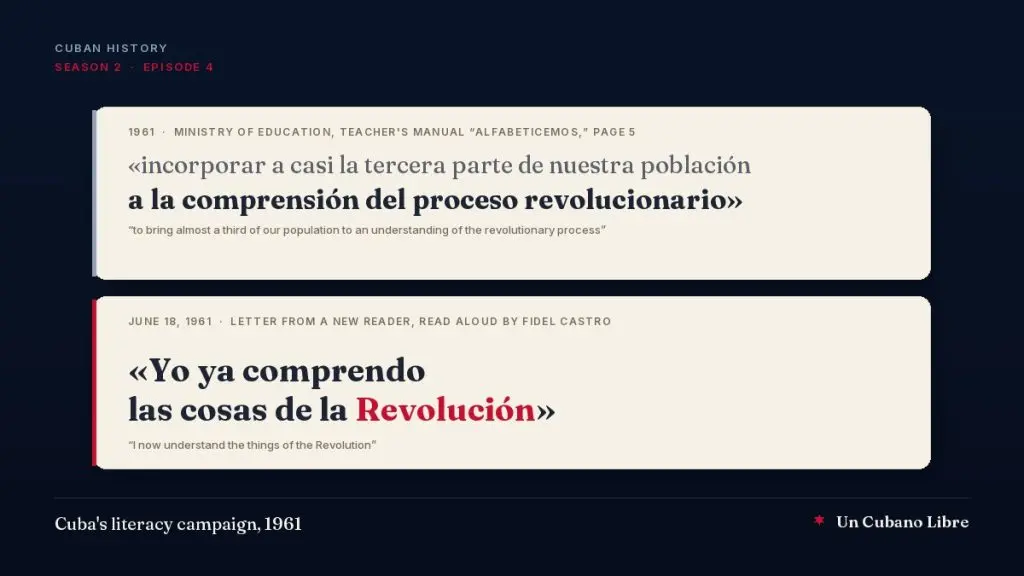
In 1961 hundreds of thousands of Cubans learned to read and write. That is true and it comes first. Then come the sums: two percentages that do not measure the same thing, a manual with ten pages on teaching and fifty-four on politics, and a final exam that was a letter to Fidel Castro.
“That their father is a deserter or a traitor”: Huber Matos, Camilo and October 1959
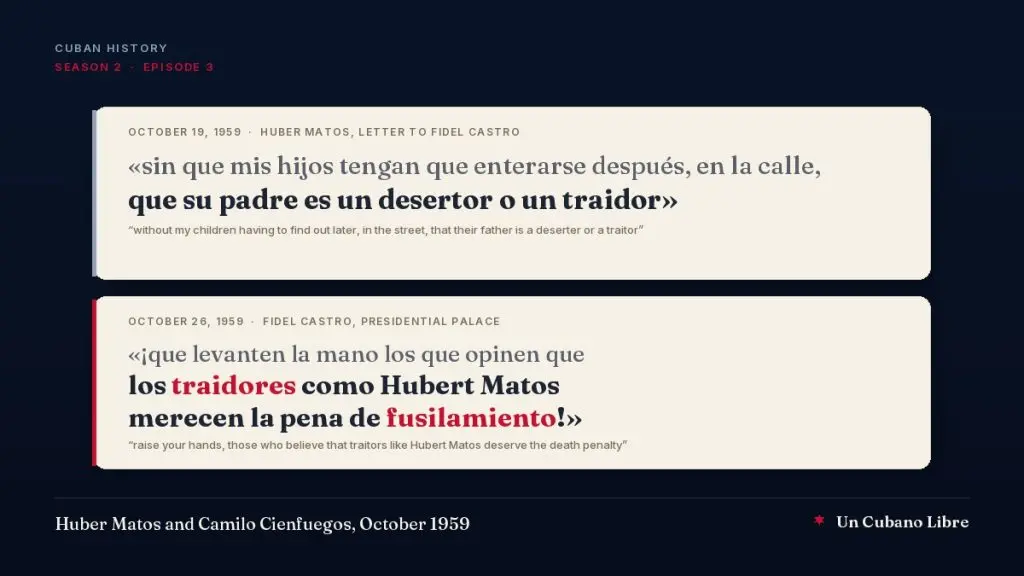
A commander resigns by letter and within a week he is a “traitor.” Another arrests him, defends him in private, by his account, and vanishes in a plane. October 1959, with the official transcripts, the declassified cables and this episode’s rule: keep what is documented apart from what is suspected.
“Here no one has even been called a bandit”: the Escambray
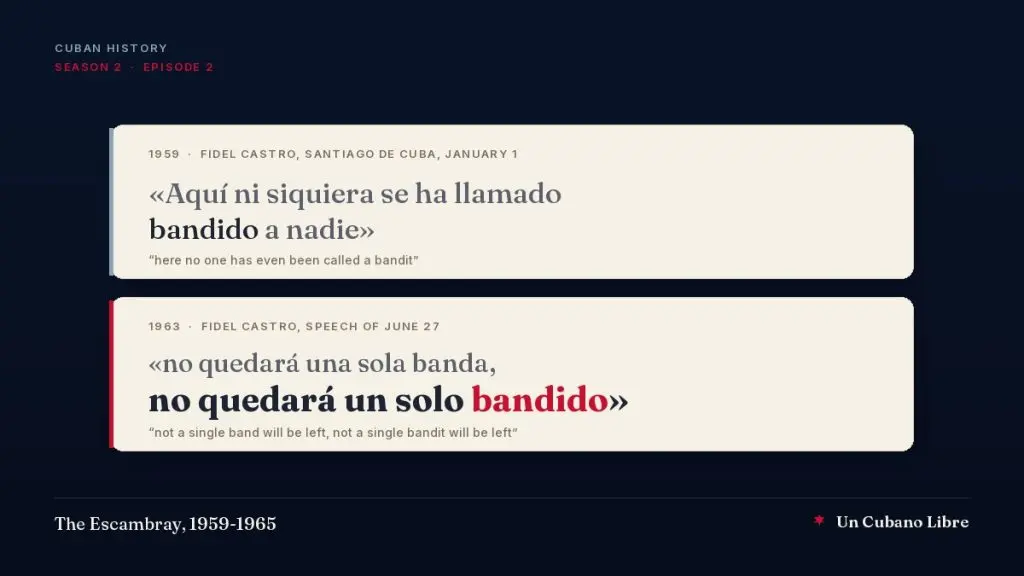
On January 1, 1959, Fidel Castro said that in Cuba “no one has even been called a bandit.” Four years later his army had “fight against bandits” battalions. What the Escambray war was, when the word arrived, what the CIA’s own papers say about the “mercenaries,” and what happened to the families.
“They weren’t punishment units”: the UMAP
![Cover: two quote cards on light paper over a midnight blue background. The first, headed 1966, Fidel Castro, speech of March 13, reads in Spanish: unos tendrán que ir a la cárcel [...]; otros tendrán que ir a la UMAP, with the translation: some will have to go to prison [...]; others will have to go to the UMAP. The second, headed 2006, Fidel Castro, Cien horas con Fidel, reads in Spanish: no eran unidades de internamiento, ni eran unidades de castigo, with the word castigo in red, and the English edition's wording: they weren't internment camps, or punishment units. Footer: The UMAP camps, Camagüey, 1965-1968.](https://uncubanolibre.com/wp-content/uploads/2026/09/they-werent-punishment-units-umap-fidel-castro-1966-2006-1024x576.jpg)
In 2006, Fidel Castro said the UMAP were not punishment units. In 1966 he had put them on the same list as prison. What the Military Units to Aid Production were, what those who were there tell, and how the regime keeps changing its story.
“Let the scum go”: the Peruvian Embassy and the Mariel boatlift
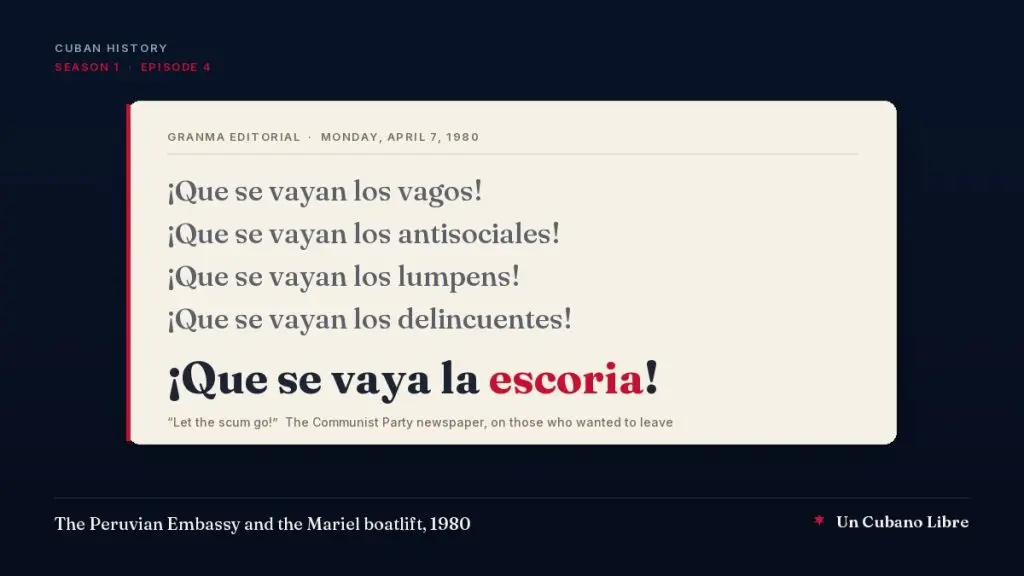
On April 7, 1980, the Communist Party newspaper demanded “let the scum go.” This episode is not about the Mariel numbers: it is about how the Cuban state turned neighbors into mobs, what word it gave them to do it, and why it did not end in 1980.
Thirteen names: the Canímar River massacre
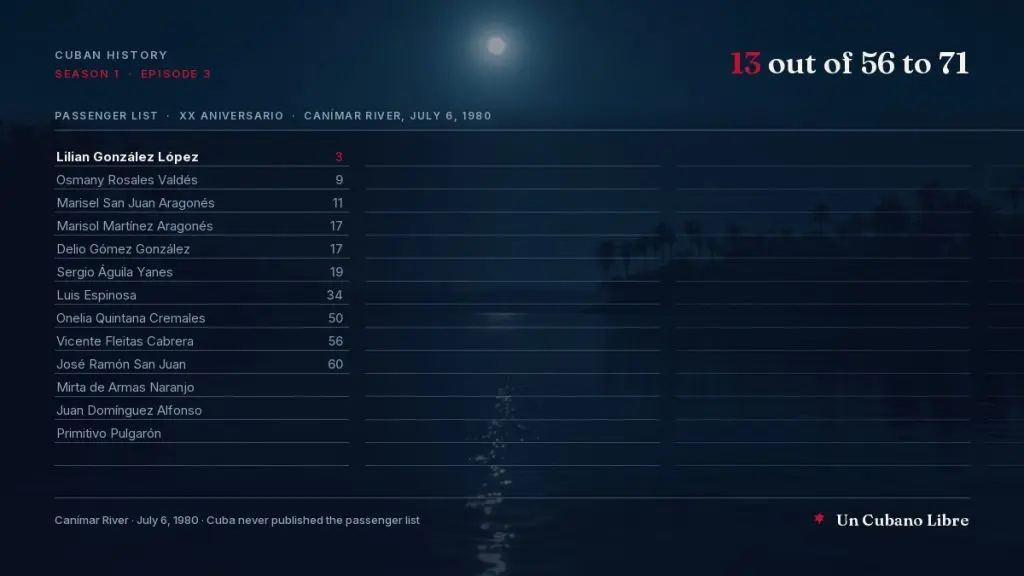
On July 6, 1980 the Cuban state sank an excursion boat full of civilians on the Canímar River. Between 56 and 71 people are believed to have died. No figure is confirmed, and only thirteen names are known.
It is recorded: the Brothers to the Rescue shootdown
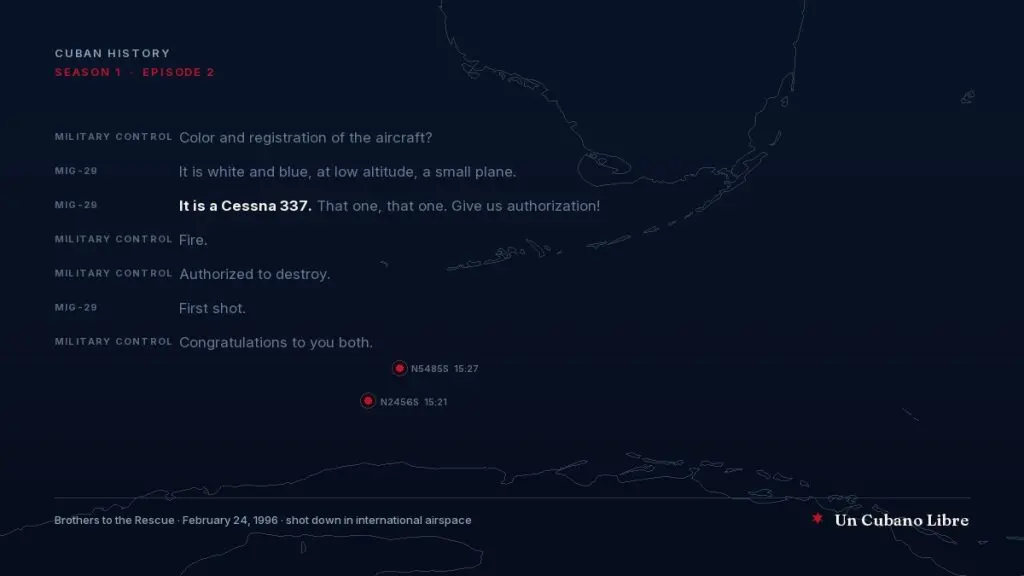
A Cuban pilot identified the plane by type and color before firing, and asked for authorization. He was given it twice, six minutes apart. What ICAO, the Security Council and a federal grand jury say, thirty years on.
The word “accident”: the sinking of the tugboat 13 de Marzo
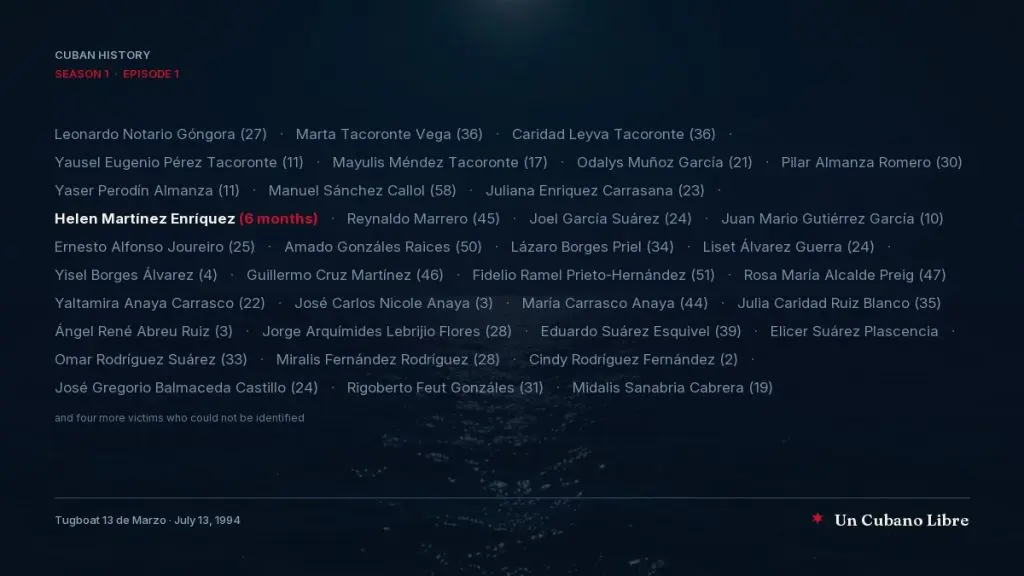
“Cuban History” series · Season 1, episode 1 In the early hours of July 13, 1994, seventy-two people left the port of Havana on an old tugboat. Forty-one died that night. Ten were children. The Ministry of the Interior called it, in writing, “the accident that occurred as a result of the attempt to leave […]