“Cuban History” series · Season 2, episode 3
On January 8, 1959, at Camp Columbia, Fidel Castro turned to Camilo Cienfuegos in the middle of a speech and asked him: “Am I doing all right, Camilo?” (in Spanish). The official transcript records the question and, in parentheses, what came next: “(SHOUTS OF: ‘Long live Camilo!’).” The answer the state repeats today, “You’re doing fine, Fidel,” is not in the document. It is in the official memory (in Spanish), which added it later.
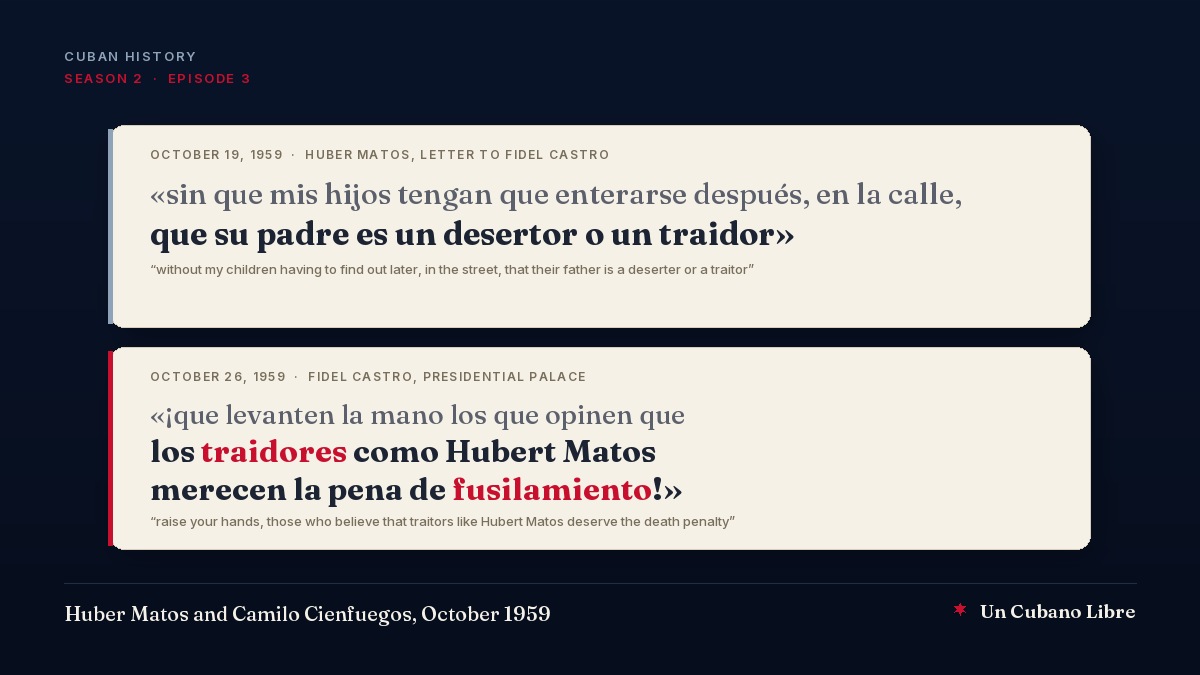
Nine months later, on October 26, Castro asked the crowd in front of the Presidential Palace to raise their hands: “raise your hands, those who believe that traitors like Hubert Matos deserve the death penalty!” (in Spanish). The stenographer noted: “(SHOUTS OF: ‘To the wall!’ and ‘Firing squad!’ WITH HANDS RAISED).” Huber Matos, a commander from the Sierra and the military chief of Camagüey, had been in El Morro prison for five days for having resigned by letter. Camilo, who had arrested him, was on the platform. Two days later, Camilo disappeared in a plane.
This episode is about that month. It is about a letter, a word and a plane. And it has a rule I set myself before writing a line, because it is the subject with the most legend in the whole series: keep what is documented apart from what is suspected, and say in each case which is which. Where there is a document, I link it. Where there is the testimony of a single person, I say so. Where there is nothing, I say that too, even when it is what I would like to be true.
What it was
Huber Matos was a teacher. Born in Yara in 1918, he trained as a schoolteacher and earned a doctorate in education, and in March 1958 he brought Castro a shipment of arms in a plane from Costa Rica. Che wrote it into his Reminiscences of the Cuban Revolutionary War with an irony that has not aged well: a rice grower who “came back turned into a hero on the plane that brought some arms from that country; his name: Hubert Matos” (in Spanish). He commanded Column 9 and in January 1959 he was given Camagüey. The US Embassy noted it that same month, without adjectives: sent “to take command of the 26th of July military forces in Camaguey Province.”
In July 1959 he wanted to leave. Both sides tell it, and on this they agree: Matos said in 2011 (in Spanish) that he put his resignation to Castro over the communists in the government, and that Castro answered that Raúl did want “to take the country into a communist process,” but that he himself was not a communist. Castro, at the trial in December, told the same conversation his own way: “Do not worry, this is unimportant, go on working,” and again on the 27th: “Go on working.” He said it under oath, according to the translation of his testimony preserved by the US government, because the official Cuban archive of speeches does not include what Castro said at that trial.
On October 19 Matos wrote the letter. It survives in full (in Spanish), and it is worth reading whole, because it is not what the state says it is. It begins by requesting discharge “through regulation channels” and goes on to three reasons. The first: “I do not wish to become an obstacle to the Revolution, and I believe that, having to choose between adapting or stepping aside so as not to do harm, the honest and revolutionary thing is to leave.” The second, communism: “everyone who has had the frankness to speak to you about the communist problem should leave before he is removed.” The third, a request: “let it be said where we are going and how we are going, let there be less listening to gossip and intrigue, and let no one who raises these things with honest judgment be branded a reactionary or a conspirator.” And the ending, which is the title of this episode: that he be allowed “to return home as a civilian without my children having to find out later, in the street, that their father is a deserter or a traitor.”
He asked not to be called a traitor. He was called one twice before daybreak.
The first time was on the radio. On the morning of October 21, the Camagüey stations began repeating that two captains, Orestes Valera and Jorge Enrique Mendoza, denounced Matos as a “traitor to the revolution.” We know it by the hour because the US Embassy telegraphed Washington at noon: telegram 876 says the stations were calling him “traitor and coward, afraid of Trujillo,” that Castro and Camilo had arrived at dawn and taken over the radio stations, that the city’s population and the local 26th of July Movement itself “solidly supported Matos,” that Matos had turned in the weapons, and that the underlying cause was his conviction that the agrarian reform institute was “under Communist control.” The consular agent reporting called the radio campaign “unnecessary demagoguery.” It is a document hostile to Castro, and even so it must be read for what it is: what a US official heard from Camagüey, not a court record. But it says something that collides head-on with what Castro would say hours later: that civilian officials wanted to resign in support of Matos and that Matos “dissuaded them saying act would harm revolution.” Castro, at one in the afternoon, accused him of having prepared exactly the opposite, a “mass resignation” of officers to “create a state of anarchy.”
The second time was Castro in person, at one in the afternoon, at the Agramonte barracks. The official transcript is online and it is the central document of this episode, because in it Castro does something he never did again: he reads Matos’s letter aloud (in Spanish), almost in full, with commentary (“He prepared a little letter for publicity”), and then reads his own written reply, dated the previous afternoon: “I believe that if anyone has been disloyal, it is you. My fault or my failing in this case has not been disloyalty or injustice, but tolerance.” And: “Since your decision to resign is irrevocable, Commander Cienfuegos will take over the command.” Then came the sentence that sums up the method: “More than a traitor, the first thing I would call him is an ingrate.” In that speech Castro says “Matos” eighteen times, “traitor” ten, and “ingrate,” with its variants, eighteen. And in Camagüey he brings out a formula he had already used in July against Díaz Lanz: “Men can be traitors, but not peoples!”
There are two things in that reading you cannot see unless you set the letter beside the transcript. Castro skipped the paragraph in which Matos writes “if after all this I am taken for an ambitious man or it is insinuated that I am conspiring, there are reasons to leave.” And he cut the last sentence right before “without my children having to find out later, in the street, that their father is a deserter or a traitor.” It may be the stenographer’s editing or the speaker’s. Either way, the official text does not record it. Matos, for his part, wrote in his memoirs that Castro quoted “maliciously only one paragraph.” That is not true either: he read almost the whole letter. Neither of them told the reading as it was.
The arrest did not involve a single shot. On that Granma agrees, celebrating in 2022 that Camilo “aborted the conspiracy of the traitor Hubert Matos without firing a single shot” (in Spanish), and so does Matos, who said at the trial: “Not a shot was fired, no one drew a weapon, no violence of any kind was resorted to.” What does not agree is Camilo’s sentence in Matos’s room. Today’s official version, in EcuRed and in Granma (in Spanish), is “I am arresting you for high treason.” Camilo’s bodyguard, Manolo Espinosa, whose testimony Cubadebate published in 2009 (in Spanish), remembers it without that word: “Hubert, I, as chief of the Rebel Army, am taking command of the province, you are under arrest.” And Matos, in his memoirs, remembers a Camilo who apologizes and says “I do not see this very clearly.” Three versions, no record. The only certain thing is that nobody fired.
That same afternoon of the 21st, a plane flown by Pedro Luis Díaz Lanz, the former air force chief who had defected in June, flew over Havana dropping leaflets. Two people died and dozens were wounded. Castro spoke of a “bombing.” The US Embassy investigated and concluded, in a dispatch of November 12, that the injuries had not been caused by any plane, but by “government fire and grenades thrown from cars.” That flight, which Matos neither organized nor knew about, gave Castro what he needed: to put Díaz Lanz, Urrutia and Matos into a single sentence. “The ‘three musketeers’ have fallen,” he said in Camagüey.
The word that came later
The word of this episode is “traitor,” and the first thing to say about it is that it was not born with Matos. It already had a mold. On July 12, 1959, against Díaz Lanz, Castro had said: “men can be traitors, but peoples cannot be traitors!” (in Spanish). The phrase traveled to Camagüey on October 21, and from there to Camilo, who signed it the next day in a note to the newspaper Adelante: “there will be traitorous men, but not peoples, and least of all Camagüey.” Today Granma attributes it to Camilo (in Spanish) as if it were his own. It is Fidel Castro’s, and three months older. It is the same mechanism as in the Escambray, where “bandits” arrived years after the events: here the word arrived in a single night.
I read the official transcripts of every Castro speech from October to December 1959, which the Cuban government itself publishes (in Spanish), and I counted each word with its plural, without derivatives. October 21 in Camagüey: ten “traitor,” seven “treason.” October 26 at the Palace: twenty-seven “traitor,” ten “treason,” seven “coward,” five “deserter,” and the show of hands. After that the name fades. On November 18 it is “a little traitor like the one from Camagüey” (in Spanish); on the 21st, “that leader from Camagüey”; on the 27th, “a mere traitor”; on the 30th, in Santiago, “Mr. traitor Hubert Matos” (in Spanish), the last time he names him from the podium that year. In December, the month of the trial, he does not name him once.
And there is a word Castro never said in those speeches: “sedition.” Zero times in nine official transcripts. The sentence was for sedition. The word of the file and the word of the street were not the same: one served to convict and the other to make people raise their hands.
On October 26 five men spoke. Castro asked for the show of hands. Raúl Castro, according to the summary made by the US Embassy, said that in July the people had denounced “a traitor, President Urrutia” and that now it denounced “another traitor: Major Hubert Matos,” and closed with a sentence that needs no comment: “we do not kill, we do not torture, we do not offend, but we execute by firing squads.” Che spoke of a major who “took the road of treason” disguised “in the garb of anti-Communism.” And Camilo gave his last speech. He said “for every traitor who appears, there will be a thousand rebel soldiers ready to die” (in Spanish). He did not say Matos’s name. The Embassy noted it that same day: “He did not mention the name of Hubert Matos.” And Cubadebate confirms it, without meaning to, when in 2009 it had to explain that it was “a clear allusion.”
About what Camilo said of Matos in Camagüey, a triad circulates in the exile, “coward, traitor, immoral,” that is in no text, official or otherwise. But the attack did happen, and the proof was published by the state itself: in 2019 Cubadebate posted online, “courtesy of the Institute of Cuban History,” (in Spanish) the twenty-one-minute audio of Camilo’s speech at the Agramonte Theater on the afternoon of October 21, titled by them “Camilo in Camagüey denounces the treason of Hubert Matos” (in Spanish). There is no official transcript; the one that follows we made from the recording, with the minute mark so anyone can check. Camilo said that “months ago” they knew of “a comrade who was not loyal to the revolution” (minute 2); that there are men who in the hard hour “falter,” “weak,” “cowardly,” “ambitious,” and that “Commander Huber Matos had given himself over to a bad cause” (minute 4); that he dragged along, “deceived,” comrades who did not know “of the unworthy attitude of Huber Matos” (minute 5); and, near the end, that Matos “as chief of the army paid me a single visit and never raised problems of any kind with me,” but met with Díaz Lanz and went to Commanders Almeida and Calixto García with “indecorous propositions,” “to confront Fidel in the immediate future” (minute 18). “Coward” and “ambitious” are there, in the plural and in a list; “traitor” he says of others; “immoral” he does not say. And he announced the letter: “tomorrow you will all see it on television.” The man who, according to Matos, was apologizing to him in private that morning called him unworthy in a theater that afternoon. One of the two things is on tape.
The trial
The trial began on December 11, 1959, not at La Cabaña, as is often repeated, but in the movie theater of Camp Columbia, with some fifteen hundred officers seated in the stalls on Castro’s orders. Matos tells it in the chapter of his memoirs published by Letras Libres (in Spanish), and TIME magazine that week confirms it, adding a detail that says a great deal: when Matos walked in, a group of rebel soldiers cheered him, “and were seized and hauled off to have their beards shaved for their impertinence.” The court was five majors, with Sergio del Valle presiding and Jorge “Papito” Serguera as prosecutor. The defendants slept at El Morro.
Raúl Castro testified on December 13 and, according to Matos, waved before the court “a transparent nylon bag with many papers inside”: checks. Fidel Castro testified on the 14th, with a microphone for the national radio network. TIME wrote that in “a seven-hour harangue” Castro “produced not one fact to support the charge of treason.” The Inter-American Commission on Human Rights (in Spanish) recorded it in 1983 with the same seven hours: “a violently accusatory speech that lasted 7 hours and was broadcast by the State radio.” And in Washington, on December 16, the US Attorney General asked at the National Security Council how, after Castro had demanded the death penalty for seven hours, the court had given only twenty years. The director of the CIA answered that Castro “probably told the court quietly to mitigate the severe penalty.” It is a declassified record, and it is an opinion, not a fact.
What Castro said that day is not in the official Cuban archive. It can be read in English, in the translation of a union pamphlet that the US government kept. There Castro insists on ingratitude, on “the game of the counterrevolution,” on the point that Matos “did not invent the invention that the revolution is communist” because “this was invented by Batista,” and he lays out a choice: either Matos and his men are guilty of slander and treason, “or Camilo is. Let Camilo speak!” Camilo had been missing for almost seven weeks. And the next day, at another event, Castro said he had not been able to bring a paper “because I attached it to the case file, the report that Commander Camilo Cienfuegos sent me from Las Villas” (in Spanish), and that he had read it at the trial. Camilo’s last written report sits inside the file of the man he was sent to arrest. It has never been published. He also read a letter Matos had written at El Morro on October 28, the day of the plane: “There was no plot, no betrayal, no sedition or anything, nothing, but a private letter.” And: “the only one who made the letter public was Fidel, in his desire to represent me as a traitor.”
The sentence was read before dawn on December 15: twenty years for Matos, with demotion, and sentences of two to seven years for twenty-one more officers, without a single acquittal. The list of names and sentences we have only from Matos and from an exile book of 1965; I found no judgment and no Cuban press account from December 1959 that confirms it. Castro called the verdict “most generous.” The US Embassy had summed up what happened at the Palace on October 26 in one dry sentence: “He got approval of execution of Matos and others.” In the end they did not shoot him. In 1979, just out, Matos credited Amnesty International for the fact that he had not been executed.
Twenty years, and who kept count
Matos served the full twenty years: El Morro, Isla de Pinos from January 1960, La Cabaña from 1966, the Combinado del Este from 1977, Boniato in 1979. What is known of those years outside his own memoirs is less than the exile believes and more than the state admits, and it has to be said exactly how much.
The Inter-American Commission on Human Rights did not mention him in its reports of 1962, 1963 or 1967. He enters the 1970 report (in Spanish), through a complaint of October 1967: detained “when the truth is that he had only resigned his post,” held incommunicado at La Cabaña, without clothes for refusing to wear the uniform of the “rehabilitated,” on hunger strike. In 1976 (in Spanish) he appears in the list of ten prisoners isolated in the Castillo del Príncipe since December 1970, with Gutiérrez Menoyo, Boitel and Valls. And in 1979 (in Spanish) the Commission speaks in its own voice, something it does not often do: a sentence “which the Inter-American Commission on Human Rights condemns for its severity and for the inhumane treatment Matos received during the seven years he was kept incommunicado.”
Amnesty International named him for the first time in its 1977 annual report, as an example of the prisoners of conscience “who have been held for over 15 years,” and told how Pinochet had offered to exchange the communist senator Jorge Montes for Matos and Cuba had not responded. In the 1978 report it told how a delegation of its own had visited Cuba at the end of 1977 and how the government refused to let it see the group of the plantados, Matos among them. That he was “Amnesty’s first Cuban prisoner of conscience” is what the British section says in 2014; the year of adoption I found in no document. The details of torture that Matos tells in his memoirs, including the beating on the morning he was released, are backed by the Commission in general terms and by Amnesty with a reference to the autobiography. That is what there is, and I write it that way.
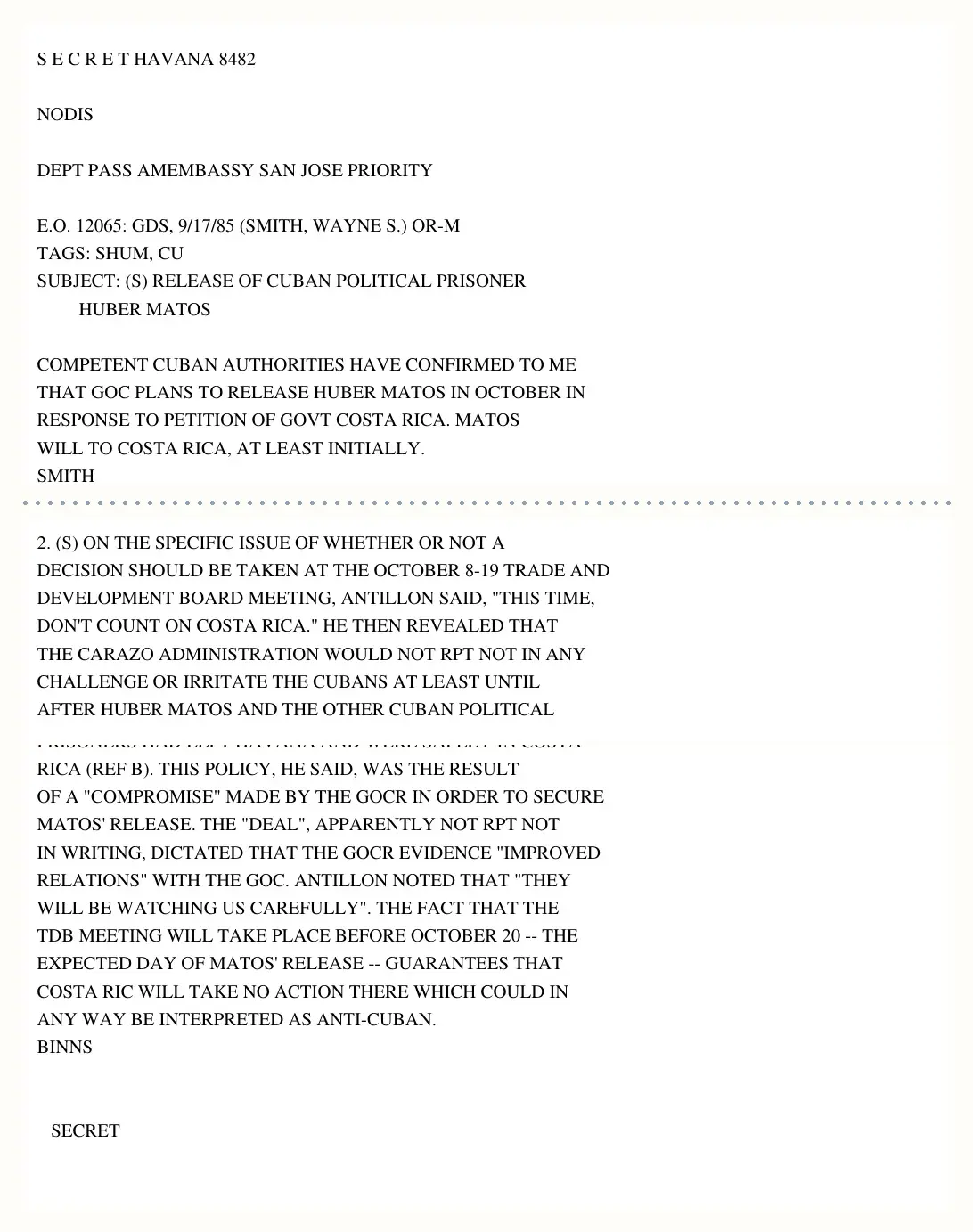
The release was negotiated by Costa Rica, and of that there are papers. The US government declassified the 1979 telegrams in 2014 and they can be downloaded one by one. On September 18, the head of the US Interests Section in Havana informed Washington: “Competent Cuban authorities have confirmed to me that GOC plans to release Huber Matos in October in response to petition of Govt Costa Rica.” On the 28th, the Costa Rican foreign ministry announced that Cuba would free 138 prisoners whose release “the GOCR has been negotiating with the GOC since the beginning of the year.” On October 3, a senior Costa Rican official told the US Embassy the price: the Carazo administration would not irritate Cuba in any way “at least until after Huber Matos and the other Cuban political prisoners had left Havana,” under a “compromise” that was “apparently not in writing.” President Carazo sent his aide Jorge Poveda to Havana with instructions to see Matos in person and act as his “guarantor” from the prison gate to Costa Rica.
Matos walked out on October 21, 1979, at exactly twenty years, and the Cubana flight reached San José “early morning Oct. 22 with 25 ex-prisoners (including Huber Matos) and 61 dependents on board.” Of the 138 on the list, Castro let out a part, described twenty to thirty as “terrorists” who would not be released, and in December the Costa Ricans themselves admitted to the Embassy that “the primary goal of the GOCR in this matter had already been achieved: the liberation of Huber Matos.” It was a trade with no written counterpart, and those who stayed inside paid for it. Matos lived in Miami, founded Cuba Independiente y Democrática and died on February 27, 2014. I found no note in Granma or Cubadebate on his death. What I found is what EcuRed (in Spanish) says today: “counterrevolutionary,” category “Terrorists of Cuba,” and a wrong date, “October 1958.”
Camilo: the documented, the official and the suspected
This is where it is easiest to slip, so I will go in blocks.
The documented. On October 28, 1959, at 6:01 p.m., an air force Cessna 310, number 53, took off from Camagüey for Havana with Camilo, the pilot Luciano Fariñas and the escort Félix Rodríguez, a rebel soldier with no connection to the CIA agent of the same name who was present at Che’s capture in 1967. It never arrived. So says the official notice published by the newspaper Revolución on October 30, which Cubadebate transcribed in 2023 (in Spanish): “The existence of squalls at that hour between Ciego de Ávila and Matanzas may have caused some accident.” Night was falling: sunset in Camagüey that day was at 5:37 p.m., by the standard astronomical calculation; the plane took off twenty-four minutes later and the whole flight was in darkness. It is the only physical fact in the case that anyone can check, and it supports the frame of the official version. The government took some thirty-six hours to announce the disappearance; Granma (in Spanish) acknowledges it: “On Friday October 30 the search is officially ordered.” The search lasted fifteen days, with some seventy aircraft. The United States took part: the Navy searched on November 1 in international waters “in response to a request from the Cuban Government on October 31,” according to a State Department archive note. Castro did not mention that help when he declared Camilo dead, on the night of November 12, on television. That speech is not in the official archive at cuba.cu: the index jumps from October 26 to November 18. What he said we know from Ambassador Bonsal’s telegram the next morning: “in all probability dead, crashed in the sea north of Cuba,” and “died in line duty while fighting treason.”
Two neighboring facts, also documented by the state itself. On November 12, the same day Castro closed the search, Captain Cristino Naranjo, head of the General Staff security battalion and Camilo’s man in the arrest of Matos, was shot dead at the entrance to Columbia; he was killed by Captain Manuel Beatón, according to EcuRed (in Spanish), which gives no motive. Beatón rose up in the Sierra Maestra and was executed with his brother in June 1960; for that I found no official Cuban source, only exile lists (in Spanish) and the Spanish press of the time. And in 1967, at La Higuera, Che told his captors, according to the memorandum the director of the CIA sent to the Secretary of State, that “actually the death of Cienfuegos was an accident” and that Castro “had loved Cienfuegos more than any of his lieutenants.” That is what the CIA reported Che said; it is not proof of what happened to the plane. And not even he treated it as known: “the theory was,” the memorandum says, that the plane got lost under a low ceiling and ran out of fuel. The theory. The regime’s number two had no closed explanation either.
The official version, and its seams. Since October 30, 1959, the version has been the same: squalls, a detour north, fuel for three hours, a fall into the sea without a trace. What has changed is what surrounds it. In 1959 Camilo traveled to Camagüey “on work matters”; today Granma ties it bluntly to the Matos case. In 2024 Granma wrote that “the inexperience of the pilot” (in Spanish) caused the disappearance; the same year, the Comptroller General published that Fariñas was a pilot “endowed with great experience,” and Cubadebate had reported in 2017 that he had “more than 2,000 flight hours” (in Spanish). The Comptroller also admits that the plane “did not refuel in Camagüey on returning from Santiago de Cuba, and it is not known why he did not” (in Spanish). The investigating commission the official press mentions has never published its file, nor a weather report, nor a radio recording. And on November 27, 1959, at the University of Havana, when someone shouted something about Camilo, Castro gave the official explanation of guilt: “It is true that he is guilty of what happened to Camilo. It is true” (in Spanish), he said of Matos, “because although it is impossible to probe the designs of a man, it is evident that there is a direct relation between the events of Camagüey, the treason of Camagüey, and the loss of comrade Camilo Cienfuegos.” The crowd shouted “To the wall!” It is in the transcript. That same day, in Camagüey, he said Camilo “lost his life, as many placards say (in Spanish), fighting treason”: the blame was already on the banners. Thirty years later, at the anniversary rally of 1989 (in Spanish), the version was the same in other words: “the direct cause of that accident was the problem that arose in Camagüey because of the anti-communist elements”; Camilo, “bold as he was, respected neither day, nor night, nor weather,” and “we did not have safe planes.” In that speech Castro names Camilo fifty-seven times and Matos not once: he is “a gentleman whose name is not even worth mentioning.”
What is suspected, and on what basis. The suspicion that Camilo was killed is as old as the disappearance. On November 10, two days before closing the search, Raúl Castro had to say at a rally that the Revolution “neither kidnaps nor kills with impunity” (in Spanish): nobody denies what nobody is saying. On November 18 Castro himself acknowledged that the insinuations were in the press: “they went so far as to insinuate the poison,” (in Spanish) he said of the international wire reports, and that they tried to “use” Camilo “to insinuate accusations against another comrade.” A State Department intelligence official who was on vacation in Havana noted “dozens of rumors” and a sentence that fits the whole episode: “The case of Huber Matos proved that, as in Chicago or New York, no one is allowed to quit the gang.” And on November 8, Castro’s finance minister, Rufo López Fresquet, told Ambassador Bonsal that “he had heard” that a Sea Fury fighter took off after Camilo’s plane and that there was an air battle near Cruces. It is in a declassified memorandum, and it has to be read whole: Bonsal transcribes it as a rumor, López Fresquet tells it secondhand and, although he was Castro’s enemy, does not attribute the order to him: he speculates about “friends of Huber Matos” wanting to avenge him. No one has ever identified that jailed crew.
Matos believed all his life that the Castros killed him, and he wrote it as what it is, an inference: “it is no mere conjecture that both brothers are the intellectual authors of the only option left to them: his disappearance.” His basis is three things only he saw. The conversation in Camagüey, in which Camilo supposedly told him “I think Fidel is acting wrongly.” Camilo’s phone call to Castro, which he says he heard “a little over a meter away”: “What has been done is a blunder.” And two messages from Camilo at El Morro offering him an escape, which he refused: “If they shoot me, let it be defending the truth and my honor.” Camilo could neither confirm nor deny any of it, and the official version flatly denies it. The rest of what circulates in the exile, the magnetic tape with the fighter’s takeoff, Raúl’s personal pilot “with his cannon unsheathed,” the witnesses who died one by one, an execution in the Zapata Swamp told decades later, with no other witness, by Jaime Costa, a Moncada assailant and Granma expeditionary, as reported by 14ymedio (in Spanish), is a chain of “according to several versions.” Radio Martí (in Spanish) publishes it with a question mark. Cubanet (in Spanish) writes that “there is no conclusive evidence.” And the University of Florida, where the historian Lillian Guerra works, puts it with the exact verb: for decades Cubans “believed” that Raúl Castro had ordered his death. Believed. Hugh Thomas left it in writing half a century ago, in my translation from the Spanish edition: “Foul play was immediately suspected […] There is no proof.”
| Claim | Status, and where it comes from |
|---|---|
| He took off from Camagüey at 6:01 p.m. on October 28, 1959, in Cessna 310 number 53, with pilot Luciano Fariñas and escort Félix Rodríguez | Documented: official Rebel Army notice in Revolución, October 30, 1959, transcribed by Cubadebate (in Spanish). |
| There were squalls between Ciego de Ávila and Matanzas | Official version since 1959, with three independent accounts in its favor: the Cubana pilot Castro cited on November 12, the Cessna mechanic according to his nephew in Cubanet (in Spanish), and the exile press itself, which admits it. No weather report ever published. |
| The search lasted fifteen days and the United States took part | Documented: State Department archive note, FRUS 389. Castro did not mention it when he called off the search (FRUS 391). |
| The government took some thirty-six hours to announce the disappearance | Acknowledged by Granma (in Spanish): the search is officially ordered on Friday the 30th. |
| The pilot was inexperienced | Contradicted by the state itself: “more than 2,000 flight hours” in Cubadebate versus “the inexperience of the pilot” in Granma, 2024 (both in Spanish). |
| The plane did not refuel in Camagüey | Admitted by the Comptroller General in 2024 (in Spanish): “it is not known why he did not.” |
| A Sea Fury fighter chased it and shot it down | Rumor: the finance minister “had heard” it and told the US ambassador on November 8, attributing it to friends of Matos (FRUS 389). No crew identified, no tape, no wreckage. |
| Camilo called the arrest “a blunder” and offered Matos an escape | Testimony of a single person: Matos, in his memoirs (in Spanish). The official version flatly denies it. |
| Fidel and Raúl Castro ordered him killed | Suspicion without a document. None of the historians consulted asserts it; Hugh Thomas: “There is no proof.” Che, according to the CIA, denied it in 1967. |
| Matos “is guilty of what happened to Camilo” | Fidel Castro’s words, November 27, 1959 (in Spanish). No file supports them. |
| The investigating commission published its report | No. In sixty-six years the state has shown no file, no weather report and no radio recording. |
The honest way to say it is this. There is no document that proves Camilo was killed. Nor is there a file that proves it was an accident, because the state that holds it has not shown it in sixty-six years. What the state did do, and it is documented in its own transcript, was to decide within a month who was to blame for the death of a man whose plane nobody found: the one who had resigned by letter.
What has to be told even if I don’t like it
In this episode the uncomfortable part is spread around, and a large share falls on our side, because the Camilo myth belongs to everyone and the exile has spent sixty years filling it with whatever it lacks. Here is all of it.
“The weather was fine” does not hold up. Anderson repeats it in his biography of Che, Radio Martí repeats it, half the exile internet repeats it, and none of them cites the weather report. Against it there are three independent accounts of squalls that afternoon: the Cubana pilot who flew the reverse route and whom Castro cited on November 12; the mechanic who checked the Cessna, according to his nephew in Cubanet (in Spanish); and Corzo himself, who admits that “the crews of two commercial planes” reported bad weather. Anderson also writes that the search lasted “three days” and that the plane fell into “Caribbean waters,” when the route was the north coast. He should not be used as proof of anything.
Matos got things wrong too, and it has to be said as plainly as what is said about Castro. He wrote that Castro quoted “only one paragraph” of his letter; the transcript shows he read almost all of it. He wrote that Camilo’s plane made a stop in Camagüey “to refuel”; the official version says it was the pilot, not Camilo, who went to Santiago, and the Comptroller says the plane did not refuel. And his conviction about the murder is just that, a conviction, built on what he says he heard.
Castro’s accusations had some basis, and it is best not to deny it. Castro accused him on October 21 of having visited Díaz Lanz “on the eve of his treason” and of having “encouraged” Urrutia. Hugh Thomas, who is no Castro sympathizer, writes that at the trial Matos “admitted that he had discussed the need for a National Directorate of the 26th of July Movement” and that “he was undoubtedly an anti-Communist who was in contact with other leaders of the government.” And he had talked with the finance minister about Raúl possibly going so far as to “eliminate” Fidel, according to López Fresquet himself. None of that turns a private letter into sedition. But whoever wants to tell October 1959 without Díaz Lanz flying over Havana or the State Department drafting plans is telling something else.
And what the regime did that does not fit the easy picture either: the court did not shoot Matos, when the square had called for it with raised hands. You can put it down to calculation, as the director of the CIA did, or to outside pressure, as Matos himself did. Both may be right. Twenty years served to the last day, seven of them incommunicado, is not clemency. But it was not the firing squad, and this blog is not going to say it was.
The word, today
The word is still in place. Granma wrote “the traitor Hubert Matos” in 2022 and, in 2024, “I am arresting you as a traitor” (in Spanish), in an article that dates the arrest “September 21, 1959” and calls Camilo “Camillo.” Juventud Rebelde and the People’s Supreme Court (in Spanish) reproduced in 2014 a text by the director of the Office of Historical Affairs of the Council of State: “the traitor Huber Matos.” EcuRed keeps him in the category “Terrorists of Cuba.” When he died, in 2014, the only piece I found with the word came from a sympathetic outlet in Spain: “Huber Matos dies, traitor to the Cuban Revolution” (in Spanish), recycling a 2009 Cubadebate article signed by a State Security agent.
The opposite happened to Camilo: the state made him its saint. The flowers thrown into the sea every October 28 were not born of the people: according to Granma (in Spanish), the idea was Che’s, and it was launched by the magazine Verde Olivo and Radio Reloj in October 1960. The Yaguajay museum was inaugurated by Raúl Castro in 1989 (in Spanish). Camilo’s face is on the twenty-peso bill, with a note from the Central Bank (in Spanish) that calls him “inseparable friend of Ernesto Che Guevara” and does not mention Camagüey. And the phrase “You’re doing fine, Fidel,” the one that opens this episode, is still not in the transcript. A man who cannot speak is the perfect witness: he is given whatever phrase is needed, he is credited with Castro’s formula about traitors, and he is made to say “high treason” in a room where his own bodyguard remembers something else.
What remained
A letter remained that the state read aloud the day it received it and has never published in full. A twenty-year sentence remained, served to the last minute, condemned by the only human rights commission in the hemisphere, for resigning in writing. A museum remained whose only piece labeled as wreckage, a bent propeller in Yaguajay (in Spanish), nobody from outside has been able to confirm and which, according to Cubanet (in Spanish), does not match the Cessna 310. A file remained that nobody has seen and a day of mourning decreed by the apparatus. A word remained, “traitor,” which Castro said thirty-seven times in two speeches and which Granma and EcuRed write today without anyone needing to say it. And what Matos asked for in his letter and was not granted remained: that his children not find out in the street. They found out from the radio, before daybreak.
Next episode. "I now understand the things of the Revolution": Cuba's 1961 literacy campaign: the 1961 literacy campaign, two percentages that do not measure the same thing, the manual the brigadistas carried and a final exam that was a letter to Fidel Castro.