“Cuban History” series · Season 2, episode 4
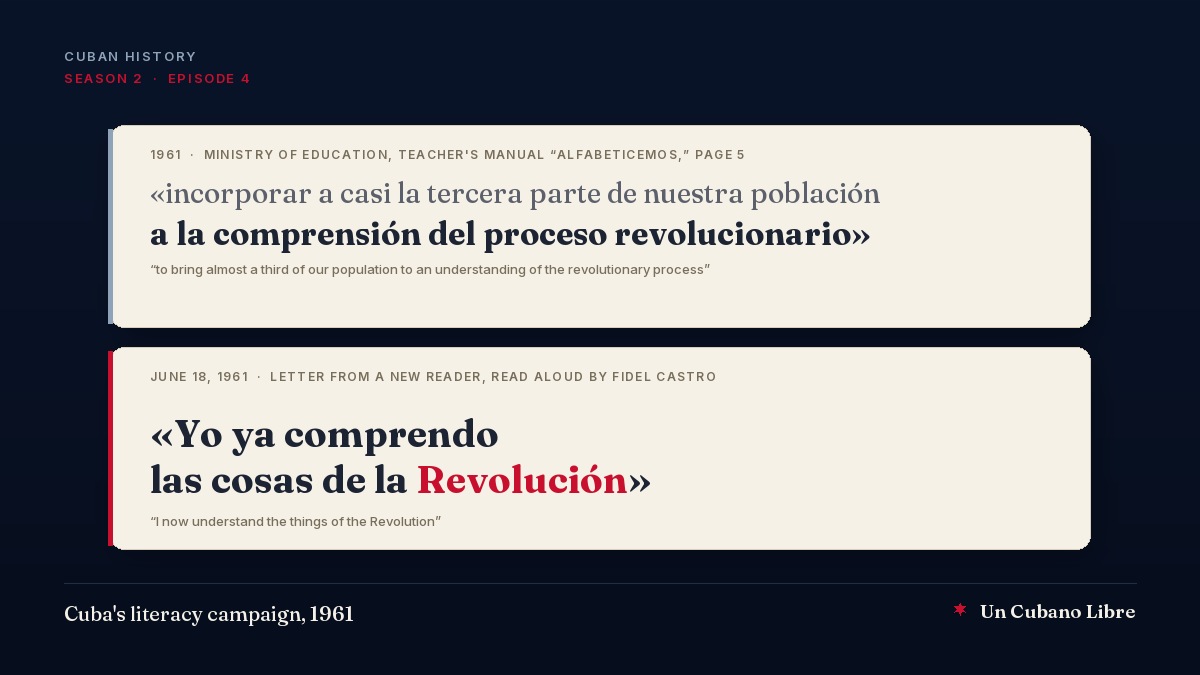
On June 18, 1961, at the Ciudad Deportiva arena in Havana, Fidel Castro handed certificates to the first people in the province to complete the literacy course and read aloud, from the podium, sentences taken from their letters. The official stenographer took them down with the applause: “I now understand the things of the Revolution (APPLAUSE)” (in Spanish). “God grant that we, the humble, never lose you.” “Thank you for freeing us from imperialism (APPLAUSE).” “Russia gives to us, the Yankee takes from us, that is why we are with Nikita.” “I would like you to send me the follow-up book (APPLAUSE).” Castro warned that it was not one letter but a selection: “the coordinators had extracted a thought from each of those letters.”
The people who wrote those sentences could not write six months earlier. That is true and it comes first, because it is what part of the exile community would rather skip. What comes second is what they wrote, and to whom. The proof that a Cuban had learned to read and write in 1961 was a letter to the prime minister, and the prime minister chose to read in public the ones that spoke about him.
This episode is about both things at once, and I am not going to pick one. The literacy campaign taught hundreds of thousands of people to read, and it was also a political mobilization that the state itself described as such, in its own words, in its books and in its speeches. Nothing needs interpreting. What is needed is to read the manual the youngsters carried in their backpacks and to do a division that the government did one way in 1953 and another way in 1961.
What it was
The promise was made in New York. On September 26, 1960, before the United Nations General Assembly, Castro announced that “Cuba will be the first country in the Americas that, within a few months, will be able to say it does not have a single illiterate” (in Spanish). A month earlier, on August 29, he had already named the coming year and said how he meant to do it: “next year will be the ‘Year of Education'” (in Spanish), and the battle would be won by “mobilizing the people.”
On January 28, 1961, in Santa Clara, he gave the details. He was going to recruit “an army of 100,000 literacy teachers from among the students, from age 13 up” (in Spanish). To that end, “classes in all the junior high and senior high schools are going to end this year on April 15.” Those who wanted to would go, provided their families “agree.” The requirement was to have “sixth grade or above, and to be at least 13 years old.” They would get a uniform, their fare and ten pesos a month. The university was left out, because of the urgent need to train engineers and technicians.
The final numbers for the teaching force are in the report that two experts sent by UNESCO, Anna Lorenzetto and Karel Neys, wrote after visiting Cuba in 1964: 120,632 “people’s” literacy teachers, 13,016 workers in the “Patria o Muerte” brigades, 34,772 schoolteachers and the “Conrado Benítez” brigadistas, who numbered 105,664 when they passed through the training camp at Varadero and 89,500 when the campaign ended (page 27 of the report). Of those 105,664, 54,953 were girls. The same report says their average age was “14 to 16 years, but some were younger,” and that 52 percent came from elementary school (page 45). The great majority were minors.
They spent months in the countryside, many of them in peasants’ homes, with a lantern and two books. One of them told the American writer Jonathan Kozol, years later, that they got up at five in the morning to work in the fields and sat down at night to teach (page 40). On September 5 Castro announced that the next school year would not start on time either: “The school year is going to start not in September, the school year is going to start in January” (in Spanish), and he acknowledged that for many families this was “a headache.” On December 22, in the Plaza de la Revolución, he proclaimed Cuba a “Territory Free of Illiteracy” (in Spanish).
The official closing figures are three, and they have not changed in sixty-five years: 979,207 illiterates located, 707,212 made literate and 271,995 who were not. They are in the report of the UNESCO mission (pages 27 and 29) and in official Cuban history (in Spanish). From them comes the most repeated percentage in the history of Cuban education: from 23.6 percent illiteracy to 3.9 percent, in one year.
The starting point
The 23.6 percent is a sound figure. It comes from the 1953 census: 1,032,849 people who could not read and write among the 4,376,529 who were ten or older. The report of the UNESCO mission reproduces the table by province (page 15), and what that table shows is a country split in two: Havana at 9.2 percent and Oriente at 35.3 percent. In the cities illiteracy was 11.6 percent and in the countryside 41.7 percent, according to the table that the economist Carmelo Mesa-Lago published from the census data (page 237, in Spanish). In the countryside, two out of every five people could not read.
The average, on the other hand, was among the best on the continent. The UNESCO study World Illiteracy at Mid-Century, from 1957, places Cuba around 1950 in the 20 to 25 percent bracket for adult illiteracy, alongside Chile and Costa Rica and behind Argentina and Uruguay (pages 40 to 43). Going by the censuses: Argentina 13.6 percent, Chile 19.9 percent, Costa Rica 20.6 percent, Cuba 22.1 percent among those over fifteen. Fourth or fifth in Latin America, depending on whether Uruguay is counted. The State Department, using the 1957 UN statistical yearbook, ranks it fourth. What exiles usually say, that Cuba was already among the most literate countries in the region, is true. The UN Demographic Yearbook for 1960 (page 437) adds a detail almost nobody remembers: in 1953 Cuban women were more literate than Cuban men, with 20.0 percent illiteracy against 24.2 percent.
And the figure had been falling for as long as there have been censuses. The originals are online: 56.8 percent in 1899, 43.4 percent in 1907 (in Spanish), 39 percent in 1919. What the numbers also say, and this does not flatter the Republic, is that the decline stopped. Between 1931 and 1943 the rate did not budge from 28 percent, and among those over fifteen it was 20.9 percent in 1943 and 22.1 percent in 1953, according to the same UN yearbook, which warns that the definition changed from one census to the next. The country had gone twenty years without progress among its adults, and the countryside was where it was.
With that as the starting point, the state has offered others. In 1953, in History Will Absolve Me, Castro had written that it was inconceivable that “thirty percent of our peasants cannot sign their names” (in Spanish), which is less than the census of that same year found. At the UN, in 1960, Castro said that “thirty-seven and a half percent of our population was illiterate”, citing no source. A year later he was using the census number in his speeches. In 2021 the minister of education summed up 1958 in four figures with no percentage: “a million absolute illiterates, more than a million semi-illiterates, 600,000 children without schools and 10,000 teachers without work” (in Spanish). The next day the newspaper Trabajadores wrote “800,000 children without schools” (in Spanish). And in 2017 an official outlet, Cubahora, published that the 979,207 illiterates among 6,933,253 inhabitants were “31 percent of the population” (in Spanish). The division, with those two numbers, gives 14.1 percent.
Two figures that do not measure the same thing
The 23.6 percent of 1953 was calculated over people aged ten and up. The 3.9 percent of 1961 was calculated over the whole population, babies included. I am not the one saying so: the table on page 29 of the report of the UNESCO mission says it, dividing 271,995 by 6,933,253, and official Cuban history says it, in the journal of the University of Pedagogical Sciences: “3.9 percent of the total population” (in Spanish). The political scientist Richard Fagen, of Stanford, explained it in a footnote in 1969: the illiterates who remained “amounted to approximately 3.9 percent of the estimated total population”, which is why from 1962 Cuba reported a literacy level of 96.1 percent, “the highest in Latin America” (page 54). The economist Richard Jolly, who was in Cuba in 1962, added that the figure “makes no allowance for the possibility of there being illiterates the campaign never discovered” (page 204).
If the sum is done as in 1953, among those over ten, the result is different. There is no published age structure for 1961, so what follows is my own calculation and I mark it as such: if the share of people over ten was the same as in 1953, three out of every four inhabitants, the 271,995 who did not learn were about 5.2 percent. That is still an enormous reduction. But it is not the figure that was proclaimed, and the two figures that have been compared for sixty-five years do not measure the same thing.
The second point is who those 271,995 are. The campaign’s closing table, dated December 20, 1961, and kept in the Literacy Museum, was published by an official historian, Felipe de J. Pérez Cruz, in the journal Varona (page 21, in Spanish). It has a row for “unteachable illiterates,” with 271,995, and another for “illiterates who did not learn,” which is empty. Everyone who did not learn was classified as someone who could not learn. The same table has 667,484 “made literate” and 39,728 “still learning.” Added together they make 707,212, which is the official figure for people made literate, the one the state has repeated ever since. That same December 20, at a meeting with the directors of the Schools of Revolutionary Instruction, Castro rounded it off: “700,000 people” (in Spanish). The table does not say those two rows were added. I only say that the sum gives that number.
The method is easier to see on a small scale. Melena del Sur was the first municipality declared free of illiteracy, on November 8, and Castro gave the accounts there: “there were 2,868 illiterates, between 14 and 100 years of age” (in Spanish); 23 died, 61 moved away, “103 refused to study,” 412 were “unteachable” and 2,269 were made literate. The territory free of illiteracy had, that day, 515 illiterates with a first and last name. A month later Castro used the exact formula: the goal of teaching “all the teachable adults” (in Spanish) had been met.
The third point is what “literate” meant. The mission’s report says it plainly: the level pursued “was that of the first grade” (page 29), the course lasted two to three months and the tests were not graded, because the literacy teacher “is the only one who knows how the pupil is progressing” (page 36). Fagen, who was sympathetic to the campaign, wrote that such a level was “much too low to be of real and immediate use” at work or at home, and that without follow-up it would slip away (page 54). Jolly calculated that in August 1962 “about a third” of the 707,000 were still in classes (page 211).
And the fourth is the pace. According to the figures Castro himself gave, by November 1 353,623 people had learned, and by December 20 there were “700,000” (both in Spanish). In seven weeks, as many people would have been taught as in the previous ten months. Fagen had already noticed it in the August data: at the end of that month only 119,000 were listed as literate (page 50).
Nine years later there was a real census. Mesa-Lago, citing the official publication of the Central Planning Board, wrote that “the 1970 population census registered a much higher illiteracy rate of 12.9 percent” (page 164), and in the Spanish edition of his later book he called the result “an important achievement, but not as great as was claimed at first” (pages 79 and 80). In the countryside, 21.5 percent. I have not been able to see the 1970 census in the original, and it has to be said that another first-rate scholar, Jorge Domínguez, wrote in 1978 that the figure “has not been released”. Mesa-Lago’s figure is later and cites the document. An exile figure that circulates for 1970, 10.7 percent, has no source that I have been able to find, and I do not use it.
| What is said | What the document says |
|---|---|
| Before 1959 illiteracy stood at 23.6 percent | True. The 1953 census: 1,032,849 of 4,376,529 people aged ten and over (report of the UNESCO mission, page 15). In the countryside, 41.7 percent; in Havana, 9.2 percent. |
| Illiteracy stood at 37.5 percent | Castro said so at the UN on September 26, 1960 (in Spanish), with no source. It does not match the census he himself used later. |
| Cuba was already among the most literate countries in Latin America | True: fourth or fifth around 1950 (UNESCO, 1957). The average hid the countryside, and among adults the rate had not fallen in twenty years (UN, 1960). |
| 707,212 people were taught to read and write | The figure of the National Literacy Commission. It matches the sum of 667,484 “made literate” and 39,728 “still learning” on December 20 (closing table, in Spanish). No outsider measured it. |
| Illiteracy fell to 3.9 percent | That is 271,995 divided by 6,933,253: the whole population, children included (page 29 of the report). By the 1953 yardstick it would be about 5.2 percent. That calculation is mine. |
| Those who remained were unable to learn | That is how all 271,995 are listed: as “unteachable.” The row for those who did not learn is empty (closing table). |
| They learned to read and write | To a first-grade level, in two or three months, with tests that were not graded (pages 29 and 36 of the report). |
| UNESCO certified it | Two experts, one month, in 1964, invited by the government. They reproduce the official figures. The report was published by Cuba’s Ministry of Education (UNESCO catalog). |
| The next census confirmed it | No. In 1970 it showed 12.9 percent among those over ten, and 21.5 percent in the countryside, according to Mesa-Lago, who cites the census. I have not seen the original. |
| It was a fraud | No. None of the scholars consulted says so. Domínguez: the reduction “was real, though perhaps less impressive.” |
Who certified it
When the Cuban state wants an endorsement for the campaign it cites UNESCO, and it cites one sentence: “The Campaign was not a miracle, but rather a difficult conquest obtained through work, technique and organization” (Granma, in Spanish). The sentence exists. It is on page 72 of the report by Lorenzetto and Neys. What is almost never said is what kind of report it is.
The mission went to Cuba “at the request of the Cuban Government” and stayed one month, from February 27 to March 27, 1964, more than two years after the campaign ended (pages 9 and 10). The report was not published by UNESCO. It was published by Cuba’s Ministry of Education, with an introduction signed at Ciudad Libertad on July 6, 1965, and the UNESCO catalog gives the Cuban National Commission as corporate author. The list of interviews in the appendix has 38 entries: ministers, deputy ministers, the national coordinator of the Committees for the Defense of the Revolution, the director of the Schools of Revolutionary Instruction. There is not one newly literate person in it, not one brigadista, not one parent. The 22 written sources are official Cuban publications.
The experts measured nothing. They present the figures as “the results of the national statistics” (page 27) and acknowledge that the brevity of the visit “did not permit a profound and exhaustive study” (page 10). That does not make them liars, and it does not make the report false. It makes it what it is: a description, by two favorable visitors, of what the government showed them. And that is precisely why what they say about politics counts, because they say it as praise.
The teacher’s book
The campaign had two books, both from the Ministry of Education and both from 1961. The pupil’s primer was called ¡Venceremos! (“We Shall Win”) and had fifteen lessons. The teacher’s manual was called Alfabeticemos (“Let’s Teach Literacy”), and it is scanned in full, one hundred pages, in an archive in California. Everything that follows comes from those pages, and I give the number of each one so that it can be checked. The translations are mine.
Page 5 (in Spanish) opens like this: “One of the most ambitious goals the Revolutionary Government has set itself is the eradication of illiteracy in 1961, the ‘Year of Education.’ With it, the government intends to bring almost a third of our population to an understanding of the revolutionary process and its rapid evolution, as well as to increase production through greater cultural and technical training.” The order of the aims is that of the original.
The manual has three parts. The guidance on how to teach takes up ten pages. The “Themes of Revolutionary Orientation” and the Declaration of Havana take up fifty-four. The rest is a vocabulary. There are twenty-four themes, and I checked them one by one against the table of contents: “The Revolution,” “Fidel Is Our Leader,” “The Land Is Ours,” “Friends and Enemies,” “Imperialism,” “Democracy,” “Freedom of Worship.” A table on page 8 tells the teacher which theme goes with each lesson of the primer, so that he knows what to talk about before opening the book. The first lesson in the primer, the one on the vowels, is called “OEA,” the Spanish initials of the Organization of American States. I know it from the manual, which tells the teacher how to give it: “Point out the phrase Organización de Estados Americanos. Have them note that OEA are the initial letters of each of these words” (page 17). The theme that goes with it explains that the delegates to that body “are nothing more than lackeys of imperialism” (page 52).
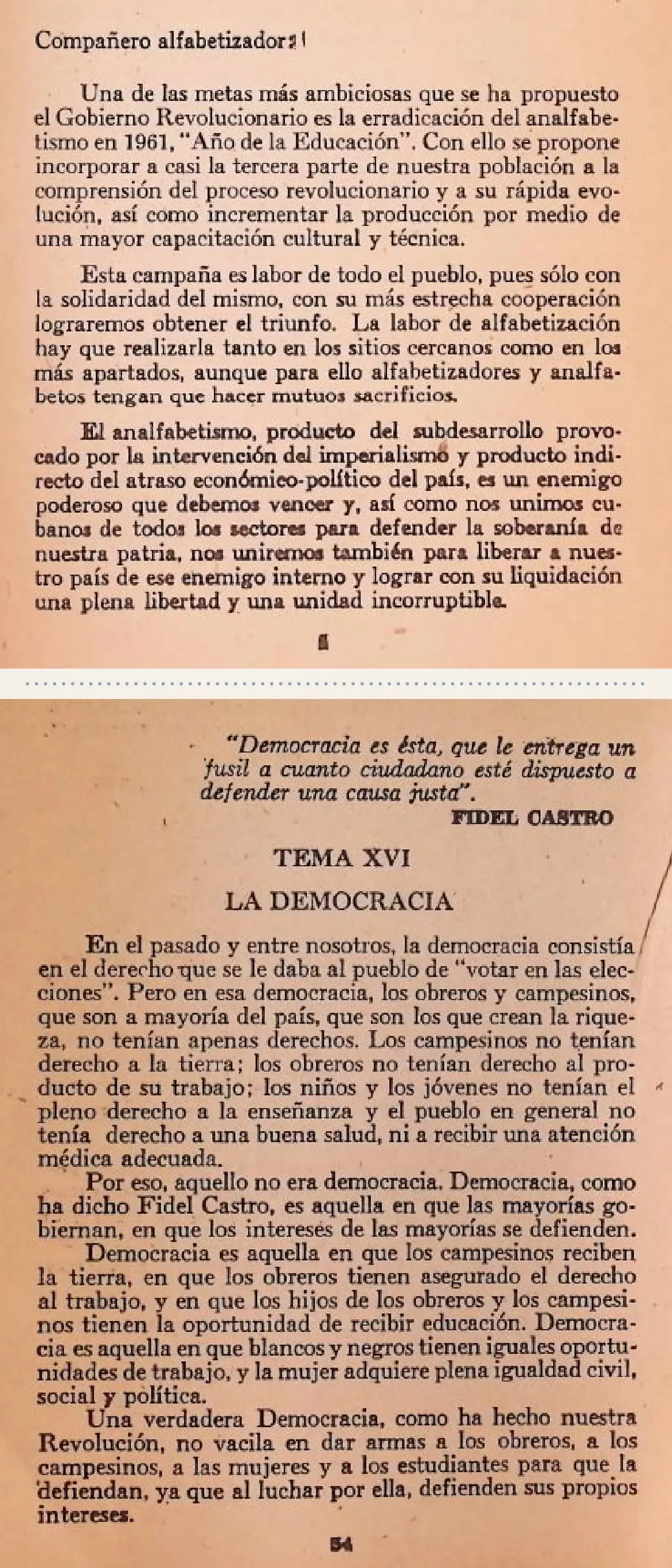
Theme XVI is titled “Democracy” and fits on one page, 54. It begins: “In the past and among us, democracy consisted of the right given to the people to ‘vote in the elections.'” The quotation marks are in the original. It goes on: “That is why that was not democracy.” And it ends: “A true Democracy, as our Revolution has done, does not hesitate to give arms to the workers, the peasants, the women and the students so that they may defend it.” Nowhere on the page is there a future election, a party or a newspaper. Theme XI says who the friends are: “the Soviet Union, People’s China and the other socialist states” (page 43).
The vocabulary has more than three hundred words. Many are what one would expect: “Bohío” (a peasant hut), “Zapateo. A dance typical of our countryside.” Others are not. AP is “Associated Press. A North American news agency in the service of the interests of Yankee imperialism” (page 80). Maximum Leader of the Revolution is “Supreme chief of the Revolution (Fidel Castro)” (page 90). Collective Revolutionary Vigilance is “Organization of the popular masses aimed at cutting off the action of counterrevolutionary elements through the action of everyone” (page 98). And there is one that by itself explains everything that came afterward. Freedom of the press: “The right to set forth one’s thoughts freely by means of the press. The Cuban revolution guarantees freedom of the press provided it is not used to attack the interests of the people” (pages 89 and 90).
I counted the words, with a program and on the text layer that comes with the scan itself, so the figures are minimums. In the twenty-four themes the “revolution” family of words appears 55 times, the “imperialism” family 31 and “Fidel” 20. “Read” and “write,” added together, four. “Communism” and “Marxism” do not appear once in the whole book: at the time it was printed, before the Bay of Pigs, the words were not yet being said.
The primer deserves fairness, because it is not the same thing as the manual. Fagen read it and noted that its overt political content was “limited and uneven”, with ordinary practice sentences alongside others such as “Now the fisherman is not exploited” (note 18 to chapter 3). The heavy politics went into the teacher’s book, and the teacher was the one who did the talking. I have not been able to see the primer: it is not scanned anywhere I have found, and for that reason I do not quote any of its sentences as if I had read it. It circulates online that it had lessons called “The Revolution” and “Fidel Is Our Leader.” It did not: those are themes from the manual.
The exam was a letter
There were three tests: initial, intermediate and final. The mission’s report reproduces the form for the last one, and it has six items. Write your name. Write your address. Read a paragraph that says: “The Revolutionary Government wants to convert Cuba into an industrialized country. Many industries will be created. Many workers will work. Unemployment will end”. Answer questions about the paragraph; the first is what the Revolutionary Government wants. Take dictation. And the sixth: “Write Dr. Fidel Castro the letter he asked for.”
The letter had a practical use, and I say so because it is true: it entitled the writer to the follow-up book for continuing to study. Castro explained it that June 18: “those letters, naturally, will be filed. Each newly literate person who writes will receive a book” (in Spanish). The teacher handed the letter to the Municipal Council, and each pupil’s file was kept in the campaign archive of his municipality. The reading exam and the act of allegiance were the same piece of paper, and the paper was filed.
There is one account, a single one and told fifty-four years later, of how the count was closed in one classroom. Blanca Acosta Rabassa was ten years old and was teaching on a farm in Matanzas. She says that one day the area coordinator arrived and told her: “You write the letter to the Comandante and have them copy it” (in Spanish). She refused, because her pupils needed another month. It is one person and one farm, it proves nothing about the total, and the same author writes that those could have been “the best months of my life.” I tell it because it is the only account I have found, by someone who was there, of how the letter was reached.
Those letters are today in the National Museum of the Literacy Campaign, at Ciudad Libertad, which is the former Columbia military camp, the same place as “Am I doing all right, Camilo?” UNESCO inscribed the collection in 2017 in the regional Memory of the World register, the one for Latin America and the Caribbean, not the international one, and the entry describes the letters as written “as proof” of the ability to read and write. It is often repeated that the museum holds more than 700,000 letters. I have not found any document that gives that number: 707,212 is the figure for people made literate, and the UNESCO entry speaks of “more than one hundred thousand documents and museum pieces” in all.
What it was for, in his words
Nobody explained the purpose of the campaign better than Castro. On June 18 he said why the deadline was one year and not three: “it would never have been possible to mobilize so large a contingent of educators” (in Spanish), because “peoples fall in love with great tasks.” On September 5 he gave another reason for having the youngsters spread across the country: “it is, in a certain sense, a security measure” (in Spanish), in case there was an atomic war. And on November 8 he told the brigadistas what he expected of them: “You are going to return to the classrooms with an experience and an attitude toward life that is more revolutionary” (in Spanish). “We are going to see how you behave in your studies, and how you advance politically.”
The scholarships that followed came with a condition. To enter the first school for elementary teachers one had to “have been a brigadista, an indispensable condition” (in Spanish). The special course for women teachers would have teacher training in the morning, and “in the afternoon they will study economics and political doctrines.” Among the scholarships of December 22 there were 2,300 for teachers of Russian (in Spanish).
That day’s speech, the one with the proclamation, is the best summary. It has 7,189 words and I counted them by family, the word and its derivatives. “Imperialism” and its family, 56 times. “Revolution,” 53. “Illiteracy” and “illiterates,” 21. “Socialism,” 16. “To teach literacy” and its derivatives, 7. “Letter,” none. The speech does not give the number of people made literate, nor of those who did not learn. It says, instead, “this is socialism!”, and it says “that is why we are Marxist-Leninists, and that is why we shall always be Marxist-Leninists!” Three weeks earlier, in a late-night broadcast that is not in the official archive of speeches and whose full text I have found only in an English translation from 1962, Castro had declared himself a Marxist-Leninist. Two days before the rally he explained why he had not said so in the Sierra: “we possibly would not have been able to come down to the plain” (in Spanish).
Outsiders saw the same thing, and each told it in his own way. The UNESCO experts, as praise: the campaign “was, in itself, a political event”, and thanks to it the peasant “has learned how to read and has become a revolutionary” (pages 72 and 73). US intelligence, as a diagnosis: a secret estimate of March 1962 says the operation served “three political purposes”, to organize and indoctrinate the brigadistas, to make the newly literate “accessible to regime propaganda” and to impress Latin America, and that “in general” it achieved them (NIE 85-62, paragraph 47). That document does not dispute the number of people made literate. No US document I have seen disputes it.
While the brigadistas were in the countryside, the state took the schools. On May 1 Castro announced “a law nationalizing the private schools” (in Spanish) and, in the paragraph before, another that would cancel the residence permit of “every foreign priest.” The law of June 6 (in Spanish) awarded all private schools to the state and left compensation in the hands of the ministry, depending on whether owners and teachers had not “acted against the interests of the Revolution.” On September 17 the steamer Covadonga left Havana with the expelled priests: 131 according to Castro, who called them “Falangist priests”, and according to the Spanish press on arrival; 135 according to the Inter-American Commission on Human Rights (all three in Spanish). A dispatch from the EFE news agency published by La Vanguardia says 46 of them were Cuban. The International Commission of Jurists summed it up the following year: “From the University of Havana down to the smallest secondary or primary school, the whole educational system has been brought under State control” (page 247). When the youngsters came back in December, the school they returned to was a different one.
The youngsters
Castro had said thirteen years old and sixth grade. The Literacy Commission’s own statistics, as recorded by Kozol, an enthusiast of the campaign, say that of the brigadistas “forty percent were ten to fourteen years of age. Forty-seven percent were between fifteen and nineteen” (page 6). The youngest on the list was eight. More than half came from elementary school. Castro himself said so at Playa Girón on July 27: “there are some youngsters you see who are tiny, 10 and 12 years old, who have been teaching literacy” (in Spanish). In 2021 the minister of education said it as if it were nothing: they were students “aged between seven and 19” (in Spanish).
Parental permission existed. What is not clear is how much it was worth. A former brigadista told Kozol that at fourteen he took the paper home, that his mother said she would not sign, and that he answered he would sign her name himself or run away. His mother signed (page 38). The official press publishes those memories today as a point of pride. In Juventud Rebelde, in 2021, one literacy teacher says: “I did not hesitate to join, even though my parents did not give me their approval” (in Spanish). And another: “My parents did not want me to because I was a girl, but I got my way.”
Around the youngsters a rumor ran that year: that the government was going to take away parents’ legal custody of their children, the patria potestad. It was false. There never was such a law, and the only known text is the one Castro read in public on September 19 (in Spanish), holding the clandestine copies in his hand, to mock it. He himself had tied the rumor to the campaign six months earlier: the counterrevolutionaries, he said, “devote themselves to sowing rumors, to try to frighten parents, so that their children will not go to teach” (in Spanish). The historian María de los Ángeles Torres, who left Cuba at the age of six, maintains in The Lost Apple that it was spread by Radio Swan, a CIA station, and she relies in part on Cuban intelligence records. I have not found a US document that confirms it.
The rumor was false, but the fear was real, and it had something to feed on. Between December 1960 and October 1962, 14,048 minors left Cuba for Miami, alone: Operation Peter Pan, which in Miami is also written Pedro Pan. Torres writes that if a single government action can be pinpointed as the catalyst for how massive it became, it was the closing of the schools (chapter 5). Those who left and those who went up into the hills were the same age, and often from the same neighborhood. Some parents signed a permission slip and others bought a plane ticket.
Those who refused
Castro said again and again that the campaign was voluntary, “no one was made literate by force” (in Spanish), and I have found no law and no documented case of punishment for refusing to learn. I put that in writing because the word “forced,” which is used a great deal, has nothing to stand on. What there is, instead, is what Castro himself said about those who refused, in Melena del Sur, with the laughter and applause noted by the stenographer.
Those who did not want to study for political reasons were “a very tiny minority that does not want to become literate because they are worms” (in Spanish), gusanos, the regime’s word for its opponents. Theirs was not a case of illiteracy but of “burrismo,” being a donkey. And he announced what awaited them: “the people are going to have a very poor opinion of any person under 55 and over 14 who cannot read or write.” Anyone who had to sign with a fingerprint would be looked at, and people would think: “Could this one be a worm? Could he be a counterrevolutionary? Could he be a donkey?” Those who refused had to set down their reasons in a written record.
The census of illiterates was no formality either. The mission’s report says that many hid the fact that they could not read, “some for fear of losing their jobs”, and that offices, banks, courthouses and post offices notified the Department of Statistics when someone could not sign a document (page 27). The experts call it persuasion. Voluntary in law and singled out in the public square: both things are in the same documents.
What has to be told even though I do not like it
In this episode the uncomfortable part begins with two dead whom the regime’s propaganda has used so much that on this side people tend not to look at them. Conrado Benítez was eighteen and a volunteer teacher. Insurgents in the Escambray seized him on January 5, 1961, and killed him. Manuel Ascunce was sixteen and a brigadista. He was hanged on November 26 on a farm in Trinidad, together with the farmer Pedro Lantigua. It happened in the middle of the Escambray war, and it was done by men who were fighting the regime, the insurgents to whom this series devoted a whole episode. The exile historian Enrique Encinosa, who wrote the history of that war from the insurgents’ side, does not deny it: “The murder of Domenech had no justification” (page 49, in Spanish).
Of Benítez, Encinosa says that he was a “spy and informer for the militias,” and he offers neither a document nor a witness. The only paper from the time says something else. It is the record drawn up by the insurgents themselves, which Castro read in public on January 23: it describes a detainee whose “profession” was “communist teacher” (in Spanish) and from whom they took four pesos, an identity card, two photographs, “an arithmetic book, a book of language exercises, a physiology book” and propaganda. They found no weapons on him. They do not accuse him of informing. If they had taken him for a spy, that was the place to write it down.
That said, the official version of those deaths has problems too, and they are the kind this blog likes, because they are in its own texts. Every detail of the torture of Benítez comes from a single source: the confession of an insurgent to a State Security agent, published in 1978 in a magazine of the Interior Ministry, as the official researcher who cites it explains (in Spanish). Granma wrote in 2024 that he died “together with five peasants who were trying to learn to read and write”; Granma had written in 2015 that one man died with him, and that he was “a combatant of the Rebel Army and founder of the Militias in the Escambray” (both in Spanish). Castro’s first report on Ascunce, two days afterward, does not mention torture and does say that Lantigua was a militiaman and “apparently tried to use his weapon” (in Spanish). Today one official source says they were hanged “with barbed wire” and another quotes the investigating judge speaking of “the rope around the neck” (both in Spanish). And the farm that Lantigua ran, according to the state’s own encyclopedia, “had been taken over from its owner six months earlier”, and one of that owner’s sons was in the band.
None of that changes the essential fact. A sixteen-year-old boy who was teaching people to read was hanged from a tree. What does have to be asked of the other side is why he was there. The government sent thousands of minors into a zone where a teacher had already been killed in January. In March Castro had given his assurance: “There is no danger for any literacy teacher” (in Spanish). On November 28 he said his concern was that mothers would “start bringing their children back from the countryside” (in Spanish). The director of the museum recalls what Ascunce’s mother told her about the wake: there were parents who showed her “the bus or train ticket they had ready to go and fetch their children” (in Spanish).
The rest of what I do not like is easier to say. The achievement was real. Mesa-Lago, who has spent his life checking the regime’s statistics, calls it “an important achievement”. Domínguez wrote that “the reduction of illiteracy was real, though perhaps less impressive” (page 165). Jolly, after listing the mistakes, concluded that the campaign “may prove to be the most successful achievement of the first 4 years” of the Revolution, and that while it was no soft sell, “neither is it indoctrination at gunpoint” (pages 205 and 347). Dimas Castellanos, who writes from Cuba in the independent press and is very hard on the content of the books, calls what was accomplished “a result of incalculable value” (in Spanish). No one in academia maintains that it was a fraud. When an exile column (in Spanish) writes “an outright fraud” and presents as a revelation that 272,000 illiterates remained, it is discovering the official figure.
The pages of the manual that teach how to teach are good. “Avoid giving orders.” “Avoid an authoritarian tone; remember that the work of literacy is carried out jointly by teacher and illiterate” (page 12, in Spanish). The same book distinguishes the people of the United States from their government: “We Cubans are not enemies of that people” (page 44). The historian Lillian Guerra, who studies the campaign as a mechanism of control, also writes that girls, young women and black Cubans “were particularly empowered by the experience,” and that in the case of black supporters of Castro it happened “in ways that the state found difficult to control” (pages 167 and 168). And President Kennedy told the Soviet deputy premier Mikoyan, in November 1962, that if Castro wished to carry on with “the education of Cuban children,” that was “well and fine.”
Nor is everything that is said about the children true. The idea that the state was taking children from their parents was also propaganda material for the United States: in July 1962 the US Information Agency reported to the chiefs of Operation Mongoose that it had in production or distribution five million copies of six comic books for Latin America, and one was titled Los Secuestradores (“The Kidnappers”), on the “brainwashing of children.” Many brigadistas went because they wanted to, sometimes against their parents, and that is how they tell it themselves. They were minors, they spent months far from home and in a country at war, and that is quite enough without adding anything to it.
The campaign today
Official memory does not hide the political content. It displays it. Armando Hart, who was minister of education in 1961, wrote that the merit of the two books lay in “teaching by means of a revolutionary content” (in Spanish). Granma recalled in May of this year the refrain of the brigades’ anthem: “Cuba, Cuba! Study! Work! Rifle! Pencil, primer, manual!” (in Spanish). What I have not found in any official piece of the last ten years is the list of the manual’s themes, or its definition of freedom of the press.
Every December 22 is Educators’ Day. The latest yearbook of the National Statistics Office says that teaching staff fell from 316,947 in the 2021-2022 school year to 292,266 in 2023-2024, and enrollment from 2,029,498 to 1,840,228 (table 18.4, in Spanish). The teachers are leaving and so are the pupils. In August 2024 the minister acknowledged “a need for around 24,000 teachers” (in Spanish). In August of this year she gave the figure another way: “73 percent total coverage with trained staff on the payroll” (in Spanish).
In UNESCO’s regional tests of 2006, Cuba stood more than one standard deviation above the average for Latin America in mathematics (in Spanish). In those of 2019 it is still first in third-grade mathematics and in science, and that has to be said. But in sixth-grade mathematics it scored 689 points against a regional average of 697, and only 20.7 percent of its pupils reached the minimum level (page 43 of the summary, in Spanish). The ministry put it this way: in mathematics “its achievements are similar to the regional average” (in Spanish). It is the same way of doing the sums, sixty years later.
What remained
What remained is people who learned to sign their names, and nobody can take that away from them. María de la Cruz Semanat was 106 years old. She was born in 1855 on a sugar mill estate, thirty-one years before slavery was abolished in Cuba, and she said at the podium that she had known it. Castro brought her up there on June 18 and asked her “what day it was that you were able to write your full name and write a letter” (in Spanish). There is no image in this whole story that the regime has used more, and none that is more true.
A method remained too. A figure proclaimed before it was counted. A division that changes its denominator when convenient. A foreign report printed at home. And a book that taught a country, along with its letters, that the press is free as long as it does not attack, that democracy is a rifle and that whoever is not with us is a worm. The rest of this series is, in good part, the story of what was done with that vocabulary.
Both things are true at once, and whoever tells only one of them is doing propaganda, for one side or the other. That year hundreds of thousands of Cubans learned to read. The first thing they read was what the government wanted them to read, and the first thing they wrote was a letter to it.
Next episode. "Havana is living through a time of extraordinary prosperity": Cuba before 1959: Cuba before 1959, one sentence torn in two and what each side leaves out of the other half.