“Cuban History” series · Season 2, episode 5
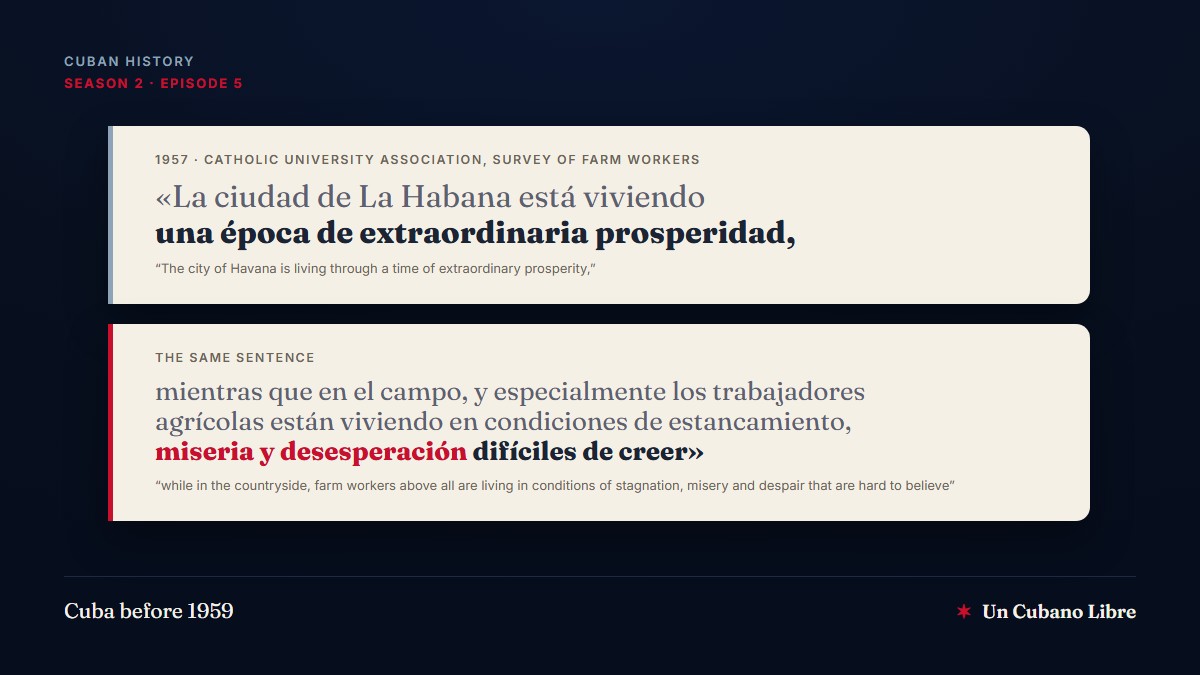
Starting on November 30, 1956, and for about ten months, interviewers from the Agrupación Católica Universitaria, the Catholic University Association, crisscrossed the Cuban countryside with a questionnaire. They carried out a thousand interviews with farm laborers’ families spread across the country’s 126 municipalities, in the middle of a war, and they put in writing that they could not reach some places because of “the ban on traveling through some areas of Pinar del Río, Las Villas and Oriente, together with the arrests suffered by some of the interviewers.” The report came out in 1957 under the title ¿Por qué reforma agraria? (Why agrarian reform?), and its introduction opens with a sentence that sums up this whole episode: “The city of Havana is living through a time of extraordinary prosperity, while in the countryside, farm workers above all are living in conditions of stagnation, misery and despair that are hard to believe” (in Spanish).
That sentence has two halves, and each side of Cuban history has kept one of them. The regime has been quoting the second for sixty-seven years. Part of the exile remembers only the first. Both are true at the same time, and the same people said them, on the same piece of paper, before 1959.
There is propaganda in both directions about Cuba before the Revolution, and this is the one episode of the series in which I have to correct my own side as much as the other. I will do it with the usual method: find the number in a document from the time, say what it measured, and compare it with the same year and the same source. Neither the paradise nor the hell survives the test. What is left is a country more interesting than either.
What each side says
The regime has a formula, and Fidel Castro set it. On the twentieth anniversary of the Moncada attack, July 26, 1973, he said the United States had turned Cuba into “a juicy center of monopoly exploitation, a modern Capua for its tourists, a great brothel, an immense gambling den” (in Spanish). In 1991 he put numbers on it: “A hundred thousand prostitutes in a population of six and a half million, 600,000 unemployed […], millions of illiterates, tens of thousands of children who died every year” (in Spanish). In 1997 he asked an audience of teachers: “Do you want us to go back to an infant mortality of 60 per 1,000 live births?” (in Spanish). The state encyclopedia, EcuRed, has an entry titled “Cuba before 1959” (in Spanish) that gives a life expectancy of 58 years and cites as its source, with no author and no page, a “History of Cuba textbook.”
The exile has a list. It circulates by email, in magazines and in speeches, and it almost always claims to come “from the UN”: Cuba was the richest country in Latin America, it had the lowest infant mortality in the region and the 13th lowest in the world, lower than France, more television sets than anyone, the peso was worth the same as the dollar, the industrial worker earned the eighth-highest wage in the world according to the ILO. I looked for where it comes from. Almost all of it comes from a single paper: Zenith and Eclipse, a State Department report from 1998, revised in 2002. The Institute for Cuban and Cuban-American Studies at the University of Miami copied it almost word for word in its bulletin Cuba Facts issue 43 in 2008, and the US House of Representatives repeated it in Resolution 868 of 2020: “in 1957 Cuba had an infant mortality rate of 32 per 1,000 births, the lowest in Latin America and the 13th lowest in the world.” That is three texts, but one source.
I will go number by number. The result, in advance, is awkward for both: the exile gets more things right than the regime, and gets wrong precisely the ones it repeats most.
What a Cuban earned
The United Nations Economic Commission for Latin America, ECLA, calculated in 1952 the product per head of ten countries with the same method, in 1950 dollars. Table 19 of its report that year (page 31) gives Venezuela 450, Argentina 428, Cuba 406, Chile 299, Brazil 217 and Mexico 214. Cuba, third. Uruguay is not in the table, and other sources put it ahead. The most careful reconstruction there is, by the economists Marianne Ward and John Devereux, published in 2012 in the Journal of Economic History, expresses 1955 income per head as a percentage of the United States: Uruguay 34, Argentina 31, Venezuela 28, Cuba 27 (appendix, table 1). Fourth of twenty Latin American countries. In the same table Italy has 29, and with a bridge estimate the authors explain, Spain 21 and Portugal 16.
Three things follow. “The richest country in Latin America” is false by any source: Venezuela, Argentina and Uruguay were ahead in all of them. “Among the first in Latin America” is true. And “richer than Spain” is true as well: in the 1950s a Cuban had a higher income than a Spaniard and almost the same as an Italian. The US Department of Commerce, which studied the country for investors, put it this way in 1956: “Cuba is not an underdeveloped country in the sense usually associated with that term” (page 5).
The same book sets the limit on the same page: the Cuban standard of living was “among the highest, if not the highest, in Latin America”, but only a third of that in the less wealthy states of the southeastern United States. It gives an example: between 1950 and 1954, Cuba’s best year produced 345 pesos per head, and Mississippi’s worst year, $638 (page 184). The comparison with Mississippi, which also circulates, is true for the 1920s and false for the 1950s.
And the peso at par with the dollar proves none of this. It was a fixed exchange rate: by law the peso had the same gold content as the dollar, and from 1945 it traded one to one with no exchange controls. It said the currency was stable. It did not say how much a Cuban produced. In the exchange-rate table of the UN Statistical Yearbook 1958 (page 444), the Cuban peso, Trujillo’s Dominican peso, the Guatemalan quetzal and the Panamanian balboa all appear at 1.000 to the dollar, in the same column.
Thirty years without moving
What the exile does not tell is in the most serious document written about the Cuban economy before 1959. In 1950 the World Bank sent a mission of economists to Havana headed by Francis Truslow, and its Report on Cuba, a thousand pages long, came out in 1951. The conclusion is on page 7: “the present per capita income of about $300 is only slightly above that of the early 1920’s.” And in the next sentence: the Cuban standard of living depended on one industry, sugar, “which stopped growing many years ago.”
Ward and Devereux later measured it with more data: income per head grew 3 percent in total between 1925 and 1955, against 28 percent in Argentina, 23 percent in Chile and 55 percent in the United States (page 124). After World War II there was a recovery, and in the last years of the Republic income finally passed the level of the 1920s. But ECLA, using official Cuban figures, calculated that between 1950 and 1954 income per head fell 1.8 percent a year, while Latin America’s rose 2.1 percent (1956 report, table 3). Cuba was a high-income country for the region that had been standing still for a generation.
The reason was the usual one. Sugar accounted for 80 to 88 percent of exports between 1946 and 1955, according to the Finance Ministry as cited by the Commerce Department (table 73), and in 1953 it employed 474,053 people, 23 percent of the labor force, with an average harvest of 94 days (page 23). What was earned in three months had to last twelve. The World Bank mission wrote that “Prosperity, too, has helped to conceal the relative stagnation of the Cuban economy” (page 8).
Toward the end, the country was also spending more than it had. Gold and foreign exchange reserves fell from $496 million in 1951 to $373 million in 1958, and gold alone from 311 to 80, according to the UN Statistical Yearbook 1959 (table 173). Public debt grew 2.4 times between December 1952 and December 1955, from 241 to 582 million pesos, according to the National Bank as cited by the Commerce Department (page 122). Neither figure is on the exile’s list.
Who owned Cuba
The regime says Cuba was a neocolony of the United States. The figure for US direct investment in 1958 was published by the Commerce Department in the Survey of Current Business of August 1959: $861 million, later revised to $879 million. It was third in Latin America, behind Venezuela and Brazil. In 1929 it had been first, with $919 million: in thirty years it had gone down. And it was concentrated. According to the Commerce Department, US companies held over 90 percent of the telephone and electric services, about half of the public-service railways, about 40 percent of raw sugar production, and the branches of US banks held almost a quarter of all deposits (page 10).
What the regime leaves out is the trend. In 1939 Cuban-owned mills ground 22.4 percent of the sugar; in 1955, 58.7 percent (page 10). The World Bank mission breaks it down by nationality: in 1950, 47.27 percent from American mills and 49.49 percent from Cuban mills (table 173, page 821). Cuban banks went from 16.8 percent of deposits in 1939 to 60.2 percent in 1950. Sugar and banking were becoming Cuban without anyone being expropriated.
In History Will Absolve Me, the defense speech Castro wrote in prison after the Moncada attack, we read that “more than half of the best cultivated land is in foreign hands” (in Spanish). There is no census of land by nationality to check it against. The closest is the official upper-secondary history textbook, which gives 110,027 caballerías (in Spanish) for US sugar companies (page 266). That is 1.48 million hectares, about 16 percent of the farm land counted by the 1946 agricultural census. The calculation is mine, with two sources from different years, and it only gives an order of magnitude: a sixth, not half.
The country in the yearbook
The best of the exile’s list holds up. The UN Statistical Yearbook 1958 has the data, and I checked each figure on the image of the page. In July 1957 Cuba had about 300,000 television sets in use (table 187), some 47 per 1,000 people: first in Latin America, far ahead of Mexico or Venezuela. It had 1.1 million radios in 1956 (table 185), 58 daily newspapers selling 796,000 copies, 129 per 1,000 people, third in the region behind Uruguay and Argentina (table 181), and 6,421 doctors in 1957 (table 176), one per thousand people, also third, behind Argentina and Uruguay. Castro himself gave the number in 2006: “there were 6,000 and they took 3,000” (in Spanish). Television had arrived in 1950. UNESCO studied it in 1953 and noted that the first station, CMUR-TV, was inaugurated on October 24, 1950, and that Cuba, which did not make a single set, had one for every 55 inhabitants when France had one for every 704.
There is fine print. The Cuban television and radio figures are estimates of sets in use, while most of Europe’s are paid licenses, which always come out lower. The calorie figure that gets quoted, 2,730 a day, is from 1948 and 1949, ten years older than the figures for the countries it is compared with (table 125). And some claims fail: Cuba was not first in Latin America in radio stations, because Brazil had 593 and Mexico 227, and Cuba 160 (table 184).
And the finest print of all: none of those numbers says where things were. The 1953 census, which the UN published in its 1960 yearbook (table 175), says it another way. Electricity reached 82.9 percent of city homes and 8.7 percent of rural ones; running water inside the house, 57.7 percent and 6.7 percent. Cuban cities were far ahead of Latin American ones, and the Cuban countryside was roughly where the rest of the region’s was. A television set without power is no use to anyone. Illiteracy, 23.6 percent in 1953 and fourth or fifth in Latin America, I covered in the previous episode.
Thirty-two, sixty and thirty-six
The exile’s star figure is infant mortality: 32 per 1,000 live births in 1957, the lowest in Latin America and the 13th lowest in the world, lower than France. The regime’s star figure is the opposite: over 60. Both claim to come from the UN.
While the Republic lasted, the UN published neither. In the 1961 Demographic Yearbook, which collects infant mortality rates for every country from 1945 to 1961, Cuba’s row has a single number, 38.9 for 1945-1949, in italics, which in that yearbook’s legend means “Data are unreliable or of unknown completeness.” For every year from 1950 to 1961 it has an ellipsis. The Cuban civil register was not good enough for the United Nations to publish it.
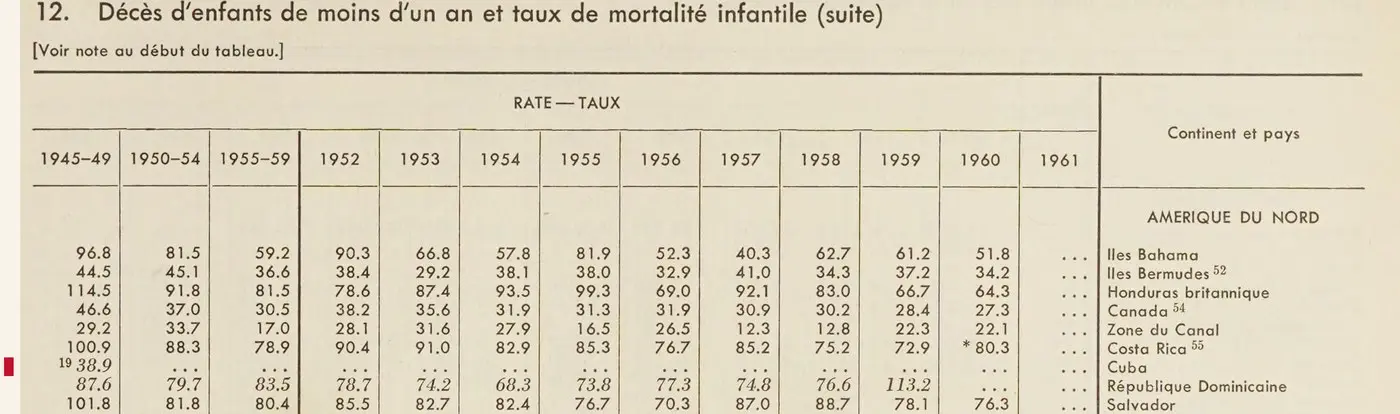
The exile’s 32 has a source, but not one from the time. In 1966, with the Revolution already in power, the UN Demographic Yearbook finally published a Cuban rate for 1957: 32.3, in italics, with a note warning that from that year on the rates were computed on births “which are estimates based on analysis of 1943 and 1953 population census returns and application of an assumed rate of growth” (table 14, note 66). It is a figure the UN itself prints as doubtful. And the rest of the sentence does not hold. In Zenith and Eclipse, the footnote for that paragraph does not even point to the UN: it points to a 1999 web page built from the CIA’s World Factbook. Thirteenth is not a world ranking: it is Cuba’s place in a list of 25 countries, almost all of them rich, chosen by the report itself, and the report says so in another sentence: “Cuba’s comparative world ranking according to data in Table 1 has fallen from 13th to last out of the 25 countries examined.”
The regime’s 60 does not come from the register either, though it says it does. A text published on Infomed, the Ministry of Public Health’s network, claims that infant mortality before 1959 “stood at 60 per thousand live births in the statistical records” (in Spanish). The Central Planning Board itself gave 33 for 1958, and the newspaper Granma published 37.3 for 1960 two years in a row, according to the political scientists James McGuire and Laura Frankel, who studied the whole series. Their comment on that figure is dry: “The Party would seem to have an interest in endorsing a higher estimate for 1960” (page 90). The economist Carmelo Mesa-Lago had already pointed it out in 1969: in January 1967 Castro said the 1958 rate was 60 per thousand, when the official table Mesa-Lago reproduces gave 33, and the registered average for 1959 to 1966, 37.2, was “substantially above the pre-revolutionary rates” (page 48). He adds that “The system for recording deaths in 1959-62 was the same as that in force in 1958.”
Neither figure is the truth. The Cuban register left out many babies who died in their first hours of life, and registering births was not compulsory, so the registered rates, between 32 and 36, fall short. By how much is disputed. The Cuban demographers who adjusted the 1953 census calculated 78.8 per thousand for that year (in Spanish), according to a 1977 report by the Latin American Demographic Center (page 29). McGuire and Frankel consider those reconstructions unreliable and accept 39 for 1960. The estimate given today by the UN group that measures child mortality is 36 for 1958. At 36, Cuba had the lowest rate in Latin America and was below Italy, Spain and Portugal, which in 1957 had 50, 53 and 88 according to the 1961 yearbook. Not below France: 33.7 in the French register for 1957, and 27 in the current estimate for 1958. Nobody knows the exact number, and each side picks the end that suits it. The exile, a register that fell short. The regime, a figure it calls a record and is not.
For life expectancy there is no figure from the time: Cuba published no life table in the UN yearbooks before 1959. Later reconstructions give 58.8 years for 1953 (in Spanish; page 36) and 64 for 1960, according to the review by McGuire and Frankel (page 91). EcuRed’s 58 years fits within that range. The official upper-secondary textbook’s “under 55” (in Spanish; page 385) does not. And a Cuban medical journal published in 2011 that “in 1959 it was 35 years” (in Spanish), and that by 1965 it was 65: thirty years of life gained in six.
The countryside
Here is the other half of the sentence, and here the exile has no defense. The 1946 agricultural census, which the World Bank mission reproduced in its tables, counted 159,958 farms. The 894 of more than a thousand hectares, 0.6 percent, occupied 36 percent of farm land; those under 25 hectares were 70 percent of farms and had 11 percent (page 90). They are farms, not owners, because the census counted operating units. And 62 percent of them were worked by tenants, subtenants, sharecroppers and squatters, people who did not own the land (table 18). In Oriente, more than one farm in five was held by squatters.
The farm worker’s problem was not so much the daily wage as the calendar. The minimum wage for agricultural workers in sugar was $2.88 for an eight-hour day from 1947 on (page 819), high for the region. But the 423,690 paid seasonal farm workers counted by the census worked an average of 4.1 months in 1945, and only 6 percent reached nine months (page 49). The rest of the year was the dead season. Here Castro was right: in History Will Absolve Me he speaks of “five hundred thousand farm workers who live in miserable huts, who work four months a year and go hungry the rest” (in Spanish). The order of magnitude is the census’s.
The Catholic Association’s survey is the other source, and the one the regime uses most. You have to know what it measures. It is not “the rural population”: it is the families of wage-earning farm workers (in Spanish) living in hamlets of fewer than 150 people, a universe the survey itself puts at 400,000 families. For those families, the housing data match the census and are very harsh: 60 percent lived in houses of wood, with thatched palm roofs and dirt floors; 64 percent had no toilet or latrine; 88.5 percent drew water from a well; 7 percent had electric light; 43 percent could not read. The family, six people on average, took in 548.75 pesos a year: twenty-five cents per person per day.
And there is a famous figure that does not measure what it is made to say. For decades it has been repeated that, according to the survey, only 4 percent of peasants ate meat. An official book by the University of Havana’s Center for Demographic Studies put it this way: “only 4% of the rural population ate meat” (in Spanish; page 204). The survey asked what had been eaten the day before, and it warns that its data “represent the frequency with which a type of food is mentioned in the makeup of the meals of the day before the interview”. Added up, the percentages for meat, eggs, milk, bread, cornmeal, root vegetables, rice and beans come to 97.7, and with fish, almost a hundred. The sum is mine. They are shares of a meal, not people: the survey itself says rice supplies “25 percent of the total diet,” and if it were 25 percent of people, three out of four would not have eaten rice, when the report’s conclusion is that the Cuban farm worker “lives on rice and beans.” The confusion starts in the survey itself, which a few lines earlier writes it as if they were people: “Only 4 percent of those interviewed mention meat as part of their usual meals.” The figure exists; what is unclear is what it measured. What it does say is enough: in those families’ daily food, meat was very rare. There is no need to stretch it. The stretch is double: from farm laborers’ families to the whole rural population, and from one day’s meals to a year’s diet.
The survey also had method problems, and it admits them. For diet, the interviewer “asked in a suggestive way,” and to find out whether someone was illiterate he asked: “You don’t know how to read and write, do you?”. Health and weight were whatever each person reported. None of that changes the housing picture, which is the most solid part of the report. And rural schooling confirms it from another angle: in the 1949-1950 school year the countryside had 77,807 children in first grade and 2,647 in sixth (table 59). For every thirty children in first grade there was one in sixth.
Work
On paper, the Cuban worker was among the best protected on the continent, and that is true. The 1940 Constitution (in Spanish) set an eight-hour day and a 44-hour week “equivalent to forty-eight in wages” (article 66), a month of paid vacation for every eleven of work (article 67), six weeks of leave before childbirth and six after, “paid the same as her work” (article 68), and it banned firing anyone “without a prior hearing” (article 77). The World Bank mission confirms it and adds the fine print: “The enforcement of the minimum wage regulations is known to be incomplete” (page 362), and unions barely existed in cattle ranching, coffee and small farms.
What Cuba had was unemployment, and each side tells it its own way. The 1953 census was taken in January, at the height of the harvest, and found 8.4 percent unemployed (pages 22 and 23). The National Economic Council ran a survey from May 1956 to April 1957, a full year, and found 361,000 unemployed, 16.4 percent of a labor force of 2,204,000 (in Spanish), plus 223,000 working fewer than forty hours. At the height of the harvest, from February to April, 9 percent; from August to October, 20.7 percent. The table was reprinted in May 1959 by Lunes de Revolución, the cultural supplement of the 26th of July Movement’s newspaper, citing the source.
An exile magazine gives for 1958 an unemployment rate of 7.07 percent (in Spanish), “the lowest in Latin America,” on a labor force of 2,204,000. That is the same labor force as the official survey, with an unemployment rate the survey does not give. Not even in the best month of the harvest did it fall below 9 percent. The same list credits the ILO with saying the Cuban industrial worker earned the eighth-highest wage in the world. The table of industrial earnings that the UN published with ILO data, in the 1958 yearbook (table 157) and in those of 1959 and 1960, does not include Cuba. I have not found where that ranking comes from.
The regime exaggerates upward. In History Will Absolve Me Castro wrote that “from May to December a million people are out of work” (in Spanish) and that Cuba had “more unemployed than France and Italy.” In the dead season the unemployed numbered between 400,000 and 450,000, according to the Commerce Department (page 23), and in 1953 Italy had 1,946,500 registered unemployed (table 7). The “600,000 unemployed” Castro repeated in 1991 come from adding to the survey’s unemployed those who worked part of the week. The ninth-grade history textbook raises the figure to 738,000 (in Spanish), with no source (page 267).
| What is said | What the document says |
|---|---|
| Exile: Cuba was the richest country in Latin America | False. Third of ten in 1952 (ECLA) and fourth of twenty in 1955 (Ward and Devereux), behind Venezuela, Argentina and Uruguay. Among the first, yes. |
| Exile: it was richer than Spain | True in the 1950s: 27 against 21, with the United States at 100. About the same as Italy, at 29 (Ward and Devereux). |
| Exile: the peso was worth the same as the dollar | True, and it proves no wealth: the Dominican peso, the quetzal and the balboa were also one to one (UN, 1958). |
| Exile: Cuba was growing fast | False. Income per head rose 3 percent in thirty years, 1925 to 1955 (Ward and Devereux), and fell 1.8 percent a year from 1950 to 1954 (ECLA). |
| Regime: the United States owned Cuba | Half true. Over 90 percent of telephones and electricity and about 40 percent of raw sugar; but in 1955 Cuban-owned mills ground 58.7 percent of the sugar (Commerce Department). |
| Exile: infant mortality of 32 per 1,000 in 1957, the 13th lowest in the world | The UN published no Cuban rate until 1966, and then gave 32.3 in italics, as a doubtful figure (1966 yearbook). The rank is within a list of 25 countries chosen by the report that makes the claim (Zenith and Eclipse). On registered figures it was the lowest in Latin America, but the register fell short. |
| Regime: over 60 per 1,000 in the records | False as a record: the register showed 33 in 1958, and Granma published 37.3 for 1960 (McGuire and Frankel, page 90). As reality, nobody knows: a later demographic adjustment gives 78.8 for 1953 (CELADE, in Spanish). |
| Regime: life expectancy of 58, under 55 or 35 years | The 58 fits; the other two do not. Reconstructions give 58.8 years in 1953 (CELADE, in Spanish) and 64 in 1960 (McGuire and Frankel, page 91). |
| Exile: more television sets than anyone in Latin America | True. About 300,000 in 1957, some 47 per 1,000 people; an estimate of sets in use (UN, 1958, table 187). |
| Exile: unemployment of 7 percent | False. 16.4 percent on average from May 1956 to April 1957; 9 percent at the height of the harvest (National Economic Council survey, in Spanish). |
| Regime: a million out of work, more than France and Italy | False. Between 400,000 and 450,000 in the dead season (Commerce Department); Italy had 1,946,500 registered unemployed in 1953 (UN, 1958). |
| Exile: the eighth-highest industrial wage in the world, per the ILO | Unverifiable. The table of industrial earnings the UN published with ILO data does not include Cuba (UN, 1958, table 157). |
| Regime: only 4 percent of peasants ate meat | A real figure of doubtful meaning: the diet percentages add up to almost a hundred, like shares of a meal, and the sample is farm laborers’ families, not peasants (Catholic University Association survey, in Spanish). |
| Regime: five hundred thousand farm workers who work four months a year | True in substance: 423,690 seasonal workers averaging 4.1 months of work in 1945 (agricultural census, via the World Bank). |
| Regime: twenty thousand killed by the dictatorship | False. The count by name stands at 1,577 deaths attributable to the dictatorship, 873 of them extrajudicial executions (Cuba Archive). A murderous dictatorship all the same. |
| Exile: Cuba took in European immigrants | False for the 1950s: 63,026 Cubans entered the United States as residents from 1951 to 1958 (Immigration Service). |
The dictatorship
Cuba had an imperfect democracy and lost it. In 1944 Ramón Grau San Martín’s opposition defeated the candidate of Fulgencio Batista, the strongman since 1934, and Batista handed over power; in the words of the historian Hugh Thomas, “He did not use the armed forces to secure a corrupt election” (page 735). The 1948 campaign was, according to the same Thomas, the last one Cuba has known (page 757). Women had voted in national elections since 1936, according to the historian K. Lynn Stoner (page 142). On March 10, 1952, Batista staged a coup against President Carlos Prío. For the State Department it came as a complete surprise, and Washington recognized the new government on March 27. Batista replaced the Constitution with a set of statutes and in 1954 returned to office in an unopposed election.
What came next was documented by the US government itself, which supported Batista. On February 15, 1957, Ambassador Arthur Gardner cabled Washington: “We here now convinced recurrent killings of persons government maintains are oppositionists and terrorists are actually work of police and army.” And he described the newspaper photographs: a “corpse riddled with bullets and unexploded bomb of dynamite sticks reposing on or near body.” His successor, Earl Smith, reported in December of that year that freedom of speech, press and assembly had been suspended for seven of the past eleven months, and that several military and police figures had become notorious for their brutality. By July 1958 a State Department report spoke of “terrorism exercised by the armed forces, including the police with feared SIM,” of closed universities and of judges in hiding or in exile.
The casinos and the mob are true as well. TIME magazine told in January 1958 how, starting in 1955, a made-to-measure decree gave tax breaks to casinos in hotels worth more than a million dollars, how Meyer Lansky turned up as an adviser, and how in December 1957 ten casinos were operating in Havana, one of them run by Santo Trafficante. What is not true is that the country lived off it. In 1957 tourism brought in 62.1 million pesos, the second source of foreign currency, far behind sugar. And Castro’s “hundred thousand prostitutes” do not appear in any census, record or study I have found. They would be one out of every sixty-five people in the country, counting men, the elderly and children.
And the dead. In its first issues of January 1959, Bohemia magazine published that the dictatorship had left twenty thousand dead, according to the writer Enrique Del Risco (in Spanish). I have not been able to see the issue. It was the month of the first firing squads: in Santiago seventy men had just been shot after summary trials, according to the US consulate. On January 17, in Pinar del Río, Castro answered the American congressman “who spoke in favor of the henchmen” with the figure: “Three, and in another place thirty, and in another three hundred, gentlemen, because the victims of the tyranny reach twenty thousand!” (in Spanish). He repeated it for years. The ninth-grade history textbook still teaches it: the revolutionary tribunals tried those responsible for “the deaths of more than twenty thousand Cubans” (in Spanish; pages 313 and 314). Nobody has ever produced the list. The count by name kept by the Cuba Archive project stands at 1,577 deaths attributable to the dictatorship, 873 of them extrajudicial executions, and 444 attributable to the armed opposition. A 1963 CIA memorandum gives twenty thousand, but adds up both sides, cites no source, and contains a sentence that undoes it: “However, no accurate estimate is possible.”
That it was not twenty thousand does not make Batista any less a dictator. Sixteen hundred dead in seven years, with nearly nine hundred executions without trial, is a murderous dictatorship, and Washington’s documents say so in more detail than Bohemia. But the figure the regime teaches in schools is more than ten times what anyone has been able to document by name, and it started using it in the same month it started shooting people.
What has to be told even if I don’t like it
The most awkward thing in this episode for the exile is that the Cuba of the 1950s was already pushing Cubans out. According to the annual reports of the US Immigration and Naturalization Service, between fiscal years 1951 and 1958 63,026 people born in Cuba entered the country as residents, with a peak of 14,953 in 1956 (table 14). In the same years, the Cuba that according to the exile’s list took in European immigrants took in few: between 1953 and 1955, 5,644 emigrants left Spain for Cuba and 5,364 returned from Cuba to Spain, according to the UN Demographic Yearbook 1957 (tables 28 and 29). In those three years, the Spaniards who stayed numbered 280, and the Cubans admitted to the United States, 18,330. The calculation is mine, from the two tables. The great immigration had come before 1930: in the 1953 census only 4 percent of the population had been born outside Cuba (table 5).
Nor was it a country without racism, whatever part of the exile says. The 1940 Constitution declared “illegal and punishable any discrimination on grounds of sex, race, color or class” (in Spanish; article 20), but the law that was supposed to punish it was never passed. Discrimination was not in the law but at the door: clubs, privatized beaches, luxury hotels and private schools that did not admit Black Cubans. The historian Alejandro de la Fuente documents it in A Nation for All, including the case of Batista, the only mixed-race president, whom the white clubs of Matanzas and Holguín refused to honor (pages 199 and 223). The idea the book opens with fits this whole episode: Cuba is neither “the racial paradise depicted by Cuban authorities […] nor the racist hell portrayed by some of the detractors” of the revolutionary government (page 2).
And the other side has to be given credit where it was right. In History Will Absolve Me Castro wrote that “two million eight hundred thousand of our rural and suburban population lack electric light” (in Spanish), and the census of that same year gives, by my calculation from the housing data, about 2.7 million people without power in the whole country. He wrote that fewer than half of rural children attended the country schools, and that was true: the World Bank mission found 33.9 percent enrolled in public school in the countryside (table 60). The five hundred thousand workers who worked four months a year existed. What he did was mix those numbers with others that were not true, and then never correct them.
The last point the regime does not like, and the exile not entirely either. McGuire and Frankel, who studied sixty years of mortality in Cuba, conclude that the Republic, from 1900 to 1959, “did even better” than the Revolution, “outperforming all other Latin American countries for which data are available,” and did so “despite experiencing slow economic growth and high income inequality.” Health was improving even when the economy was not growing. That fact fits on neither list.
What remained
With the documents of the time in hand, the Cuba of 1958 was an upper-middle-income country for Latin America, close to Italy and ahead of Spain, with television since 1950, daily papers, doctors and a real urban middle class. It was also a country that had gone thirty years without real growth, that depended on a three-month harvest, with a countryside of thatched huts and wells where half the year there was no work, with racism hidden behind the doors of the clubs, and ruled since 1952 by a dictator who killed his opponents and left a bomb next to the body.
Both propagandas need to erase one of those two Cubas. The regime needs there to have been no television sets and no doctors, so that everything begins in 1959. Part of the exile needs there to have been no huts and no Batista, so that everything bad begins in 1959. Both do the same thing to history: they cut it in half.
The Catholics who went through the countryside in 1957 were not asking for a revolution. They wrote it down: the farm worker “does not ask for a sharing out of wealth, nor for subsidies: he asks for work” (in Spanish). What came next was not the only possible answer to that survey. It is the one that prevailed, and that is what the rest of this series is about.
Next episode. "Some 70 dead is the tragic toll": the Moncada attack: the Moncada attack through the papers of 1953, the massacre of prisoners and what was built on top of it.