“Cuban History” series · Season 1, episode 2
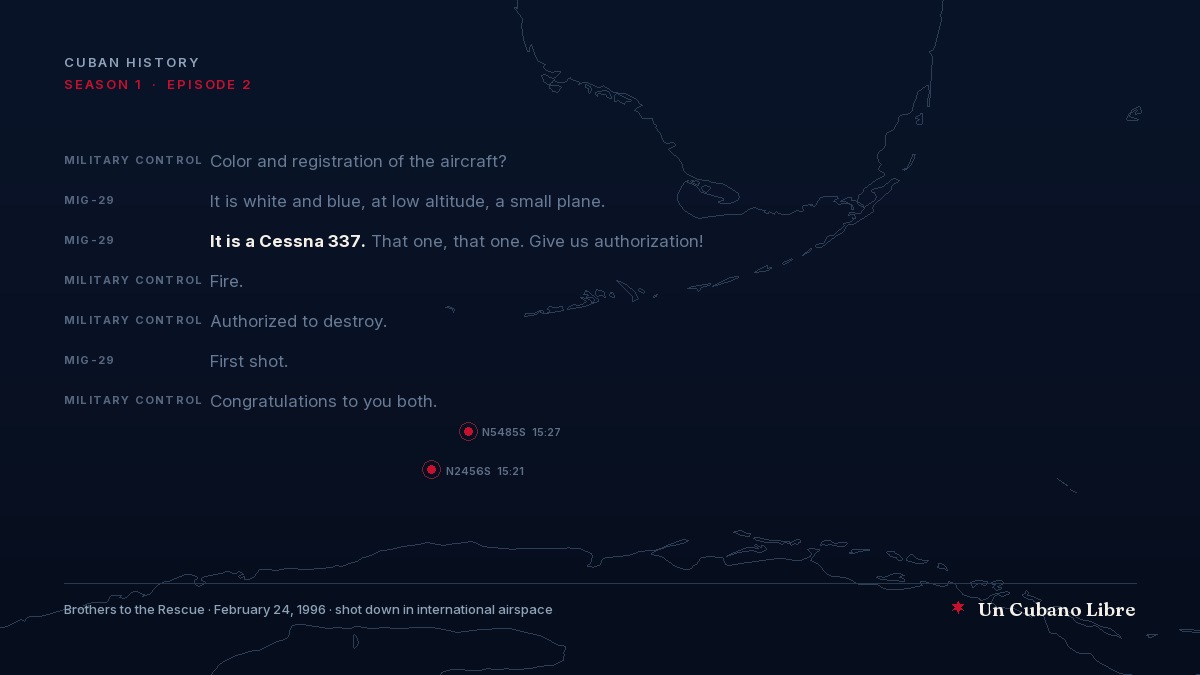
On February 24, 1996, at 3:21 in the afternoon, a Cuban Air Force pilot asked for permission to fire on a small plane he had just identified over the radio as a Cessna 337. He was given it. Six minutes later he asked again, and he was given it again.
None of this has to be reconstructed. It is recorded, and the transcript appears in Report No. 86/99 of the Inter-American Commission on Human Rights.
MIG-29: “OK, the target is in sight; the target is in sight. It is a small plane.”
MILITARY CONTROL: “Color and registration of the aircraft?”
MIG-29: “It is white and blue, at low altitude, a small plane.”
MIG-29: “We have it locked. Give us authorization.”
MIG-29: “It is a Cessna 337. That one, that one. Give us authorization, damn it!”
MILITARY CONTROL: “Fire.”
MIG-29: “Give us authorization, damn it, we have it.”
MILITARY CONTROL: “Authorized to destroy.”
MIG-29: “We copy. We copy.”
MIG-29: “First shot.”
MIG-29: “We blew his balls off! We blew his balls off!”
MIG-29: “We are right on top of him. This one will never screw us again.”
MILITARY CONTROL: “Congratulations to you both.”
And with the second plane, six minutes later:
MIG-29: “The other one is destroyed; the other one is destroyed. Homeland or death, damn it! The other one went down too.”
In the previous episode, the sinking of the tugboat 13 de Marzo, the regime chose one word, “accident,” and held it for thirty-two years. Here it did not have to choose anything. Here they said it out loud, over an open channel, while it was happening. The lie came afterward.
The four
Carlos Alberto Costa, 29, and Pablo Morales, 29, were in a Cessna 337C, registration N2456S. Shot down at 15:21.
Mario Manuel de la Peña, 24, and Armando Alejandre Jr., 45, were in a Cessna 337B, registration N5485S. Shot down at 15:27.
A third plane, N2506, was not hit. It carried four people: José Basulto, Arnaldo Iglesias, and Andrés and Silvia Iriondo. It returned to Miami. That detail, which looks marginal now, will matter thirty years later.
Three of the four dead were United States citizens. The fourth was not.
Pablo Morales had left Cuba on a raft in 1992. He spent days at sea. He was spotted from the air, and the people who spotted him were Brothers to the Rescue. When he reached Miami he joined them as an observer, the one who watches the water looking for others. That is what he was doing on February 24, 1996 when they killed him: looking for rafters, from the same organization that had pulled him out of the water.
He never became a citizen. He had permanent residency. That detail, which looks bureaucratic, will also matter later.
They knew what it was
This is the part that interests me most, and the part that almost never gets told.
Before firing, the tower asked the pilot for the color and registration of the aircraft. The pilot answered that it was white and blue, at low altitude, a small plane. And then, verbatim: “It is a Cessna 337.”
A Cessna 337 is a civilian twin-engine propeller aircraft, the kind used for surveillance and observation flights. It looks nothing like anything military. The pilot had it in sight, identified it by type and by color, told his command so, and then asked for authorization to destroy it.
That removes the only defense still standing, which is confusion. There was no doubt about what that was. There was a correct identification followed by a request for permission.
And there was insistence. “Give us authorization” appears three times in the transcript, twice with a curse after it. That is not the reaction of someone taken by surprise. It is someone waiting for a yes.
Six minutes
Look at the times: 15:21 and 15:27.
Six full minutes passed between the first shootdown and the second. Time enough to see what had just happened. Time enough for someone in the chain of command to say that was enough.
The first one can be argued to someone as a reaction, a miscalculation, a decision made in the heat of the moment. The second cannot. The second was taken knowing exactly what had just happened and what was going to happen again.
And the answer from the ground to the first was not a ceasefire order. It was “congratulations to you both.”
Where they were, and who measured it
The whole Cuban defense rests on one point: that the planes were inside its airspace.
Precision matters here, because two different figures circulate and they do not say the same thing.
The International Civil Aviation Organization concluded that the aircraft were shot down approximately 10 nautical miles outside Cuban territorial airspace. That is the measurement the Security Council endorsed.
The Inter-American Commission, drawing on the same report, gives the distance from a different reference point: “The first plane was 18 miles from the Cuban coast and the second plane 30.5 miles”, and adds that this places them “far outside the twelve miles of Cuban territorial waters that international law allows.”
One figure measures from the edge of the airspace, the other from the coast. Both say the same thing: outside.
And now the fact I find decisive, which answers in advance what Cuba would later argue.
Cuban and United States radar data contradicted each other. So ICAO relied on neither. According to the United Nations release, “the most reliable position estimates were based on the recorded positions of the Majesty of the Seas, a Norwegian cruise ship, and the observations of its crew and passengers, as well as by the position of the fishing boat Tri-Liner relative to it.”
A Norwegian cruise ship and a fishing boat. Neither Washington nor Havana.
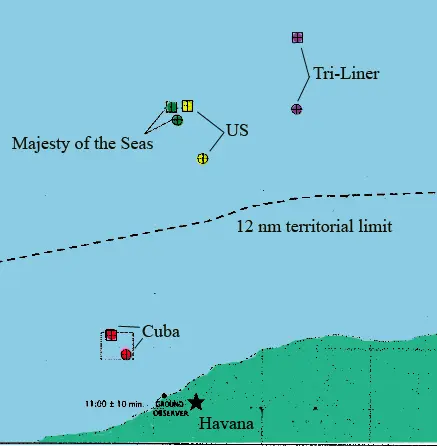
And there is something else in that map worth looking at slowly. The three positions outside the limit, the American one and the two civilian ones, are all north of the line. The Cuban one sits alone on the other side, and not by a little. The two sources with nothing to gain in the matter, a passenger cruise ship and a fishing boat, agree with the version Cuba called falsified.
Months later, at the Security Council, the Cuban representative Ricardo Alarcón de Quesada argued that the United States had tried to “manipulate information and falsify data.” Even if he had been right about American radar, it would make no difference. American radar did not fix the position.
ICAO also established that Cuba did not attempt to use the other means available to it, such as radio communication, contrary to the principle that intercepting a civil aircraft should be a last resort. No warning. No order to land. No maneuver to take them out of the area. It went from sighting to missile.
The day before
Juan Pablo Roque was a Cuban military pilot. In 1992 he turned up at the Guantánamo naval base saying he had swum out of Cuba. He settled in Miami, integrated into the exile community, and joined Brothers to the Rescue.
He disappeared from Miami on February 23, 1996. The next day the planes were shot down. On February 26, two days later, he appeared on Cuban television declaring his loyalty to the regime. He was an agent of the Wasp Network.
Roque died in Cuba on November 25, 2025, aged 70.
This is what is documented: the dates, the disappearance, the reappearance on screen. What I will not do is fill the gap between those three things with what seems obvious to me. The sequence speaks for itself and does not need me to dress it up.
What has to be told even though I do not like it
If this article dodged what follows, the first person to show up with the documents would be right to say I hid half of it, and would be right to stop believing the other half too.
The same ICAO report that places the planes outside Cuban airspace also establishes that the three Cessnas deviated from their flight plans that day and flew within danger areas designated by Cuba. That is not the regime saying it: it is the United Nations technical body, in the same document.
And there is more. On May 19, 2026 the National Security Archive published declassified Federal Aviation Administration records on this case. They are not comfortable.
Brothers to the Rescue had violated Cuban airspace on earlier flights, dropping leaflets over Havana. The FAA had warned Basulto repeatedly. On January 22, 1996, a month before the shootdown, an internal email from FAA official Cecilia Capestany described those incursions as “further taunting of the Cuban Government” and recorded State Department concern about a “worst case scenario.”
The documents also show that a State Department official asked the FAA in Miami to block the flights, and that the FAA refused: it agreed only to warn Basulto. The order to stop operations came after the shootdown.
I could have written this article without any of it. It would have read cleaner. It would also have been weaker.
Why none of that changes anything
Watch the logical jump, because it is the one anyone defending the regime will try.
That there had been earlier flights over Havana, that there had been warnings, and that there was a deviation from flight plans are all true, and they are different things from where the planes were when they were shot down. The first is context. The second was measured by ICAO using data from a Norwegian cruise ship: outside.
And above all: an airspace violation is not answered with air-to-air missiles against an unarmed civilian plane over international waters. There is a written procedure for that. Intercept. Identify. Communicate. Order to land. Escort out. Cuba knows it and applied not one step.
In fact, that there had been prior warnings does not help the Cuban defense: it makes it worse. It establishes that there was time, deliberation and decision.
| The Cuban position | What the record says |
|---|---|
| The planes were flying inside Cuban airspace. | ICAO placed them in international airspace, and the Security Council endorsed its conclusions on July 26, 1996. |
| The United States “manipulated information and falsified data.” | The position was not fixed with American radar. It was fixed using the recorded positions of the Norwegian cruise ship Majesty of the Seas and the fishing boat Tri-Liner. |
What the world did
And here is the difference from the tugboat.
When the 13 de Marzo went down with forty-one people aboard, ten of them children, there was a report from the Inter-American Commission and nothing else. No Security Council. No technical body. No resolution.
Here there was.
The ICAO Council ordered the investigation on March 6, 1996 and endorsed its conclusions on June 27.
The United Nations Security Council adopted Resolution 1067 on July 26, 1996, at its 3683rd meeting, by thirteen votes in favor, none against and two abstentions: China and the Russian Federation. The resolution notes that the shootdown was unlawful and condemns the use of weapons against civil aircraft in flight as “incompatible with elementary considerations of humanity.”
It is worth reading what those who abstained actually said, because they did not say Cuba was right. China’s Qin Huasun held that the principle of not using weapons against civil aircraft should be respected “and, by the same token,” those on the inviolability of territorial airspace and the abuse of civil aviation. Russia’s Alexander Gorelik said the text was “imbalanced, both politically and legally.” The United States ambassador, Madeleine Albright, was less diplomatic: “Quite frankly, Cuba’s position has been callous and contemptible. They shoot down civil aircraft and then blame the victims.”
For what it is worth, the resolution itself does carry the other half: its paragraph 5 reaffirms that each State shall prohibit the deliberate use of civil aircraft registered in it for purposes inconsistent with the Chicago Convention. It is there, in writing, and it does not change paragraph 2.
The Inter-American Commission closed the case on September 29, 1999, with Report No. 86/99. Its paragraph 53 holds Cuba responsible for violating the right to life. Its paragraph 54, the right to justice, for failing to investigate or punish. And it recommended investigating and criminally punishing those responsible “materially and intellectually,” ratifying the article 3 bis protocol, and compensating the families.
Cuba did not answer the Commission. Not one line. In the tugboat case it at least sent a communiqué from the Ministry of the Interior. Here, silence.
It was summoned in both proceedings. At the Security Council it spoke; before the Inter-American Commission, it did not.
That said. All of that happened because three of the four dead were United States citizens and because the planes carried United States registration. I say it without resentment: the forty-one from the tugboat were Cubans, on a Cuban boat, sunk seven miles off Havana and inside Cuban territorial waters. There was no Security Council for them. The difference was not the gravity of what happened. It was the passport: the one the dead carried and the one the planes carried.
And let me be clear about what I am saying and what I am not. There was nothing excessive about the Security Council of 1996. What was missing was the one of 1994.
The only person convicted
The Commission asked in 1999 for the criminal punishment of those responsible, materially and intellectually.
In the three decades since, a single person has been convicted over this shootdown in any court in the world. And it was not in Cuba.
Gerardo Hernández, head of the Wasp Network, was convicted in the United States in 2001 of conspiracy to commit murder over these events, and given a double life sentence. The case rested on his having informed Havana about the flights.
Here comes a qualification I am not going to skip: at trial no evidence was presented that Hernández knew Cuba was going to fire. It is an inferential argument and there are jurists who dispute it. I say so because if I demand evidence from the regime, I have to demand it too when the outcome favors me.
What happened next admits no qualification. On December 17, 2014, in the prisoner exchange that accompanied the normalization of relations, Obama commuted his sentence. Hernández returned to Cuba the same day, was received as a hero, was named Hero of the Republic of Cuba and given an academic post.
The Inter-American Commission asked for sanctions. The only person convicted in the case walked out of prison, went back to Havana and was given a medal.
It is not that Cuba punished nobody. It is that it decorated.
The other recording
This article opens with a recording. There is a second one, and it is the one that explains why the first name on the 2026 indictment is Raul Castro’s and not a pilot’s.
On June 21, 1996, four months after the shootdown, Raul Castro met at the provincial Communist Party headquarters in Holguin with officials and with journalists from Radio Rebelde and its correspondents around the country. Technical staff from the station itself recorded the conversation: eleven minutes and thirty two seconds. Inside them, Castro asks them twice not to publish any of it.
“I was saying they should try to bring them down over our territory, but they would come into Havana and leave… Of course, with one of those rockets, air to air, what comes down is a ball of fire, and it is going to land on top of the city.”
“All right, drop them into the sea when they show up; and let the ones with the authority not consult anybody.”
On how the decision was organized: “I made clear it had to be decentralized if we wanted it to do its job, and five generals were given the authority.” On whether the matter had ended with the shootdown: “The order has been given, but now we have to act with more flexibility. And it stands.”
The meeting was six days before the ICAO findings became known. On the tape, Castro already knows where they are heading: as they have it drafted so far, he says, “it is not beneficial for us.”
Ten years later, someone who had been in that room got a copy out of Cuba. It reached Miami through the Nueva Prensa Cubana agency and from there the hands of the journalist Wilfredo Cancio Isla, who published it on the front page of El Nuevo Herald on Sunday, August 20, 2006, three weeks after Fidel Castro handed power to his brother.
And here I have to hold myself to the same standard I have been applying to everything else, because the two recordings are not worth the same. The MiG one is transcribed in the ICAO report and in the Inter-American Commission’s, and it was played to a federal jury in Miami in February 2001. This other one went through a journalistic authentication, not a judicial one: El Nuevo Herald consulted voice analysis specialists, checked the tape against two photographs of that meeting published in 1996, and played it to Alcibiades Hidalgo, who had been Raul Castro’s personal secretary and confirmed that the voice was his.
What cannot be audited is the chain of custody: who got the copy out of Cuba, and how. And what there has not been is a later independent verification: when CNN covered it in May 2026 it noted that it had not verified the audio recordings. With that in view, each reader weighs it.
Cancio also holds that the recording is part of the scaffolding the Department of Justice now has in hand. That is what he believes, not something in the record, and I leave it stated as exactly that.
May 2026
On May 20, 2026, at the Freedom Tower in Miami, the United States Department of Justice unsealed a superseding indictment against six people.
Superseding, because it does not start from zero. In August 2003 a federal grand jury in Miami had already charged three Cuban military officers over these same events: the pilots, brothers Lorenzo Alberto and Francisco Perez-Perez, and their commander, General Ruben Martinez Puente, who had led the Cuban Air Force since November 1987. None of the three was ever arrested: they stayed in Cuba, out of reach of American justice. Martinez Puente died there on July 24, 2021, aged 79, and the Ministry of the Armed Forces gave no cause. Of those three names from 2003, one reappears on the 2026 list: Lorenzo Alberto Perez-Perez.
The charges, in the Department of Justice’s own words: conspiracy to kill U.S. nationals, two counts of destruction of aircraft, and four counts of murder. The victims are described as “four U.S. nationals, including three U.S. citizens.”
Four counts of murder. One for each. Including Pablo Morales, who was not a citizen. Thirty years later, permanent residency was enough to get him his own count.
Acting Attorney General Todd Blanche put it this way: “if you kill Americans, we will pursue you. No matter who you are. No matter what title you hold.”
It is the first time in nearly seventy years that the senior political leadership of the Cuban regime has been charged in the United States over acts of violence resulting in American deaths.
A note on method, because it matters: the Department of Justice release does not assign individual roles. That Perez-Perez was the one who fired the missiles and that Gonzalez-Pardo flew the MiG-29A identified as “Code 22” without firing comes from press coverage of the case, not from the release. I keep them apart because they are not the same thing.
| Defendant | Role | Status |
|---|---|---|
| Raul Modesto Castro Ruz, 94, of Holguín | In command of the Armed Forces in 1996 | In Cuba |
| Lorenzo Alberto Perez-Perez, of Las Tunas | According to coverage of the case, the pilot who fired the missiles | Not on record |
| Luis Raul Gonzalez-Pardo Rodriguez, 65, of Havana | Pilot of the MiG-29A “Code 22.” Did not fire. Alleged to have pursued the third plane | In custody in the United States. Pleaded not guilty in June 2026 |
| Emilio José Palacio Blanco | Not detailed in the release | Not on record |
| José Fidel Gual Barzaga | Not detailed in the release | Not on record |
| Raul Simanca Cardenas | Not detailed in the release | Not on record |
September 2026
And here is what makes this current rather than commemorative.
Gonzalez-Pardo is in the United States.
He entered on humanitarian parole after applying in 2024. In applying for permanent residency he concealed nearly three decades of service in the Revolutionary Air Force, where he reached the rank of lieutenant colonel. The FBI arrested him in Jacksonville in November 2025 and he was sentenced for immigration fraud to seven months, nearly all of it already served.
On June 9, 2026 he was transferred to Miami. In June he pleaded not guilty to the single charge he faces in that case, conspiracy to kill U.S. citizens, which can carry life imprisonment.
The indictment alleges that on the day he took part in the operation and that he pursued the third plane, the one that escaped. Silvia Iriondo was aboard it.
The trial was set for August 24, 2026 before federal judge Darrin P. Gayles. It was postponed at the request of both sides given the volume of evidence. At the follow-up hearing on September 2, prosecutors announced that they will not seek the death penalty. The case still has no trial date, with status conferences roughly every sixty days, held up in part by classified material and by obsolete storage media.
I am writing this on September 9, 2026. By the time you read it there may be a date. That is the state of it today, and I give it with its date attached, like everything else here.
What is left
I do not know how this ends. Raul Castro is 94 and he is in Cuba, and an indictment is not a conviction. He may never set foot in a courtroom. That is the likeliest outcome, even.
But something has already happened and it does not come undone.
For thirty years, the Cuban position consisted of asking the world not to believe what it was hearing. That the recording did not mean what it means. That a Cessna 337 identified by its color was a military threat. That the data had been falsified, when the data came from a Norwegian cruise ship.
The case file says otherwise. And the case file does not belong to the exile community: it belongs to ICAO, to the Security Council, to the Inter-American Commission and now to a federal grand jury.
I write this because none of it is taught in Cuba. A twenty-year-old in Havana does not know Brothers to the Rescue existed, or that February 24, celebrated there as the start of the 1895 war of independence, is also the date on which his government killed four men who were looking for rafters.

The sea gave Pablo Morales back once. Days adrift and a small plane that saw him from the air.
The second time there was nobody watching from above. The ones watching from above were in a MiG-29, they knew it was a Cessna, and when they were done they said it was the homeland or death.
What you can hear and see
This case has something the tugboat case does not: almost everything I have told you here can be listened to or watched. You do not have to take my word for it. Here is where each piece is, with what I know about where it came from and also with what I do not know.
The MiG transcript, February 24, 1996. Intercepted by the United States, which made the transcripts public on February 27, three days after the shootdown. The full text is in Report 86/99 of the Inter-American Commission, linked at the top. The day the tape was played in a Miami courtroom, before the jury in the Wasp Network trial, was reported by the Miami Herald of February 16, 2001.
Raul Castro in Holguin, June 21, 1996. Eleven minutes and thirty two seconds recorded by Radio Rebelde technicians. The full text is at Cafe Fuerte, signed by the journalist who published it and who in 2006 authenticated it with voice analysis specialists and with the man who had been Raul Castro’s personal secretary. What there is not is a later independent verification.
The cockpit of the plane that came back. Jose Basulto had a microphone on his headset. The tape was kept for three decades by former pilot Reinaldo Martin, and CNN en Espanol made it public in 2026. He can be heard saying “they are going to shoot us,” and then calling “Charlie” and “Mike” with no answer. Covered by 14ymedio and Cubanet.
The Freedom Tower, May 20, 2026. The Department of Justice event, with two thousand people in front of it. Video of the speeches at Local 10.
Madeleine Albright at the United Nations, February 27, 1996. Twenty minutes of press conference, three days after the shootdown. It is catalogued in the UN audiovisual library, but it cannot be watched online: you have to request the footage. The record exists and is not at hand, which is a fairly exact way of describing half the history of this case.
The thirty years, told on video. Marti Noticias and Univision Miami, both from February 2026.
Shoot Down (2007). The documentary by Cristina Khuly, niece of one of the victims, with interviews of the families and of Basulto. Details of the film.
Next episode. Thirteen names: the Canímar River massacre: July 6, 1980, the excursion boat the Cuban state sank on the Canímar River, and the thirteen names known out of 56 to 71 dead.