“Cuban History” series · Season 2, episode 2
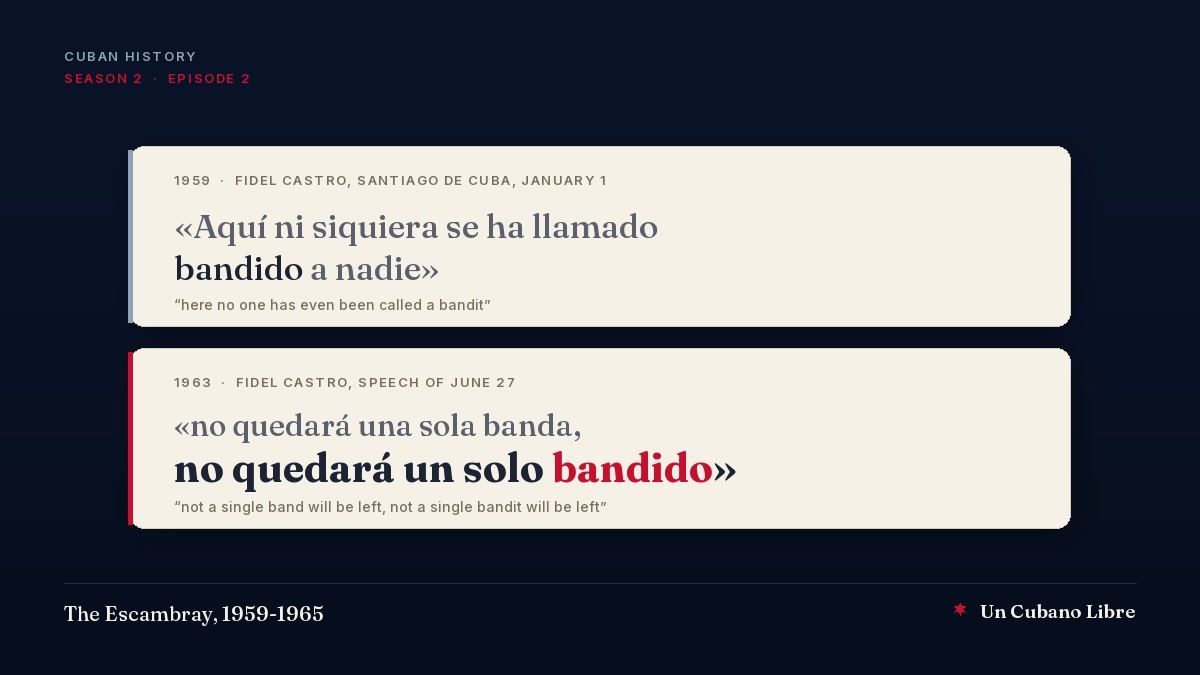
On January 1, 1959, in Santiago de Cuba, Fidel Castro spoke about the dictator who had just fled and about the difference between that government and his own. The official transcript (in Spanish) records the sentence:
“The tough guy, the arrogant man who never gave a speech without calling everyone else cowards, and wretches, and bandits! Here no one has even been called a bandit; here neither hatred, nor arrogance, nor contempt reigns or is breathed, as in those speeches of the dictatorship.”
Today, in Trinidad, there is a Cuban state museum called the National Museum of the Fight Against Bandits, opened in 1984. EcuRed, the state’s encyclopedia, has an entry titled “Fight against bandits” that begins: “it is a historical event that took place in Cuba and lasted from 1959 to 1965” (in Spanish). There is a Day of the Fighter Against Bandits, on October 18. And there is an acronym, LCB, which was the name of a military section: Lucha Contra Bandidos.
Between that sentence and this museum there was a war in the mountains of central Cuba. Raúl Castro himself said so, on April 11, 2015, in front of the presidents of the Americas gathered in Panama: “Six years of war against armed groups that on two occasions spread across the whole country. […] That process cost us thousands of lives” (in Spanish). Six years of war, says the head of the army that won it. In Cuba, that war is not called a war. It is called the “fight against bandits.”
This episode is about that war, but above all it is about the word. Because the word was not there at the beginning. It came later, and it came from a very specific place: the military org chart.
What it was
Little is known about 1959. The Escambray only became a problem in mid-1960, when men who had fought against Batista, and peasants who had supported the guerrillas against him, rose up. The US Embassy in Havana wrote it down on December 6, 1960, in a dispatch to the State Department, now declassified. Of the previous year it says only that “reportedly some ex-Batista elements took refuge in the mountains shortly after the victory of Castro”; of 1960 it says the mountains “did not gain prominence as a center of opposition until the middle of this year when revolutionary elements defected and went into the hills.” The groups, it says, “appear to have done so independently,” and what exists is “a collection of bands operating on their own with no central coordination, no adequate system of supply and no satisfactory means of communication.”
Two months earlier, on October 20, 1960, the director of the CIA had told the National Security Council the same thing, with numbers: “There are about 1000 guerrillas in the Escambray Mountains. These are poorly armed and have inadequate provisions, but their worst problem is their lack of unity and of effective popular leaders.” Guerrillas, the minutes say.
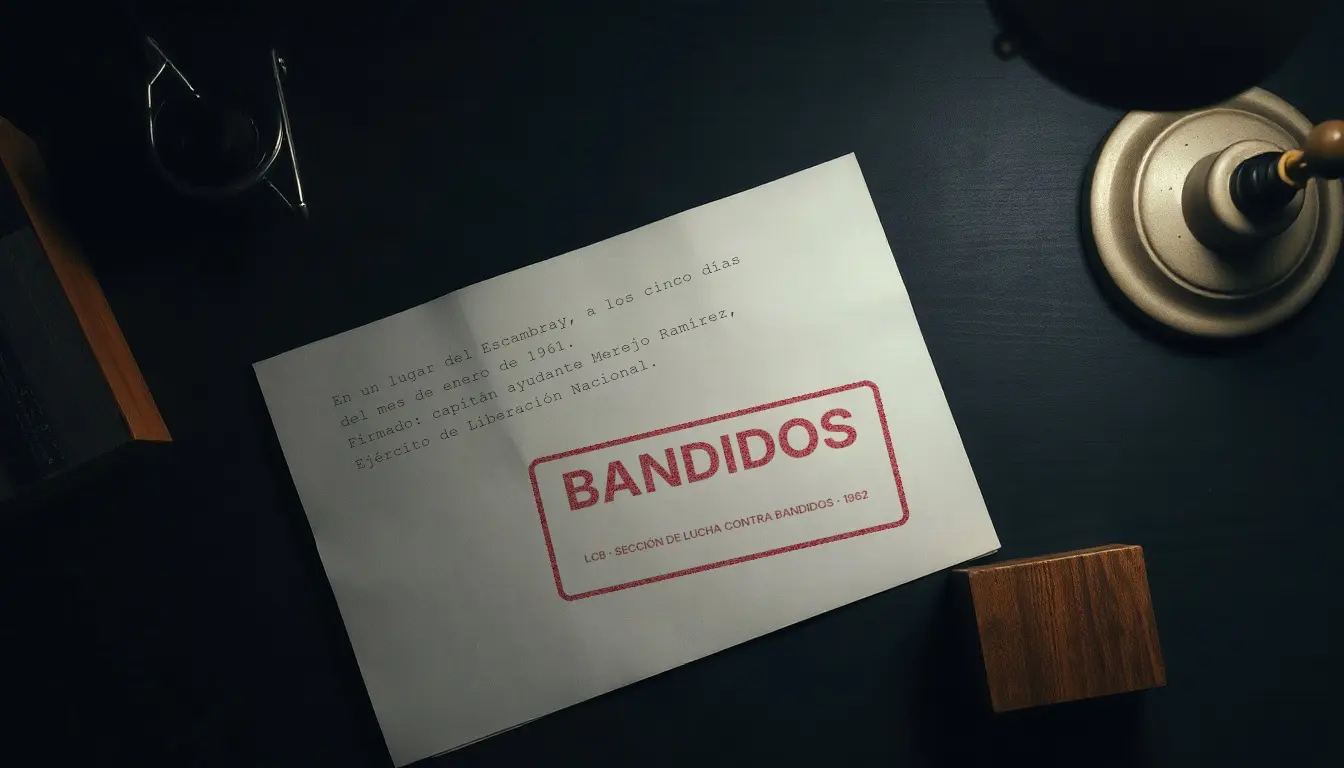
They called themselves something else, and we know it from Castro himself. On January 23, 1961, he read out in public, as evidence in the murder of the teacher Conrado Benítez, a document signed by the rebels (in Spanish) that ended: “signed in a place in the Escambray, on the fifth day of January 1961. Signed: adjutant captain Merejo Ramírez, National Liberation Army.” Ejército de Liberación Nacional. That was their word.
The historian Jonathan C. Brown, of the University of Texas, worked with the papers of the anti-bandit command itself and with the CIA’s files for a 2017 study that can be read in full online. His count: 177 bands operated in the Escambray between September 1959 and July 1965, most of them for a short time; across the island, nearly 300. Some 2,000 men took up arms in the Escambray, with at least 6,000 collaborators. The rebellion, he writes, did not come out of exploitation on the plantations, but out of the accelerated transformation of social relations in the countryside: the agrarian reform first gave land to many peasants and then began to decide for them. And he concludes: “No, they were not mere brigands. These rebels were alzados,” the word Cuba first used for slaves who fled to the mountains and later for the men of Martí and Maceo.
The word that came later
Fidel Castro’s speeches from 1959 to 1966 are published by the government itself in its official transcript archive. The two researchers who prepared this episode went through them one by one looking for the word, and the result is the same.
In 1960 the rebels were something else in his mouth. On September 8 he speaks of a “little group of guerrillas” and “little groups of rebels” (in Spanish). When he says “bandits” that year, he is talking about the United States: “the bandits of the Yankee Pentagon,” on December 14.
On January 28, 1961, in Santa Clara, in the speech where he talks most about the Escambray, he does not call them bandits once. He calls them counterrevolutionary bands, henchmen, adventurers, and he gives them a nickname: “they did not go there to fight the soldiers of the tyranny, but to eat cows in the Sierra del Escambray” (in Spanish). That is where comevacas, “cow-eaters,” comes from; he repeats it in the same speech, and the transcript records the laughter.
The official word appears later, and it appears as the name of a military unit. On July 3, 1962, according to EcuRed, Commander Juan Almeida “made official the creation of the Fight Against Bandits Section (LCB).” First there was the section. Then the word became a category. On June 27, 1963, with the section up and running, Castro said in public: “the fight-against-bandits battalions of the Revolutionary Armed Forces emerged (APPLAUSE), and they have been gradually cleaning them out of our countryside […] and not a single band will be left, not a single bandit will be left” (in Spanish).
When it suits him, he goes back to the other word. On July 26, 1965, declaring the war over, he says imperialism learned that “counterrevolutionary guerrillas cannot prosper” (in Spanish). Guerrillas. And by 1966 “bandits” is liturgy: “to deny it is to deny the dead who fought against the bandits in the Escambray (APPLAUSE).”
Brown explains it this way: the leaders “dug up the word bandido, the term by which the Spaniards defamed the rebels of the independence war and Batista used to describe Castro’s guerrillas.” An alzado is someone who rises up for something. A bandit is a criminal. The difference is not in what they did, but in what one is allowed to think about what they did.
The law, however, never said “bandits.” Law 988 of 1961, which brought the death penalty, speaks of those who “organize or form part of an armed group” (in Spanish). The word lived in the speeches, in the name of the troops and in the press. And it still lives: the state’s encyclopedia today describes the rebels as “despotic former overseers of the area, or other people of equally low class sent by the United States” (in Spanish), and Granma wrote in 2017 that “the term ‘bandits’ was the name the people themselves gave them” (in Spanish). The government’s own transcripts tell another story: the army gave them the name, in 1962, and the people heard it afterward.
The cleanup and the 48-hour law
To put an end to it, the government carried out what in Cuba is known as the Cleanup of the Escambray, and in the military papers as Operation Cage. The website of the Ministry of the Revolutionary Armed Forces told it with pride: “Eighty battalions of the National Revolutionary Militias set out for the Escambray, some 60,000 workers and peasants from all over the country” (in Spanish). The other official figures do not match that one, or each other: the 1999 lawsuit (in Spanish) speaks of “40,000 workers, laborers and students from the capital” plus local forces; Castro himself said “50,000 men” twice, in 1963 and in 1965 (both in Spanish); the newspaper Escambray gives “more than 70,000 men” (in Spanish), and EcuRed goes up to “more than 100,000 troops” (in Spanish) if the six years are counted together. Against a few hundred rebels.
Castro explained the method in Santa Clara, in January 1961: “they are encircled in a wide ring, that is, a cordon has been laid around them where they will have to collide if they try to escape. But not only that: once the cordons are set, battalions of specially trained militiamen advance on them inside the rings” (in Spanish). And he gave the objective: “no one will move from the Escambray while a single counterrevolutionary remains.”
The first leaders had already been shot. On the night of October 12 to 13, 1960, at the La Campana militia camp in Manicaragua, five men tried in the same case were executed: Plinio Prieto, Sinesio Walsh, José Palomino, Ángel Rodríguez del Sol and Porfirio Ramírez, president of the University Student Federation of Las Villas and formerly a captain in the Rebel Army. The foreign press published it the next day: there is a wire-service report in a Montevideo newspaper dated October 14 (in Spanish). Today’s official Cuban chronologies record the capture and leave out the execution: EcuRed opens the fight against bandits with the skirmish of September 7, 1960 in which “Sinesio Walsh was captured,” and Granma repeated the phrase in 2025 (both in Spanish); the word “shot” appears in neither.
On November 28, 1961, closing a labor congress, Castro said of those captured in the Cleanup: “in a few weeks close to 500 counterrevolutionaries were captured. And yet, not a single one has been brought to trial, not a single one has been shot” (in Spanish). He was talking about the men captured in that particular operation. But when he said it, Cuba Archive, the project that documents case by case the politically motivated deaths in Cuba, has on record, with full names and dates, 32 Escambray rebels executed before that night, 24 of them in 1961. It cannot be claimed that they were among the five hundred. The sentence can be set next to the list.
And the sentence was the preamble to something else. In that same speech he announced that the next day he would propose the law to the Council of Ministers: “every individual captured in arms, that is, risen against the Revolution, regardless of whether he is a leader or a rank-and-file soldier, apply to him, with no other alternative, inexorably, capital punishment! […] so that within no more than 48 hours the sentences are carried out” (in Spanish). The transcript records applause and shouts of “To the wall!” He added: “And against counterrevolutionary terror, apply, to the extent necessary, revolutionary terror!” And for the peasants who fed them: “let them know they lose the little farm!”
Law 988 appeared in the Official Gazette of November 30, 1961. Its text was reproduced by the International Commission of Jurists in a 1962 report (in Spanish): the death penalty, “as long as, on the part of North American imperialism, the threat of aggression from abroad or the promotion of counterrevolutionary activities in the country persists,” for “those who, in order to commit any of the crimes against the powers of the State, organize or form part of an armed group.” Form part. No one had to have fired a shot. And Article 2 put the little farm in writing: confiscation of property from “owners who provide supplies, shelter or in any way collaborate with or cover for saboteurs, terrorists, murderers, armed groups or counterrevolutionary elements of any kind.”
The official press tells it differently today. The newspaper Escambray wrote in 2019 that Law 988 “established the application of the death penalty by firing squad for those responsible for crimes” (in Spanish). The speech that announced it said “leader or rank-and-file soldier.”
Manacas de Iznaga, one in the morning
In 1970 the Inter-American Commission on Human Rights published a report on political prisoners in Cuba. Among the complaints it transcribes is one about “twenty-one political prisoners of the so-called ‘Escambray Case’” (in Spanish) who had spent three years on Isla de Pinos, were taken one morning to Santa Clara for a trial and all came out sentenced to death: “the execution was by machine gun as they climbed down from a truck.”
That complaint gets three things wrong, and we know it because a survivor told the story. The Commission itself refined the complaint in its 1976 report (in Spanish): it now says “more than two years” in prison, places the site at “Torre de Iznaga” and gives twelve names, though it still says there was no trial. Aldo Chaviano Rodríguez, who spent twenty-six years in prison, published his testimony in 2013: “They had transferred 23 political prisoners from the Isla de Pinos prison, where we had been for close to two years. It was July 12, 1963” (in Spanish). The trial took place beside the old Iznaga tower, at Manacas de Iznaga, between Sancti Spíritus and Trinidad: “In the end, the sentence: 19 condemned to death by firing squad and two to 30 years in prison. The appeal lasted a few minutes.” And the end: “At approximately 1:00 a.m. on July 13, 1963, they took down those condemned to death, lit them with the headlights of the military transport trucks, called Nando Lima, Zacarías García and Roberto Montalvo, and machine-gunned them.”
Cuba Archive has at least twelve records of men executed on that date in the Escambray, nine of them at the Puerta del Médico farm; among them are Zacarías García López and Roberto Montalvo Cabrera, two of the three men the witness names. So: it was not in Santa Clara but at Manacas de Iznaga; they had not been imprisoned for three years but close to two; and they did not all die, because the man telling it came out alive. What the complaint got right is the essential part: they were taken off a truck and machine-gunned before dawn.
“CIA mercenaries,” according to the CIA
The official version says the rebels were bands organized, armed and paid by the CIA. In 1999, in the Cuban government’s lawsuit against the United States (in Spanish), they are called “3,995 mercenaries.” The declassified US papers make it possible to measure that phrase.
First, what supports the official story: the plan to help them existed. The report of the CIA’s inspector general on the Cuba operation, written in 1961 and then classified Top Secret, records that the program Eisenhower approved on March 17, 1960 included a small paramilitary force “to be introduced into Cuba to organize, train and lead resistance groups.” The operation’s paramilitary chief, Colonel Jack Hawkins, states in an internal history dated May 5, 1961, declassified in 2024, that arms brought in by sea were used for “partially equipping a 400 man guerrilla force” in the Escambray. And from the fall of 1960 there were planes dropping cargo by parachute.
Second, what happened to those planes, as told by the CIA itself in the same report:
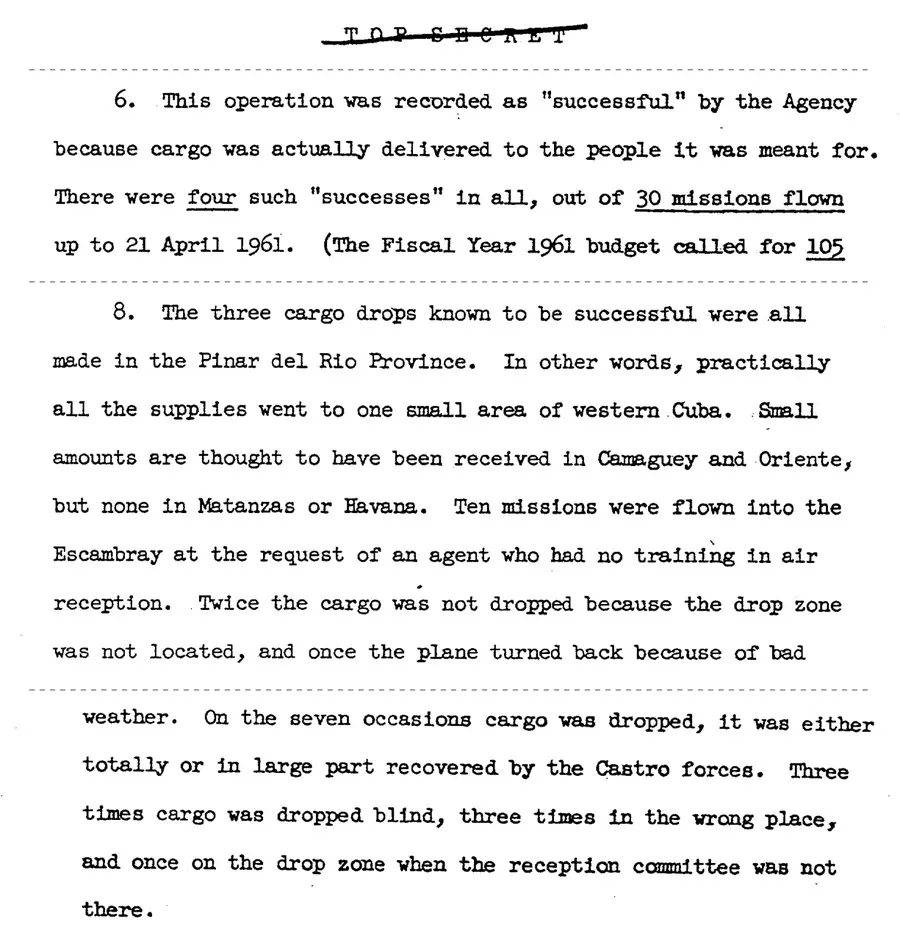
Ten missions were flown into the Escambray. In three, nothing was dropped; in the other seven, the cargo “was either totally or in large part recovered by the Castro forces.” The only drops that reached their destination were in Pinar del Río, at the other end of the island. Hawkins wrote in that same document: “Of 27 missions attempted only 4 achieved desired results,” and the CIA “never succeeded in establishing a direct radio link with any of these forces.” He estimates that “600 to 1,000 ill-equipped guerrilla troops” operated in the Escambray.
Cuba’s 1999 lawsuit (in Spanish) cites that same inspector general’s report, for the twelve million pounds of propaganda leaflets, and skips the paragraph where the CIA says the militias picked up the cargo.
And after the Bay of Pigs, even less. In January 1964, a joint paper by the CIA, the State Department and the Pentagon summed up that “insurgency and sabotage inside Cuba are not part of a coordinated program; they are acts of individual or small group defiance.” And it added a sentence that applies to this whole episode: “almost every act of defiance against his regime has been credited to the Agency.”
The American weapons the regime put on display were real. They were, in good part, the ones from the parachutes that fell into the militias’ hands: the proof of foreign help was precisely the help that never arrived. Brown concludes that “CIA responsibility for rebellion in the countryside seems exaggerated,” because the rebels were worse armed than the militias and rose up for reasons of their own. Other historians give Washington more weight. What no document says, for or against, is that those peasants were paid a salary.
The families
This is the least known part, and the striking thing is that you do not need the exile to document it. It is in the regime’s press.
Granma published in 2017 a report on “that other war” (in Spanish), with a veteran of that war, adviser to the television series LCB: La otra guerra, as its source. It tells of “Peasants Plan 1,” in 1961, and “Peasants Plan 2,” in 1963, which “consisted of cutting off the logistical supply base” of the rebels. The men were sent to build a new town in Pinar del Río, Sandino, at the other end of the island; “the women, children and elderly were housed in a special zone in Miramar, Havana,” in the houses left behind by those who had left the country. And it gives a figure the exile never had: in the Escambray “8,000 caballerías of land were confiscated.” That is more than 100,000 hectares, or about 265,000 acres.
The official website Cuba Sí published in 2022 an interview with the historian of the municipality of Sandino (in Spanish): “By 1963 there were already, to the south, where the city was later built, three camps in which, in the situation of detainees and looked after by the Ministry of the Interior, were the heads of household and some older sons of each family considered guilty.” Guilty without trial, and guilty as a family. The same text calls it a “misunderstood, but necessary revolutionary measure.” EcuRed lists among the reasons for founding Sandino the “rehabilitation plan of the Ministry of the Interior with families who collaborated with the rebels.”
In January 2023 the magazine Bohemia interviewed Lucy Villegas Oria, who ran the women’s plan: “It was the Commander’s idea […] He decided to bring to Havana many of those women with their children, whose husbands were in prison for those criminal acts. The objective was to reeducate them politically and culturally and then to place them in different towns” (in Spanish). Reeducate them, and then place them. She tells it with pride, in the official press, in 2023.
There was a third wave, and the date matters. In December 1971, six years after Castro declared the war over, men were again taken out of the Escambray, many of them former prisoners who had served their sentences and gone back home. They were taken by train to Pinar del Río to build towns such as Briones Montoto and Ramón López Peña; the families followed, over the years. EcuRed says it in its own words (in Spanish): “By decision of the Central Committee of the Communist Party […] the transfer of personnel from Las Villas, Escambray Region, to the province of Pinar del Río was ordered, due to the counterrevolutionary participation taking place in that area.” Without trial, without sentence and without any law authorizing it, as far as I have been able to find.
From that wave there are names, and they were given by a magazine made inside Cuba. In 2009, Convivencia, of Pinar del Río, published the testimonies of two residents of López Peña. Jesús Monte: “One day they came and summoned me to clear up a matter about the legality of my land […] At shotgun point they took us to the railroad; they had given me a can of meat and some crackers and told me to save it, that it was for the trip. We could not even talk; we came on the train like cattle” (in Spanish). Raúl López, who was a child then: “I remember my father left one day for a meeting he had been summoned to, but he did not come back. My mother was going out of her mind.” These are memories told almost forty years later, and they are worth what a testimony is worth; what they describe matches what the official press itself describes as a plan.
How many people were taken is not known. The figure that circulates most, twenty-five thousand relocated in 1963, comes from two 1965 clippings of the exile press, El Diario de las Américas in April and Cuban Labor in August, filed in the collection of a Washington lobbying group now held by the Hoover Institution. It is not an archive: it is a press estimate that academia has been passing down, and the historians who repeat it write it in the conditional. On the Cuban side there is no overall figure: neither Granma, nor Cuba Sí, nor EcuRed give a number of families; the most there is, is one loose figure from EcuRed, 300 men (in Spanish) sent to build López Peña in December 1971. The honest way to say it is this: we do not know how many there were. We know how it was done, and we know it from them.
The exile calls those towns pueblos cautivos, captive towns. In Pinar del Río they were called pueblos de presos, prisoners’ towns, as the historian Joanna Swanger records. In 2014 Granma published a report for Sandino’s fiftieth anniversary (in Spanish): it names residents, tells how the houses were built and celebrates the date. In the whole text the word Escambray does not appear.
How many
The official figures have changed over the years, and none of them comes from a register anyone can consult.
| Figure | Who gives it, and what is behind it |
|---|---|
| 295 of its own dead; 2,005 rebels “captured in part, and in part annihilated” | Fidel Castro, July 26, 1965, declaring the war over. Las Villas only. |
| “About 1000 guerrillas” in the Escambray | The director of the CIA to the National Security Council, October 20, 1960. An intelligence estimate. |
| “600 to 1,000 ill-equipped guerrilla troops” | Colonel Jack Hawkins, the CIA’s paramilitary chief, May 5, 1961. |
| “40,000” from the capital plus local forces, 50,000, “some 60,000,” “more than 70,000” or “more than 100,000 troops” over six years | Official Cuban sources, depending on the document: the 1999 lawsuit, Castro in 1963 and 1965, the Ministry of the Armed Forces, the newspaper Escambray and EcuRed. There is no single figure. |
| 299 bands; 3,995 “mercenaries”; 549 dead | Cuban government’s lawsuit against the United States, 1999, a partisan pleading; the same figures on the ministry’s website, where they are “outlaws.” |
| 177 bands in the Escambray, nearly 300 in Cuba; 2,000 fighters; 6,000 collaborators | Jonathan C. Brown, 2017, from the papers of the anti-bandit command itself. |
| “Thousands of lives” | Raúl Castro, April 11, 2015, in Panama. No breakdown. |
| 723 deaths with a name, 715 of them between 1959 and 1971: 563 attributed to the regime, 157 to the rebels; 229 executed, 48 confirmed with primary sources | Cuba Archive, database consulted on September 17, 2026. A documented minimum. |
| “Almost 3,000” dead on the rebel side; that they were “fundamentally” executed is a secondhand quote | Norberto Fuentes, the regime’s reporter in that war and later an exile. A single source, no document. |
On July 26, 1965, Castro gave his numbers for Las Villas: “295 revolutionary fighters lost their lives […] and 2,005 counterrevolutionaries were captured in part, and in part annihilated” (in Spanish). The 295 include, in his own words, those who died “in accidents caused by the service itself.” In 1999, the lawsuit against the United States already said 549 dead and “299 bands, totaling 3,995 mercenaries.” In 2015, Raúl Castro said “thousands of lives.” Of those executed there is no official figure, and there never has been.
What there are is names. Cuba Archive had on record, the day I consulted its database, 723 deaths linked to the Escambray uprising, 715 of them dated between 1959 and 1971: 563 attributed to the regime and 157 to the rebels. Of the former, 229 are executions with a name and a date; only 48 carry the status “confirmed with primary sources.” It is a documented minimum, not a total.
What has to be told even though I do not like it
In this episode the uncomfortable part weighs more than in the previous ones, because both sides killed and because part of what the exile repeats does not hold up. All of it goes in.
The rebels killed. Cuba Archive, which is an exile project, attributes 157 deaths to them in the Escambray: 140 militiamen and soldiers in combat, 16 people killed outside it and one civilian casualty of violence. Among the latter are Conrado Benítez, an 18-year-old volunteer teacher, hanged on January 5, 1961, and Manuel Ascunce Domenech, a 16-year-old literacy brigade member, hanged on November 26, 1961 together with Pedro Lantigua, the peasant in whose house he gave the lessons. Castro announced Ascunce’s death in the same speech as the death penalty: “a young literacy brigade member, 16 years of age, was murdered by counterrevolutionary elements” (in Spanish). It is not only the regime’s word. Enrique Encinosa, the exile’s reference historian, writes in Cuba en guerra (in Spanish) that the deaths of Ascunce and Lantigua “were counterproductive and lacked justification,” and that Ascunce “was a minor, a literacy teacher, and was unarmed.” What is only official version is the detail of Benítez’s torture and mutilation: in Castro’s speech of January 1961 he appears hanged, nothing more; the torture enters seventeen years later, in “La confesión de un bandido,” published in June 1978 by Moncada, the Ministry of the Interior’s magazine; the official historian who tells the case today (in Spanish) cites it himself. And the official figures for people killed by the rebels shift with the publication: Granma says 196, EcuRed says 214, Cubadebate says “more than 200” (all in Spanish) and Jonathan Brown, summarizing the command’s own statistics, says 300. The first three come from the same source, Bandidismo: derrota de la CIA en Cuba, a 2008 book from the Ministry of the Interior’s publishing house; one of its two authors, a researcher at State Security’s historical research center, also signs the Granma piece. The difference between 196 and 214 is that EcuRed adds the eighteen rebels who killed each other.
The CIA plan existed, and that is said above. The United States wanted to arm those men, tried, and failed. That does not make them mercenaries, but it does not allow the rebellion to be told as if Washington had not been there.
And there are things that circulate on our side that do not hold up. The Inter-American Commission on Human Rights did not document the transfers of families: they do not appear in its seven reports on Cuba between 1962 and 1983; what it transcribes about the Escambray are complaints, and they have to be cited as such. Where the “twenty-five thousand relocated” comes from, I said above. The “3,478 militiamen killed in the Escambray” given by two serious historians do not come from any archive: they come from a 1968 book by Norberto Fuentes, and from there they passed into academia. The same pair of numbers, 3,478 dead and 2,099 disabled, is what the Cuban government claims in the 1999 lawsuit (in Spanish) for all US aggressions over forty years, the Bay of Pigs and terrorism included. Whichever way they were copied, they are not the militiamen killed in this war; Wikipedia, for its part, says 3,500. The “almost three thousand” dead on the rebel side given by the same Fuentes are a single source without a document, and that they were “fundamentally” executed appears only in a secondhand quote. The “five hundred shot at La Campana” comes from a single witness before the IACHR, and the witness says sentenced, not shot. The complaint of 345 peasants executed in fifteen days of June 1963 does not hold either: in Cuba Archive’s database there are eight in that fortnight. All of that gets used a lot, and badly. A figure dropped in time is worth more than a doubtful figure published.
The word, today
The word is still in place. In September 2025 Granma was writing about “the notorious bandits Luis Vargas and José Rebozo” (in Spanish) and about “the atrocities committed by the outlaws.”
For today’s opponents there is another word, and the state itself took care of linking the two. On July 11, 2021, with protests in the streets, Miguel Díaz-Canel said on television that they would not allow “any counterrevolutionary, mercenary sold to the Government of the United States, sold to the empire” (in Spanish) to provoke destabilization, and closed with: “The order to fight has been given! Revolutionaries, to the streets!” On November 23, Cubadebate published a text titled “Mercenaries,” (in Spanish) signed by René González Barrios, then president of the Cuban Institute of History: “To the mercenaries of yesterday, and of always, is added today the despicable criminal scum who carried out criminal acts, vandalism and violence last Sunday, July 11.” The mercenaries of yesterday and the scum of today, in the same sentence. “Scum” was the word of the Mariel.
The 2022 Penal Code has a crime called “mercenarism,” Article 135, with penalties of ten to thirty years, life imprisonment or death; the text defines it for anyone who joins foreign military formations. Against opponents who receive money from abroad another article is used, 143, with four to ten years. But the word said on television is not the one in the code: it is the one in the speech, as in 1963.
What remained
A museum remained, in Trinidad. A commemoration day remained. The word remained in the state’s encyclopedia, in Granma’s anniversaries and in a television series, LCB: La otra guerra. No list of the dead remained, no official figure of those executed, no open archive, just as with the UMAP. And in Pinar del Río there remained some towns whose official history does not mention where their first residents came from.
Raúl Castro said in Panama that it was six years of war and that it cost thousands of lives. It is the most honest description of those years to have come out of the Cuban leadership, and he gave it to foreigners. Inside the island, the dead on one side have a fighters’ day. The dead on the other side have a word.
Jesús Monte arrived in Pinar del Río on a train, like cattle, and he told it. On some, the state put a word so that they would not have to be explained. On others it put none, which is another form of the same thing.
Next episode. "That their father is a deserter or a traitor": Huber Matos, Camilo and October 1959: Huber Matos’s resignation letter, the word “traitor” that arrived within a week, the trial and the twenty years, and what is documented and what is not about Camilo’s disappearance.