“Cuban History” series · Season 1, episode 4
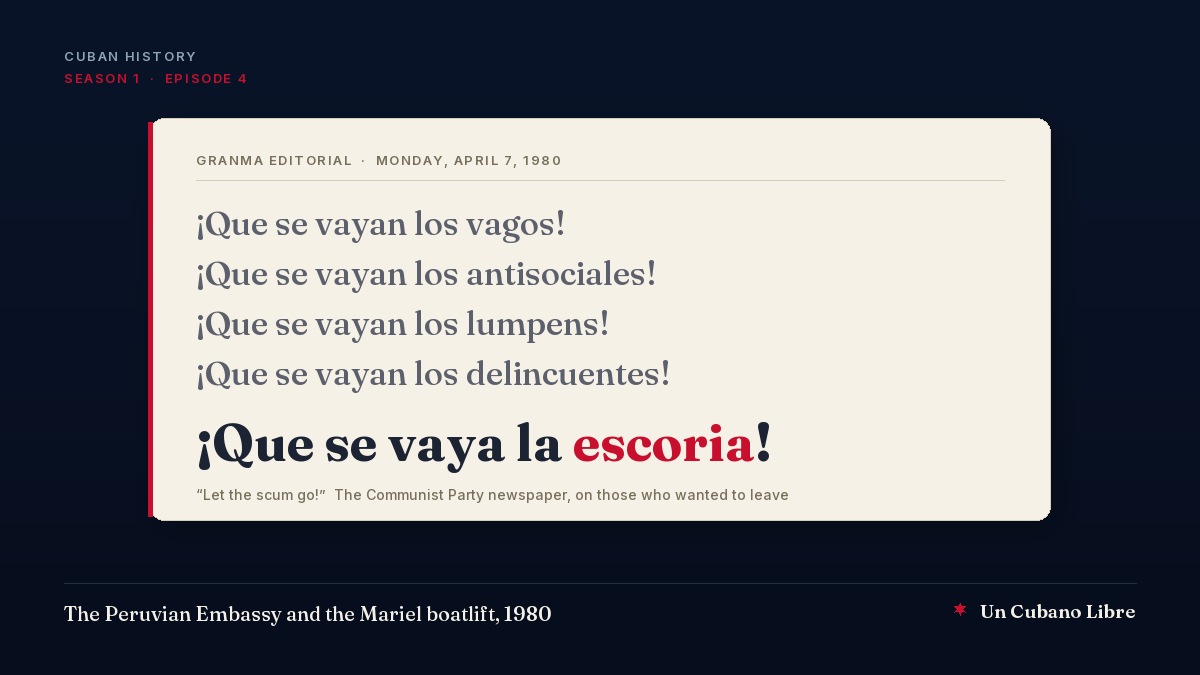
On April 7, 1980, Granma ran a front-page editorial about what was happening at the Peruvian Embassy. It ended like this:
“Let the loafers go! Let the antisocials go! Let the lumpen go! Let the criminals go! Let the scum go!”
That was not shouted by some hot-headed neighbor. It was printed by the newspaper of the Communist Party of Cuba. A little over three weeks later, on May 1, Fidel Castro told the crowd in Revolution Square, in the translation the US government made from the live broadcast, that “he who has no revolutionary genes, he who has no revolutionary blood […] We do not want them; we do not need them.” The official transcript of that speech records what the crowd was chanting: “Let them go!”, “Down with the scum!”, “Pim, pom, fuera, abajo la gusanera!”, out with them, down with the worms.
Almost everyone remembers the number from Mariel: some one hundred and twenty five thousand Cubans crossed the Florida Straits between April and September 1980. This episode is not about the number. It is about what happened to those people before they could get on a boat: how the Cuban state turned neighbors into a mob, what word it gave them to do it, and why it did not end in 1980.
It has a name: act of repudiation. And it has a method.
The open gate
On April 1, 1980, a 31-year-old unemployed driver, Héctor Sanyustiz, and five friends and relatives crashed a bus through the gates of the Peruvian Embassy in Miramar. Mirta Ojito, who left Cuba through Mariel, tells it in a piece she published in The New York Times Magazine in 2000. The soldiers guarding the embassy opened fire. Sanyustiz and one of his companions were wounded. And a Cuban guard died, Pedro Ortiz Cabrera, 27.
How he died is the first thing that is not clear. I come back to it below, with every version, because the regime built everything that followed on that death.
On Friday, April 4, Good Friday, the government withdrew its guards from the embassy. The statement by the Revolutionary Government that Granma published that day, in the English version quoted by Alex Larzelere, the US Coast Guard captain who wrote the history of the boatlift, said: “From now on, the embassy’s officials will be solely responsible for what occurs in their embassy. We cannot give protection to embassies that do not cooperate with that protection.”
It was no oversight. On May 1, in the square, Castro said so himself. It is in the official Spanish transcript of his speech, and the US government’s monitoring service translated it at the time: “We simply removed the guards from the embassy. And we knew what was going to happen.”
What happened next is told by Larzelere in his book, which the Coast Guard Historian’s Office publishes on its website today: during the 38 hours the guards were absent, 10,865 “men, women, and children had crowded onto the Embassy grounds, an area slightly larger than a football field.” The book gives two different figures on two pages, 10,856 and 10,865, and the White House spoke of 10,800. The figures wobble by a few dozen. What does not wobble is that there were more than ten thousand.
Granma wrote something else. That after 48 hours “there were more than three thousand,” and that they were “criminals, lumpen, antisocials, loafers and parasites for the most part.” And it added a sentence that captures those years better than any analysis: “Although in our country homosexuals are neither persecuted nor harassed, among those who took shelter in the courtyard of the Peruvian embassy there were not a few of them.”
Inside, conditions were terrible. People ate the green mangoes off the trees, then the fruit of the papaya trees, and then the leaves. In the hot and rainy weather, Larzelere writes, “the stench of urine and excrement pervaded the compound.” On Easter Day a baby boy was born inside. He was named “Peru.”
Outside, by the fence, government supporters gathered. According to Larzelere, they chanted “Scum! Scum! Up with the workers! Down with the criminals, let them go to Peru!” and threw sticks and stones at the refugees, “who were gathered so tightly that they could not avoid being hit.” Nine refugees were injured.
The government offered safe-conduct passes so people could go home and wait to leave. With all of that going on inside, only 1,730 accepted them the first day. They were afraid they would not be allowed back in. And they were afraid of the government supporters waiting outside the fence, whom Larzelere calls the pro-Castro “bully boys.”
In mid-April an airlift to Costa Rica began. In two days, 678 people left. On the third day, Costa Rica announced that all flights were suspended at the request of the Cubans. The Inter-American Commission on Human Rights puts it plainly: the Cuban government interrupted the evacuation, “having taken exception to the publicity with which the airplanes that arrived in Costa Rica were received.”
The word
A mob needs a word that gives it permission. In the spring of 1980 that word was escoria, scum, and the street did not invent it. It came from above.
It was already in the April 7 editorial. On May 1, Castro took it to the square: “That, that is this people, not the lumpen they want to present as its image, not the scum that took shelter in the Peruvian embassy!” In that same speech he spoke of “this hatred that has been expressed against the loafer, against the parasite, against the lumpen, against the antisocial,” and presented it as a force to be put to use, not as a problem. And he made clear who knew who was who on every block. Speaking of those who had slipped into the embassy, he said: “You know it, the Committees know that well, better than anyone.”
There is a line of his that circulates widely: “no los queremos, no los necesitamos,” we do not want them, we do not need them. He said it, and you can hear it in a video clip of that speech. There is also a record from the time: the US government’s monitoring service, which translated the live broadcast on Cuban radio, wrote “We do not want them; we do not need them” at that same point in the speech. But the official transcript kept by the Council of State says something else: “no lo necesitamos en nuestro país,” we do not need him in our country. The “we do not want them” is not there. In an article about the regime’s words, that counts too: the version the state itself keeps of that speech does not say what was heard in the square. What does need correcting is another line that circulates: the famous “let them go!” was chanted by the crowd; in the official version, Castro says “que se marche,” let him leave.
In September, at the anniversary of the CDRs, the neighborhood Committees for the Defense of the Revolution, Castro was still joking with the word: “This year we have done the biggest weeding of the whole revolutionary period, I mean, not the weeding out of the scum, which was gigantic, I mean the weeding of the sugarcane.” The transcript notes: laughter.
The Inter-American Commission put it in writing in 1983, in its seventh report on Cuba: “In official language and in public demonstrations, Cubans who joined the boat exodus were vilified as the dregs of society and unpatriotic.” The Spanish version of the same report uses the regime’s own word: escoria.
If you read the first episode of this series, you recognize the mechanism. There the word was accident, and it made a crime not look like a crime. Here the word is scum, and it makes a neighbor stop looking like a neighbor.
The method
An act of repudiation was not spontaneous. It had a call to action, it had organization, and it had the addresses.
The IACHR itself describes it in that 1983 report: “In 1980, the Committees for the Defense of the Revolution were convened to organize ‘assemblies of repudiation’, at which members could express their reproof of neighbors who wished to leave the country. On some occasions these meetings erupted in acts of violence against possible emigrants.”
The exit paperwork handed people over. To leave, you had to ask for your “baja,” your formal discharge, at your workplace or school, and the unemployed asked for it at the CDR. As Roberto Jesús Quiñones Haces wrote in Cubanet, that was “the indispensable requirement to obtain the exit permit, which allowed the mobs to intercept the applicants in order to attack them.”
Mirta Ojito describes what it was like: “The victims were often pelted with rocks, tomatoes and eggs. Windows were shattered. Doors were knocked down.” And she tells a scene that, for me, explains the whole method. The day the officers came to her house to take the family out of the country, the lead officer turned to a neighbor and asked her: “Why don’t you call the other neighbors and arrange something for these people?” That something was an act of repudiation. An official asked for it. The neighborhood had to supply it.
It is the public face of something I wrote about in another article: a system that has spent sixty years rewarding informers. Informing is done quietly. An act of repudiation is informing out loud, in front of the house.
Not even artists were left out, on either side. In 1980 the trova singer Mike Porcel, the author of “Ay, del amor,” decided to leave through Mariel. His own colleagues in the Nueva Trova movement staged an act of repudiation in front of his parents’ house. Porcel told it this way forty years later on Miami television, as Diario de Cuba reported: “They arrived, they set up the act of repudiation with the CDR from my parents’ house, with buses and everything, perfectly organized.”
In 2020, Silvio Rodríguez acknowledged in the comments section of his blog, Segunda Cita, that he was there: “I walked toward the porch of the house and there I whispered a word,” 14ymedio reported. Tony Pinelli, then a member of the national leadership of the Nueva Trova, tells it differently: that Silvio went up to the microphone, “there was a microphone,” and said to him “Traitor.” Eduardo Ramos, another musician from that group, told it years later in an interview with the filmmaker Juan Vilar: shouting “traitor” at Porcel was, he said, “the only thing I have regretted in my life.”
I do not know which of the two versions about Silvio is true, and I do not need to. What matters in this case is not which word each person said. It is Porcel’s sentence: with the CDR, with buses, perfectly organized.
And on April 19, the state organized the biggest act of repudiation of all: the March of the Fighting People, which paraded along Fifth Avenue past the same embassy. According to Granma, “more than a million Cubans” for 13 hours and 17 minutes. There is no independent count of that figure. It is the regime’s own, and it was written before the march: on April 15, Granma was already announcing on its front page that “a million Cubans” would parade in front of the embassy on the 19th.
On May 2, the method reached the door of the United States. Nearly 800 former political prisoners and their families had gathered around the US Interests Section to process their departure. According to the official edition of US diplomatic documents, “a pro-government group of civilians arrived and began to assault the ex-prisoners; approximately 400 people took refuge in the Interests Section as the angry mob gathered outside.”
Two days later, on the night of May 4, a senior Cuban official, José Luis Padrón, spoke privately with the head of the Interests Section, Wayne Smith. Smith summed it up the next day in a cable to Washington: Padrón “alluded to widespread violence,” which Smith himself called “an amazingly frank admission,” and, again in Smith’s summary, passions were running high and some regrettable things were happening. In public, the line was different. On July 26, in Ciego de Ávila, Castro said that “the people had to be urged many times not to liquidate the lumpen; but not a hair on their heads was touched.” He admits it and denies it in the same sentence.
Were people killed in the acts of repudiation? Mirta Ojito writes that “some people were killed, dragged through the streets.” I have not been able to find a single case with a name, a date and a source that can be checked, so I will not write a number.
The Mariel boatlift
On April 21 the first two boats, the Dos Hermanos and the Blanche III, reached Key West with 48 Cubans. Over the next five months 124,776 people arrived in the United States, according to the Coast Guard history. The IACHR speaks of “approximately 125,000.” Cuba suspended departures from Mariel on September 25. According to State Department documents, “Castro would only guarantee that Mariel would remain closed until November 4,” which was Election Day in the United States, “after which he would review the situation.”
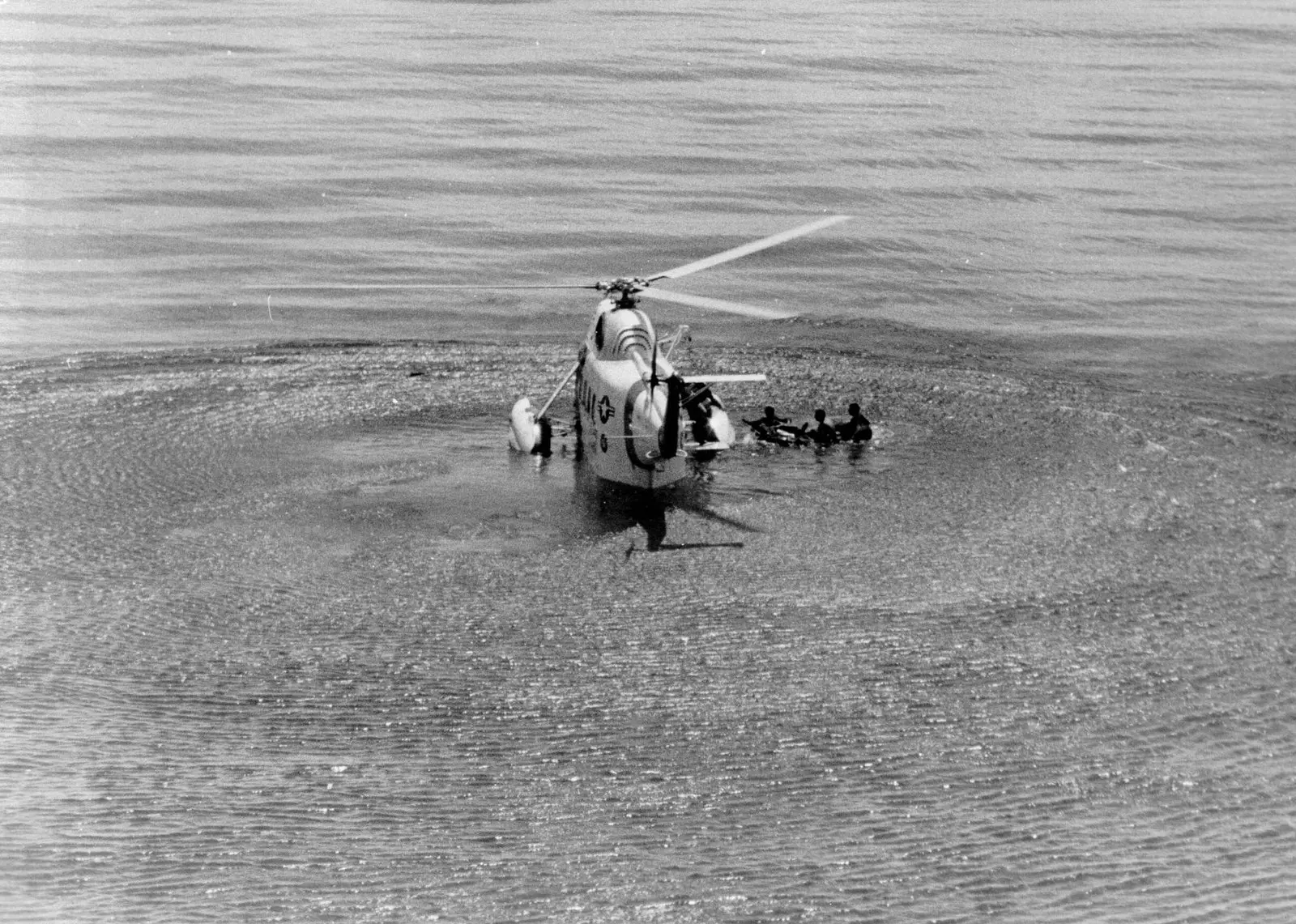
At sea, at least 27 people died. That is the sum of the cases documented by the Coast Guard, and it is a floor, not a total: boats that vanished without anyone recording them are in no table. The worst sinking was that of the Olo Yumi, a 35-foot pleasure craft with 52 people on board. It went down north of Mariel on May 17. Fourteen died; the Coast Guard rescued 38.
That boat ties the two halves of this story together. According to Larzelere, “Cuban guards had loaded OLO YUMI […] with refugees from the Peruvian Embassy,” and the boat “contained life jackets for only half the passengers.” In other words: fourteen of the people who had been in that courtyard died in the Straits.
On May 5, Jimmy Carter said the United States would “continue to provide an open heart and open arms to refugees seeking freedom from Communist domination.” Nine days later he changed course: he announced fines and prosecutions, said that “boats used to bring people unlawfully to this country will be seized,” and accused Castro of having “taken hardened criminals out of prison.”
What has to be told even though I do not like it
If I skip this, the article is worth nothing. There are two things.
The first: it is true that the regime put people taken from prisons and psychiatric hospitals on the boats. Carter denounced it, the US government’s internal papers document it, and the IACHR writes it in full: “The Cuban Government placed these people in the boats against the will, or at least contrary to the intention of the owners of the boats, but this was certainly not done against the will of the prisoners or any of the others considered to be ‘undesirable’.”
The second half of that sentence matters. Many prisoners were given a choice. A witness told the US Congress, as Larzelere records, that “Cuban prison authorities gave him a choice of signing a release and being sent to the United States, or being sentenced to an additional four years in prison.”
But look at the numbers. The Immigration and Naturalization Service reported that 1,761 refugees, 1.4 percent of the total arrivals, were classified as felons, “convicted of murder, rape, or burglary.” Another 23,927, or 19.1 percent, had been in prison, but that group included minor offenses and an estimated 2,000 political prisoners. And the US government task force that handled the new arrivals explained what a “record” meant in Cuba: “the overwhelming majority had been in jail for crimes which would not have resulted in prison sentences in the United States.” Its examples: “counterrevolutionary activity, refusal to work, refusal to join the communist party, refusal to join the army, traffic violations, loitering, gambling, drinking, fighting, and petty theft.”
In August 1980, Washington’s internal papers said: “We have already identified 1700 criminals and 1500 emotionally disturbed people, whom we would like to repatriate to Cuba,” and estimated there might be as many as 5,000 to 7,000 people they would like to exclude. In December 1984, Cuba agreed to take back 2,746 “excludables,” 2.2 percent of those who arrived. But be careful with that figure, which gets used a lot: according to the White House, the list covered people who “admitted to committing serious crimes in Cuba, have committed serious crimes in the United States, or suffer from severe mental disorders.” It is not a count of what Castro sent.
That is the whole uncomfortable truth. There were criminals, the regime sent them on purpose, and they were a small fraction. With that fraction, the regime labeled everyone.
The second: Pedro Ortiz Cabrera died. That is a fact, and he was a man of 27. How he died is not known. Larzelere writes that when the bus accelerated toward the gates, the Cuban guards opened fire, and that the guard was “mortally wounded by a ricocheting bullet,” without saying whose. Ojito writes that the soldiers fired. Fidel Castro himself, in September 1980, called it “the accident in which one of our fighters lost his life.”
And Granma has told it two ways. In the 1980 editorial it wrote that the soldier died “while carrying out his selfless duty,” without saying who fired. Forty years later, in a 2020 article, the same newspaper states it without hesitation: “They shoot and murder the guard.”
I do not know whose bullet it was. Nobody has proved it. What I do know is that three days later the regime withdrew the guards from the embassy, with that death in the background, and that the 1980 Granma editorial does not accuse anyone of killing him. The murder charge shows up, without evidence, in the Granma of 2020.
The method goes on
There are videos going around that put the Rapid Response Brigades on the streets in 1980. That is a mistake: according to Americas Watch, those “government-organized bands of civilian recruits” were “a new development in 1991.” What was not new was the method. That same year, in November, “scores of armed state security police and a mob of civilian recruits,” perhaps as many as two hundred people, surrounded the home of the poet María Elena Cruz Varela.
On March 15, 2008, the Ladies in White were marching through Havana with gladioli to demand freedom for 55 political prisoners. A crowd shouted at them “terrorists,” “prostitutes,” “murderers,” “mercenaries” and “bastards.”
In November 2009, in the Vedado district, an act of repudiation was staged against the journalist Reinaldo Escobar, 62, on a corner where the Union of Young Communists had set up an event. The crowd chanted “pin-pon fuera, abajo la gusanera,” out, down with the worms. It is the same chant the official transcript records in the square on May 1, 1980. Twenty-nine years later, the same lyrics.
In its report on 2010, the State Department described it this way: “Although the government characterized the mobs as spontaneous, participants frequently arrived in government-owned vehicles or were recruited by local CP leaders from nearby workplaces or schools.”
On July 11, 2021, with thousands of Cubans protesting in the streets, Miguel Díaz-Canel said: “The order of combat has been given, revolutionaries to the streets.” He did not say “act of repudiation.” He did not need to.
And in its 2022 annual report, the IACHR records the concern of the UN Committee against Torture over “‘acts of repudiation’ in front of the homes, workplaces, and places of study of political opponents.”
Forty-two years later, the same name for the same thing.
What is left
In the first episode of this series the word was accident. In the third, what was missing was a list. In this one, what is left over is a word. Scum made it possible for a people to throw eggs at a neighbor without feeling it was being done to a neighbor, and for a hundred and twenty five thousand people to carry for years a name the state gave them.
I end with Mirta Ojito’s neighbor, because she explains why the method takes so much effort. When the officer asked her to arrange something against that family, that woman, who had fought with Castro’s guerrillas in the Sierra Maestra, held the rank of lieutenant and was married to an army colonel, looked him straight in the eye and said: “Nobody touches this family. I’ve seen these kids grow up.” Then she asked for the children’s pictures from the wall, to keep them. And when the officer was not looking, she hid under her housedress the portable radio Mirta’s parents had given her for her 16th birthday.
An act of repudiation needs the neighbor to obey. That time, in that house, she did not.
Next episode. "They weren't punishment units": the UMAP: season 2 begins. The Military Units to Aid Production, 1965-1968: what Fidel Castro said about them in 1966, what he said in 2006, and an official version that has never stopped changing.