“Cuban History” series · Season 2, episode 1
![Cover: two quote cards on light paper over a midnight blue background. The first, headed 1966, Fidel Castro, speech of March 13, reads in Spanish: unos tendrán que ir a la cárcel [...]; otros tendrán que ir a la UMAP, with the translation: some will have to go to prison [...]; others will have to go to the UMAP. The second, headed 2006, Fidel Castro, Cien horas con Fidel, reads in Spanish: no eran unidades de internamiento, ni eran unidades de castigo, with the word castigo in red, and the English edition's wording: they weren't internment camps, or punishment units. Footer: The UMAP camps, Camagüey, 1965-1968.](https://uncubanolibre.com/wp-content/uploads/2026/09/they-werent-punishment-units-umap-fidel-castro-1966-2006.jpg)
Between 2003 and 2005, the journalist Ignacio Ramonet asked Fidel Castro about the camps where, in the 1960s, homosexuals had been locked up in Cuba. The answer is in the book published in Havana in 2006 by the Council of State’s publishing office, Cien horas con Fidel, which came out in English as My Life:
“I can guarantee you that there was no persecution of homosexuals, or internment camps for homosexuals.”
Ramonet did not let it go: “But there are many reports, eyewitness testimony to them.”
So Castro explained. He said that when compulsory military service came in, there were three groups who at first were not called up: those with very little schooling, religious believers who would not take up arms, and homosexuals. “With those three categories of people who for one reason or another were excluded [from duty], the Unidades Militares de Ayuda a la Producción (UMAPs, or Military Units to Aid Production) were created, where people in those three categories were sent. That’s what happened.” And a little further on: “it is true that they weren’t internment camps, or punishment units.” On the contrary, he said, “we tried to raise the morale of the people who were sent to the camps, present them with an opportunity to work, to help the country in those difficult times.”
The first season of this series was about what is not told in Cuba. This one is about something else: what is told, but told differently. The UMAP is the best example, because here the regime has not stayed silent. It has given its version many times. The problem is that the version keeps changing, and that its own papers contradict it.
What they were
The Military Units to Aid Production, Unidades Militares de Ayuda a la Producción, operated from late 1965 to 1968, mainly in Camagüey. Even the journal Temas, published in Havana with official backing, sums it up this way in a 2015 article by its director, Rafael Hernández (in Spanish): the first call-up came at the end of November 1965, the second in June 1966, and “more than 25,000 recruits went through the UMAP.” The last ones left in June 1968. In all, he writes, they “lasted two years and seven months.”
Formally they were military service, under Law 1129 of November 26, 1963. In April 1966 the newspaper El Mundo explained it this way, according to the historian Roberto Garcés Marrero, who went through the press of the time for a 2019 academic article (in Spanish): “One enters the UMAP through the military service call-ups, its members wear the military service uniform and its discipline is that of military service.” The name, the same article said, had been suggested by Fidel Castro.
But the idea of setting apart those who were not trusted came earlier. Four days before that law was enacted, a secret CIA weekly summary reported that Raúl Castro had told representatives of the central labor organization that “politically unreliable Cubans will be impressed into labor battalions rather than inducted into regular military units,” and called the law “an important new instrument of control over the population.” It is a declassified US government document dated November 22, 1963.
And on March 13, 1966, on the steps of the University of Havana, Castro himself spoke of the UMAP in a different way. He was talking about a “few dozen” individuals who, he said, passed themselves off as revolutionaries, and whom he called “revolutionary lumpen”; and he said what awaited them. It is in the official transcript (in Spanish): “some will have to go to prison for common crimes […]; others will have to go to Military Service; others will have to go to the UMAP, Military Units to Aid Production; and others will have to go to rehabilitation centers.” The transcript records applause.
Prison, the UMAP and rehabilitation, on the same list. Forty years before saying they were not punishment units, he himself named them among the punishments.
The word that came first
Three years earlier, on March 13, 1963, in the same place, Castro was talking about loafers when the crowd started shouting. The transcript records it like this: “(FROM THE CROWD THEY SAY: ‘The limp-legged ones, Fidel!’, ‘the homosexuals!’).”
Castro picked up the shout. He spoke of young men in “little trousers that are too tight,” with “‘Elvis Presley’ attitudes,” who put on “their effeminate shows,” and he said: “our society cannot make room for those degenerations.” A little further on, in the same speech: “we consider that our agriculture needs hands.”
That speech does not talk about camps. The UMAP came two years later. But the word had already been said from the podium, to applause. Seventeen years later, during the Peruvian Embassy crisis, Granma would write “Let the loafers go!” and “Let the lumpen go!”
Who they were
The 2006 version speaks of three categories. The CIA, in a secret special report of September 30, 1966, put it more bluntly.
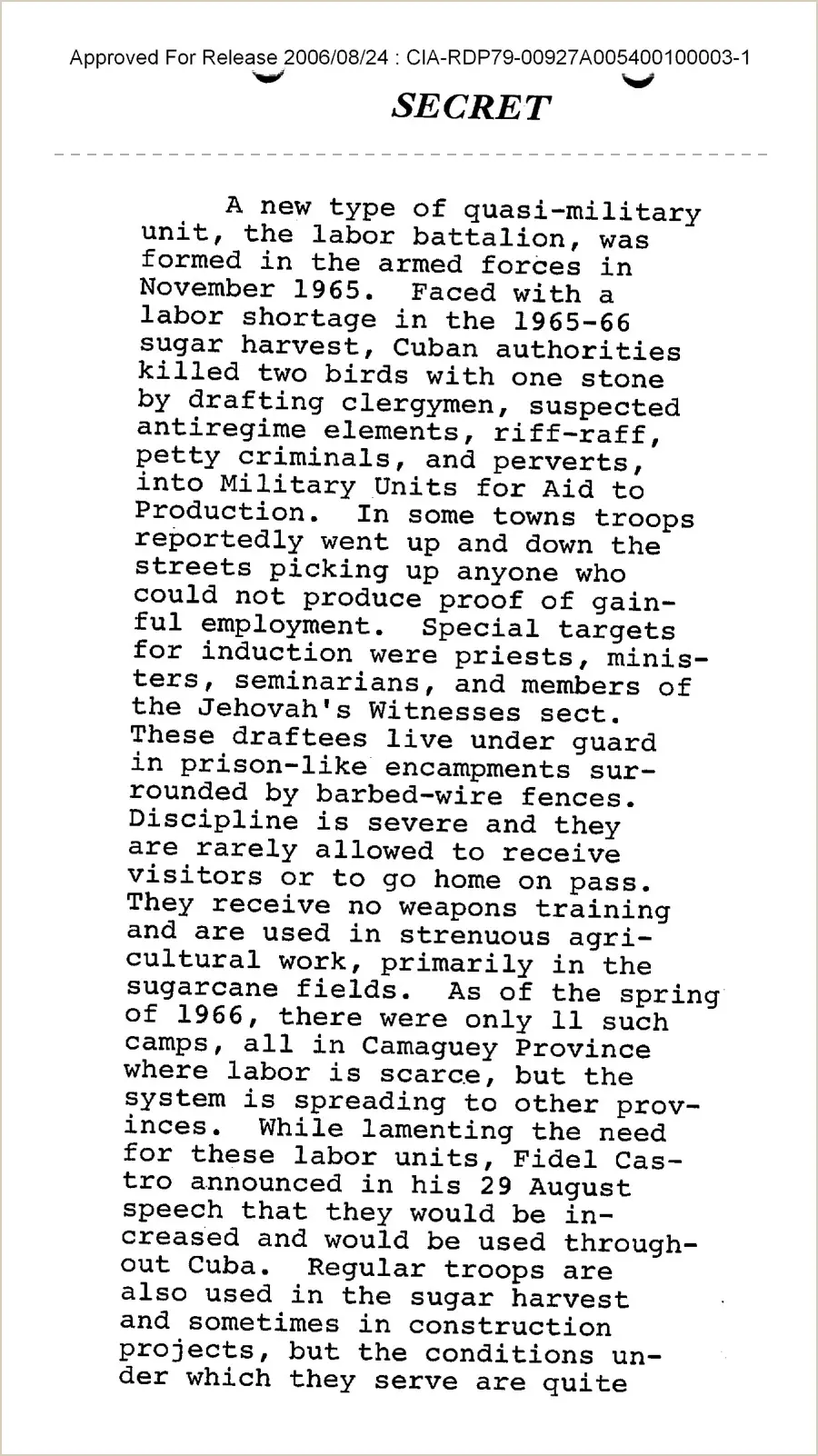
Those who were there tell more. Jaime Ortega Alamino was a young priest from Matanzas; years later he would become a cardinal. In 2014 he remembered it like this, in words reported by Martí Noticias (in Spanish): “I spent 8 months there.” And he told a story: one day the unit’s political officer told the recruits they should call him by his name or his number. “My number was 36.” The recruits answered no, they would keep calling him Father.
Pablo Milanés was 23. In 2015 he told El País (in Spanish) that he escaped from his camp, that 280 fellow internees followed him, and that he went to Havana to report what was happening: “The result was that they sent me to prison for two months at the fortress of La Cabaña, and then I was in a punishment camp worse than the UMAP.” The historian Abel Sierra Madero records that Milanés remembered the fence: “fourteen strands of barbed wire.”
The writer Ariel Hidalgo tells it in his own biography (in Spanish): he was taken to a UMAP camp, “which was really a kind of concentration camp with forced labor. After four months, when they gave me a ten-day pass, I did not go back.”
Jehovah’s Witnesses, who refused to salute the flag and to bear arms, appear in almost every account as the worst treated. One of them, Luis Alcantur, told it in a publication of his organization in 1981 (in Spanish): “We were deprived of food for 12 consecutive days. We were given water only once a day. We were kept standing, at the mercy of the sun, the rain, the mosquitoes and the gnats.” He was 19. Héctor Santiago, who was in a camp for homosexuals, summed it up in 2013 for the researcher Joseph Tahbaz: “With us, they were terrible, but let me tell you the truth, they treat you like a lady compared to the testigos de Jehová.”
Sierra Madero, who interviewed former internees for his study of the UMAP, published in 2016 in the academic journal Cuban Studies, records specific punishments that several of them described to him: burying an internee in a hole with only his head above ground for hours, putting him in a water tank until he lost consciousness, tying him at night to a post or a fence, out in the open.
In 1984, Néstor Almendros and Orlando Jiménez Leal brought several of them together in the documentary Improper Conduct. One describes how he was called up: “I showed up for that military service call-up and it was a trick. […] the government called people up as if it were for military service.” Another remembers the entrance to his camp: “it said military unit 2269 and then it had a huge banner, a big sign that said: work will make you a man.” And another, about a group of Jehovah’s Witnesses who refused to work: “they stabbed a young man with a bayonet and tore his chest.” These are testimonies, given almost twenty years later, and the documentary does not put names to those segments; I quote them as what they are.
What the regime itself admitted
You do not need an exile’s testimony to know there were beatings. The official press published it in 1966, with the units in full operation.
On April 14, 1966, El Mundo explained that at first “the situation was so tense that some officers made the mistake of losing their tempers. For example, there were several cases of lieutenants who, exasperated by how negative the conduct of certain young men was, slapped them.” And Granma, the same day: “some officers did not have the necessary patience or the required experience and lost their tempers. For those reasons they were brought before a court-martial.” Both quotes are given by Garcés Marrero, with the issue and page of each newspaper; I have not seen the original newspapers.
That same year, on August 29, Castro spoke in public about prison labor and said: “Are they going to turn the country into a concentration camp? And whenever they make a plan for anything, prisoners over there behind a barbed-wire fence? No, the Revolution does not mean slave labor.” He was not talking about the UMAP, and he did not name it. But he said it while the Camagüey camps were operating, as the CIA described a month later, surrounded by barbed wire.
Almost fifty years later, the officer put in charge of dismantling the UMAP, Felipe Guerra Matos, spoke with Abel Sierra Madero. In the historian’s summary, he said the camps came to hold “some thirty thousand individuals, among them 850 homosexuals, approximately.” And at another point in the conversation, in his own words: “We made serious mistakes, punishments for the little faggots, and twenty things were done there […] They made them stare at the sun, count ants […] Any barbarity that could occur to a brainless officer. I am to blame too, because I signed recruitment orders.”
The slur is his, not mine. I leave it because it says more than any analysis about how the men who were there were seen from the top.
The psychologists
In 1966 a team of psychologists arrived at the camps. One of them, María Elena Solé, told Sierra Madero in 2012 that they first interviewed about a hundred homosexuals, and, according to the historian, when the team returned in 1967, “around eight hundred homosexuals were interviewed and studied.” They classified them from A1 to A4, according to what they called “afocante” behavior, meaning conspicuous, and then separated them from the rest.
Solé explained how the category was decided: “A2 is an A1 but missing a little something, and A3 was more A4 but had something good that brought it closer to A1.” And she added: “That was a bit subjective, wasn’t it?”
Some former internees insist that electroshock was used there. Solé maintains that the tests were only meant to “measure intelligence.” Héctor Santiago tells it differently: in 2015 he said “they applied electroshocks to you or injected you with insulin to shock you” (in Spanish). I have found no document that proves it and none that disproves it. They are two testimonies, and I give both.
The papers
In August 2024, the journalist José Raúl Gallego published six documents about the UMAP (in Spanish) that, he said, were handed to him by a source who asked for anonymity. I have read them in their scans. Before quoting them, here is what you need to know: nobody has authenticated them, most are unsigned, and there is no way to check where they came from. What I can say is that I found nothing that does not fit the period, and that what they describe matches what the psychologist Solé told Sierra Madero years before they surfaced.
One of them, unsigned and undated, is a plan about the homosexuals in the UMAP. It proposes separating them into companies by political attitude: those “akin to or linked with the Revolution,” “counterrevolutionaries who do not want to leave the country” and “counterrevolutionaries who want to leave the country.” It proposes a “Model Reeducation Center” whose first aim would be to “erase all mannered or antisocial behavior,” and it refers to a plan submitted to the Central Committee “on professions barred to homosexuals.” And it says what would happen to revolutionary recruits who did not declare their homosexuality when called up and then showed it in a regular unit: “as punishment they will serve in the UMAP Homosexuals Battalion (company A) before being able to go to the Model Center.”
As punishment. That is the document’s word.
Another, dated at “UMAP Headquarters” on April 4, 1967, the “Year of Heroic Vietnam,” is addressed to the head of the UMAP and signed by Private Enrique González Suárez. It begins: “Considering the current members of our UMAP unfit to be trained as Cadres of our Armed Forces.” It proposes pre-military schools and compulsory sports, because they are “an effective means of combating effeminate gestures and poses.” What would be gained, he writes, is making “a group of deviant individuals or individuals with tendencies to deviate” useful to society.
A third is a report on religions in Camagüey. About the Jehovah’s Witnesses it says: “The bulk of the religious people called up to the UMAP has been from this sect,” and “the most aggressive plans of detention, demoralization, cooling off, etc. have likewise been against these elements.” And it complains that the Witnesses “have unleashed a broad campaign to discredit the UMAP, calling them concentration camps.” All three are in the folder linked from Gallego’s publication. (Translations mine.)
How it ended
There is no closing decree. Nobody has published one, and Garcés Marrero, after going through the press of the time, puts it this way: from 1968 those units “were closed for unknown reasons and were never again mentioned in official writings.”
What there is are witnesses to how the closing came about. Félix Sautié, then a leader of the Union of Young Communists, told Sierra Madero in 2012 that about fifty young men trained to get themselves arrested (in Spanish) were sent into the camps to see from the inside what was going on: “those fifty guys got into trouble and ended up locked up in different UMAP camps.” When they were pulled out, he says, “we corroborated most of the things that are known.” They wrote a report, sent it up to the country’s leadership, and Quintín Pino Machado, who was one of those running the UMAP and had been his friend, stopped being one: “the report hit him and they hit him. Then came the dismantling.”
Carlos Franqui, the former director of the newspaper Revolución, tells another part in Improper Conduct. His Italian friends Giangiacomo Feltrinelli and Valerio Riva, who were preparing a book with him on Fidel Castro, raised the issue with Castro himself, and there was “a very violent argument.” According to Franqui, Castro argued that the country needed strong men, “but he admitted that there was a very great persecution, that in the UMAP they had not only taken homosexuals or dissidents or religious people, but that they had been physically mistreated, and he committed himself […] to the UMAP disappearing.” It is the memory of a man who had already broken with Castro, undated, with no witnesses confirming it in writing. But if it is true, in the 1960s Castro admitted in private what in 2006 he denied in public.
A 1974 CIA report tells it from the outside: the UMAP had aroused so much public antipathy that “recruitment” was halted and “the system was permitted to die a natural death”; by mid-1968, those still there were moved to regular military units to finish their three years.
How many
The regime has never published a figure; it has kept those numbers secret (in Spanish). These are the ones that circulate, and where each comes from.
| Figure | Who gives it, and what is behind it |
|---|---|
| “An estimated 30,000” | Paul Kidd, a Canadian correspondent, in a November 1966 dispatch. No source given; I have read it in a transcript, not in the original newspaper. |
| 25,000 to 30,000 | The CIA, in propaganda guidance from February 1967, based on refugees’ accounts. |
| “More than 30,000” | A complaint that the IACHR transcribes in its April 1967 report (in Spanish). It is the complainant’s figure, not the Commission’s. |
| “More than 25,000” | Rafael Hernández, director of the journal Temas, in Havana, in 2015 (in Spanish). He does not say where it comes from. |
| “Some thirty thousand,” 850 of them homosexuals | Felipe Guerra Matos, the officer who dismantled the units, to Abel Sierra Madero in 2014, in the historian’s summary (in Spanish). His memory, not a register. |
| 35,000 | Norberto Fuentes and Juan Vivés, described as former intelligence agents by Joseph Tahbaz, who cites them. I have not been able to read their books. |
| “Probably never exceeded 45,000” | The CIA, in a 1974 report. A ceiling, not a count. |
| “More than 40,000” and, in 2018, “50,000” | Pablo Milanés, who was there, in El País and La Tercera (in Spanish). The same witness, two figures. |
| “More than 60,000” homosexuals | Virgilio Piñera to Juan Goytisolo in Havana in 1967, as Goytisolo tells it in Improper Conduct. What people said in whispers. |
The highest ones should not be taken as lies: they are what was said on an island where nobody published anything. But they cannot be used as data. The rest agree on something: between twenty-five and thirty-five thousand men. The figure that carries the most weight is Guerra Matos’s, because it does not come from an enemy of the regime, but from the officer put in charge of shutting the units down.
On the dead, I cannot give you a number. Seventy deaths from torture, 180 suicides and some five hundred sent to psychiatric hospitals circulate, and all of it comes from two books cited by Tahbaz, by Norberto Fuentes and Juan Vivés, which I have not been able to read. Few have a name and a date: in 2013, Cuba Archive had documented nine cases of extrajudicial or deliberate executions and disappearances related to the UMAP, according to Manuel Zayas in Diario de Cuba (in Spanish). One is Ramón Lamadrid, 18. He had escaped from a camp in Camagüey, was shot as he left his mother’s house in Marianao on January 24, 1966, and died two weeks later at the Naval Hospital. The account comes from a friend of his; Cuba Archive lists the case as confirmed with primary sources.
The official version, year by year
In 2006, in the first Spanish edition of Cien horas con Fidel (in Spanish), Castro says there were no internment camps and that they were not punishment units. On how long they lasted: “I couldn’t tell you now how many years that lasted, whether it lasted six or seven years.” And, as the English edition also has it: “the part of the responsibility that I bear, I accept.”
The revised edition of the book, the one translated into English in 2007, changes that passage. It adds that on a visit to Camagüey he himself became aware of “the distortion the original plan had been subjected to,” that he personally asked for a review, and that “those units lasted only about three years.” The translator, Andrew Hurley, warns in his note that “in dozens of cases” Castro made changes for that second edition whose effect was “to soften a judgement, or to avoid a ‘politically incorrect’ statement, or to be more diplomatic.” From six or seven years to three, and with a Castro who now corrects them.
In 2010, in an interview with Carmen Lira Saade in La Jornada (in Spanish), datelined Havana, Castro says: “those were moments of a great injustice, a great injustice!” And he takes responsibility: “If anyone is responsible, it’s me.” But the responsibility he takes is for not paying attention: “we had so many and such terrible problems, problems of life and death, you know, that we did not pay enough attention to it.” As an excuse he mentions the October Crisis, which was in 1962, three years before the UMAP existed. In the whole interview, neither he nor the journalist says the word UMAP.
Mariela Castro, Raúl’s daughter and director of the National Center for Sex Education, told La Jornada in 2011 (in Spanish): “It is not exactly as it has been told. Not all the UMAP behaved the same way. Not all of them had homophobic directors.” And she announced that CENESEX would investigate the subject; I have found no published result of that investigation. In 2013, in an interview with Salim Lamrani (in Spanish), she went further: “Fidel Castro played no role in the creation of the UMAP.” Three years earlier he had said “If anyone is responsible, it’s me.”
In 2020, on a YouTube program, according to Diario de Cuba (in Spanish), Mariela Castro said: “The way people were rounded up was terrible.” But she attributed it to another ministry: “That was work done by the Ministry of the Interior (MININT), it was not compatible with what the Armed Forces had decided.” And in 2023, according to the same newspaper: “no concentration camp in Cuba against LGBT people.” And: “They were military service centers.”
The official press strikes a different note. In November 2022, Cubadebate published a column by Javier Gómez Sánchez (in Spanish) that speaks of the UMAP’s “erroneous character” and of a “taboo subject,” and concludes: “The regrettable aspects of the UMAP do not belong to the essence of our Revolution.” EcuRed, the Cuban state’s encyclopedia, has no entry on the UMAP; it mentions it in a film’s entry, with a text by Pedro de la Hoz, as “an episode fortunately overcome in a short time.”
Put side by side, the versions do not hold each other up. They were punishment on Castro’s 1966 list and they were not in his 2006 book. They lasted six or seven years in the first edition and three in the second. They were a great injustice in 2010, something Castro had no part in by 2013, and military service centers in 2023. The blame lay with a lack of attention, then with the Ministry of the Interior, then with no one.
What has to be told even though I do not like it
Things circulate about the UMAP that do not hold up, on our side too. If I do not point them out, the first person who wants to knock down everything else will use them. And there are things the regime did that do not fit the easy picture either. Those are the two that follow.
First: the documentation on the UMAP is weaker than is usually said, and you have to know how to read it. The 1967 report of the Inter-American Commission on Human Rights, often cited as if it had condemned the UMAP, actually transcribes a complaint (in Spanish): the Commission presents that chapter as “the text of some of the complaints received.” The words “equal to slavery” and “true concentration camps” belong to that complaint, not to the Commission. The 1967 CIA document that estimates 25,000 to 30,000 internees is propaganda guidance, built from refugees’ accounts. The documents leaked in 2024, almost all unsigned, have not been authenticated by anyone: I quote them as what they are, and no conclusion in this article rests on them alone.
The often repeated story that Raúl Castro copied the Bulgarian model comes, as far as I have been able to find, from what Heberto Padilla says in Improper Conduct: that on a trip to Bulgaria Raúl was told they had “a separate camp” for homosexuals there. Padilla does not say who told him, and there is no document to back it up. A description of Che Guevara’s “new man” as “heterosexual, monogamous and austere” also circulates. It sounds like him, but it is not his: the words are Carlos Alberto Montaner’s, as ABC reports (in Spanish), and none of the three appears in Che’s text. And the death figures, as I said, I have not been able to verify. All of that gets used a lot, and badly. I am not going to use it that way.
Second: it was not the same everywhere, and the regime did eventually react. Jaime Ortega, who was there eight months, said in 2014: “I do not think it marked me negatively in the sense of leaving me with suspicion and resentment afterward.” Its own press reported in 1966 that officers had been court-martialed for hitting recruits. They sent infiltrators to see what was going on, and in 1968 they shut the units down. And Fidel Castro went as far as saying “a great injustice,” which is more than his government has ever said about the tugboat 13 de Marzo, which it called an accident. That has to be said.
But neither of those two things changes what is proven: that tens of thousands of men were sent to work in the fields, under military discipline, behind a fence, for being homosexual, religious or suspect, without trial; and that this is told by the victims, by the regime’s own press in 1966, by the officer who closed the camps and by the man who created them.
What remained afterward
The closing was not the end. Eleven years after the UMAP were dismantled, the 1979 Penal Code, Law 21, punished with three to nine months in prison, or a fine, anyone who “makes a public display of his homosexual condition,” and anyone performing homosexual acts in a private place where they could be seen. The 1987 Penal Code, in force from 1988, went on to punish anyone who “importunes another with homosexual advances,” and the word did not leave that article until Decree-Law 175 of 1997. (All in Spanish; translations mine.)
In 1992, with that article in force, Castro told Tomás Borge, in Un grano de maíz (in Spanish), that he had never supported policies against homosexuals. He did not speak of the UMAP, which does not appear anywhere in the book. He spoke of homosexuals.
Today Cuba has a Constitution that bans discrimination on the grounds of sexual orientation and gender identity in its Article 42, and a Families Code that recognizes marriage between people of the same sex, approved by referendum in 2022 with 66.85 percent of valid votes. That is true. But neither of those two texts mentions the UMAP. And the same state that approved same-sex marriage broke up an independent march of LGBTI activists in Havana in May 2019: the Inter-American Commission on Human Rights was informed that “at least five LGBTI activists were arrested by State security forces, while three independent journalists were also said to have been arrested.”
There is no open archive on the UMAP: Abel Sierra Madero says he had to write “a history of the UMAP without an official archive” (in Spanish). There is no list of those who went through them, and no official figure for how many there were or how many died. I have found no official apology. Pablo Milanés was still waiting for one in 2015: of all that, he said, there had been “no justification or explanation of any kind, much less the apology I am waiting for the Cuban government to make” (in Spanish). What there is, instead, is an official version that has never stopped changing.
I end with number 36. When the unit’s political officer told the recruits that the priest had to be called by his number or by his name, they answered: “No, we are going to keep calling him Father, because he is our Father.”
The men were sent there with a number. What we know about them, we know because some refused to be left with only that.
Next episode. "Here no one has even been called a bandit": the Escambray: six years of war in the Escambray, the word “bandits” that came afterward, what the CIA’s own papers say about the “mercenaries,” and the families the state took out of their mountains.