“Cuban History” series · Season 1, episode 3
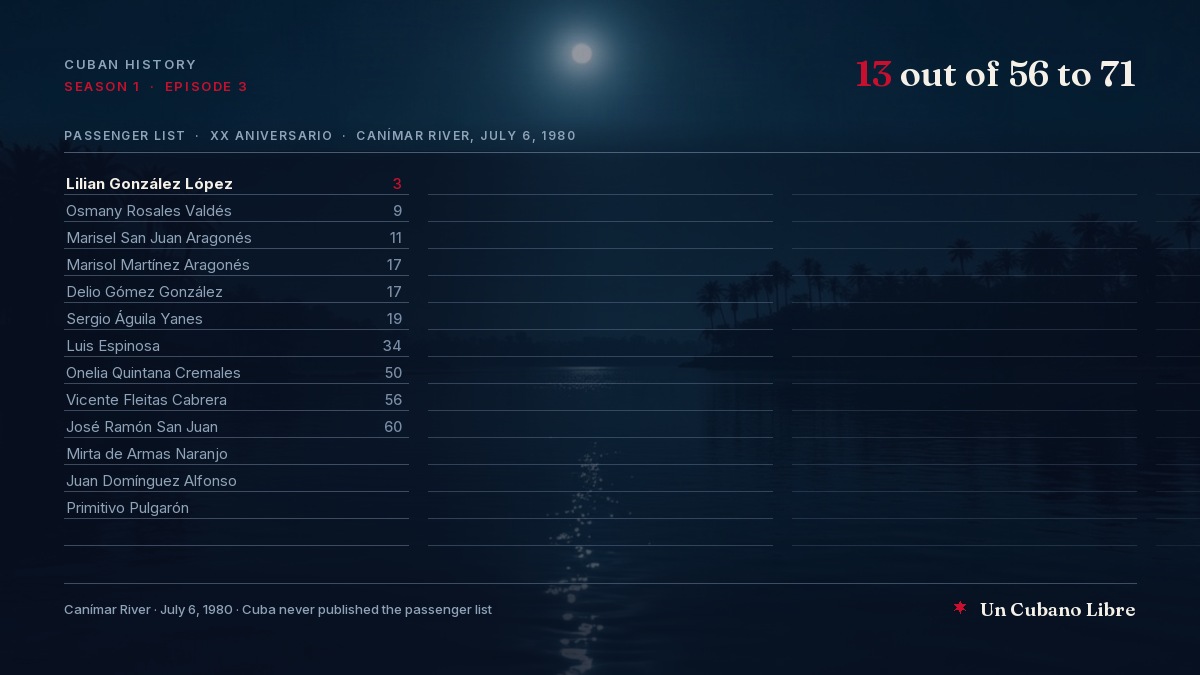
I do not know how many died.
I start there because it is the only honest thing I can say, and because it is exactly what this article is about. In the two previous episodes I could write figures: forty one people on the tugboat 13 de Marzo, four men in the Brothers to the Rescue planes. I could write them because reports exist with numbered paragraphs, and those reports name the victims one by one.
Not here.
On July 6, 1980, on the Canímar River in the province of Matanzas, the Cuban state sank a boat full of civilians. Somewhere between fifty six and seventy one people are believed to have died. Both figures come from the same organization. Neither is confirmed.
Of all of them, thirteen names are known.
What happened
In 1980 Cuba opened a tourist excursion service on the Canímar River, which flows into the bay of Matanzas near Varadero. The boat was called XX Aniversario, it was built of ferrocement and it held about a hundred passengers.
On Sunday, July 6, in the middle of the Mariel boatlift, three young men took it over. That detail of the calendar matters: between April and October of that year the regime let some one hundred and twenty five thousand people leave the country through the port of Mariel, while at the same time sinking those who tried to leave on their own.
They were the brothers Silvio Águila Yanes, 18, and Sergio Águila Yanes, 19, and Roberto Calveiro León, 16. Sergio was doing his compulsory military service and took several weapons from his unit. It is not clear all three were armed: in some accounts only two of them carried weapons.
When they seized the boat they shouted “To Miami!”, and according to Cuba Archive many passengers greeted it with screams of approval.
On board was an armed security guard in plain clothes. He drew his pistol to stop the boat from leaving, and Sergio shot him. The accounts disagree on who fired first. In some, the guard got a shot off and was wounded when they fired back; in others, including Norberto Fuentes’s book, Sergio was faster. In all of them, the one who drew a weapon to stop them was the guard.
What almost nobody tells is what they did next: they put him in a dinghy and sent him ashore. He reached land alive and raised the alarm. Cuba Archive records that it was later reported he had died.
The attack
Ashore, it was decided that this boat was not going anywhere.
Navy patrol boats went out and opened fire on the XX Aniversario. The young men fired back. The hull was ferrocement and it did not sink, but dead and wounded passengers were left on deck. Then they sent an Air Force plane, which fired on the boat.
Parents lifted their children up so they could be seen from the air and from the boats. So they would know there were children there.
It made no difference. It is the same scene that would repeat itself fourteen years later on the tugboat 13 de Marzo, and I note it because it is not a narrative coincidence: it is a method.
Finally the 23 de Mayo arrived, a large industrial vessel, and rammed the XX Aniversario until it broke apart. The boat sank.
Where it sank is not clear either, and I say so because it circulates wrongly. Cubanet writes that it was in international waters. Cuba Archive says the opposite: that it sank very close to reaching them, and its database places the deaths in Cuban territorial waters. The New York Times account from 1985 places it in the harbor of Matanzas. I go with that: it never got out. There was no International Civil Aviation Organization here fixing the position with data from a Norwegian cruise ship, as in the Brothers to the Rescue case. Nobody measured anything. Nobody wrote a record.
In the water
What follows is reported by Cubanet, 14ymedio and CiberCuba.
While the boat was sinking, Cuban forces kept firing on the survivors who were in the water. Some passengers died from the gunfire and others drowned. And the blood drew sharks.
How many bodies were recovered is not known for certain either. CiberCuba says eleven. Martí Noticias says ten and, further down the same article, eleven. Cuba Archive only says that some were reportedly recovered, and that they were not returned to the families.
And in the middle of that something else happened that also has to be told, because it complicates the story and because it is true. Silvio Águila and Roberto Calveiro, two of the three who had seized the boat, threw themselves into the water and saved several survivors from drowning.
The same men who that morning put dozens of civilians in danger were by the afternoon pulling people out of the water.
The word
The Cuban government said it had been an accident: that the swell made the boat collide with the industrial vessel.
If you read the first episode, you already know why I stop here. In July 1994, when they sank the tugboat 13 de Marzo, the Ministry of the Interior called it in writing “the accident that occurred in the course of the attempt to leave the country illegally.”
The same word, fourteen years earlier.
Families were told their dead had died at sea because of the hijacking. There was no official record of victims. Not one body was returned. Survivors were forbidden to meet more than two at a time and warned they could be prosecuted as accomplices.
There was only one funeral. It was for the state’s own guard.
The thirteen names
These are the names that are known. Cuba Archive, the organization that keeps the register of deaths attributed to the regime, says there are thirteen. But no single document has all thirteen together. Cubanet published twelve on July 6, 2022, citing Cuba Archive. Cuba Archive’s own 2019 report has a different twelve. Each list is missing one name the other has. Cross them and you get the thirteen.
| Name | Age | Cubanet, 2022 | Cuba Archive, 2019 |
|---|---|---|---|
| Minors | |||
| Lilian González López | 3 | ✓ | ✓ |
| Osmany Rosales Valdés | 9 | ✓ | ✓ |
| Marisel San Juan Aragonés | 11 | ✓ | ✓ |
| Marisol Martínez Aragonés | 17 | ✓ | ✓ |
| Delio Gómez González | 17 | ✓ | ✓ |
| Adults | |||
| Sergio Águila Yanes | 19 | ✓ | ✓ |
| Luis Espinosa | 34 | no | ✓ |
| Onelia Quintana Cremales | 50 | ✓ | ✓ |
| Vicente Fleitas Cabrera | 56 | ✓ | ✓ |
| José Ramón San Juan | 60 | ✓ | ✓ |
| Mirta de Armas Naranjo | ? | ✓ | ✓ |
| Juan Domínguez Alfonso | ? | ✓ | ✓ |
| Primitivo Pulgarón | ? | ✓ | no |
Three notes about these names, because an article about accuracy cannot afford to be inaccurate with them.
Sergio Águila Yanes was one of the three who seized the boat. He is among the dead and I do not take him off the list, but saying his name without saying who he was would be cheating. According to Cuba Archive and to Norberto Fuentes, as the boat was sinking he locked himself in the cabin and shot himself. He had said they would not take him alive.
Three of them have no known age. I am not inventing one.
And there are surnames that repeat. Marisel San Juan Aragonés was eleven; José Ramón San Juan was sixty. Marisol Martínez Aragonés was seventeen. Anyone can imagine what those repeated surnames mean in a list of the dead from the same sinking. I imagine it too. But no source says it, and I am not going to build a family out of a coincidence of surnames so the paragraph hits harder.
What cannot be proved
Here is the difference with the two previous episodes, and it goes to the heart of it.
The tugboat 13 de Marzo has Report 47/96 of the Inter-American Commission on Human Rights, which names thirty six of the forty one victims with their ages. Brothers to the Rescue has Report 86/99 from the same Commission, an ICAO report, a Security Council resolution and, since May 2026, a federal indictment in the United States.
The Canímar River has none of that. Not one ruling. Not from the Inter-American Commission, not from the United Nations, not from Amnesty International. What there is is the exile press, the Cuba Archive register and a memoir.
There is one document, and it is the regime’s own: the record of the Provincial Court of Matanzas, which Cuba Archive lists among its sources. It is the record of the trial of the young men who took the boat. According to a relative who attended, quoted by Cuba Archive, those who commanded the attack were not there.
And what there is arrived late, and from outside. Radio Martí brought it to light in September 1985, five years later, presenting it as a sinking that had never been disclosed, and The New York Times picked it up.
The most important sentence in this whole file was not said by a court. It was said by María C. Werlau, who signs as president of the Free Society Project, the organization behind Cuba Archive, in written testimony before the Committee on Foreign Affairs of the United States House of Representatives, on July 13, 2016:
“The number of victims is unconfirmed (there was capacity for one hundred passengers) and includes children, none of the recovered bodies were returned to their families for burial. The ten survivors were threatened into silence and kept under constant surveillance for years.”
The organization whose entire work consists of counting these deaths, testifying under its own name before another country’s Congress, says the figure is not confirmed.
And look at what circulates.
| Figure | Who gives it |
|---|---|
| 56 dead | Cuba Archive, cited by Cubanet and 14ymedio. |
| 71 dead | Cuba Archive as well, in its case record. CiberCuba reports it. |
| “No fewer than 45” | Baracutey Cubano. |
| 11 bodies recovered and 45 missing | Cuba Truth Project. |
| 10 survivors | Werlau, before the United States Congress. |
| 11 survivors | Spanish Wikipedia and Martí Noticias. |
This is not a failure of the people who have tried to document it. It is the intended result. Cuba never published the passenger list for that excursion. It published no list of the dead and none of the survivors. All the victims are officially recorded as “missing,” a word that does a lot of work: they did not die, they got lost.
An excursion boat sells tickets. Somebody wrote down who boarded that morning. That piece of paper existed.
What has to be told even though I do not like it
If I skip this, the article is worth nothing, and the first person who turns up with the facts will be right.
It was an armed takeover of the boat. Sergio carried weapons taken from his unit, he shot the guard and, when the patrol boats came, the young men fired back. I do not hide it, because it is exactly what the regime uses to blame the dead.
But look at whom the force was aimed at. Not at the passengers: at the armed guard who drew his pistol to stop the escape, and at the captain. Of the passengers, Werlau writes in the same testimony before Congress that they “immediately celebrated the opportunity to escape Cuba for the United States.” Ernesto Betancourt, the director of Radio Martí, put it differently in 1985 in The New York Times: some passengers apparently wanted to leave with them, but “the majority of them were trapped in the middle.” Both things can be true at once, and there were children of three and nine on board who chose nothing.
A state may step in when someone takes a boat at gunpoint. What it may not do is forget who is on board.
Because it has a duty that comes first, which is to protect the lives of the innocent people on the boat. And that is the whole matter. With civilians on board, the response has to be proportionate and discriminate. That does not erase what the men who took the boat did: what it does is set a limit on the response.
Here the priority was not to save anyone. It was to stop the boat from arriving. It was fired on from the sea and from the air in the knowledge that it was full of civilians, it was seen holding children up in the air, it was rammed by a large vessel until it broke apart, and then the people swimming were shot at.
There is no doctrine on the use of force anywhere that authorizes that. The answer to a hijacking is not to sink the boat with everyone on it.
And there is one detail that settles the argument on its own. The only person that day who got a funeral was the guard. The state buried its own man and declared the other fifty or seventy people missing. If the problem had really been the hijacking, those victims would be its victims too. It did not want them. They were in the way.
The ones who came out alive
Silvio Águila and Roberto Calveiro were sentenced to thirty years in prison.
According to Cuba Archive, as reported by Cubanet, they served part of the sentence at the Combinado del Este in Havana and were subjected to psychiatric torture with psychotropic drugs. Roberto Calveiro at least spent four years in dark cells, between 1983 and 1987. He was sixteen when he boarded that boat.
They came out after twelve years, through the intervention of Spanish politicians, and went into exile in Spain.
They were not the only ones sentenced. According to Cuba Archive, the trial was collective, about a year later, and it lasted three days. Humberto Martínez, a neighbor of Sergio who had been part of the plan and backed out before boarding, got twelve years. Three other young people, one of them a woman, were sentenced to two to three years for supposedly knowing about the plan, falsely according to Cuba Archive.
Of the other survivors, the ones who had only bought an excursion ticket, we know what Werlau told Congress: threatened into silence and kept under surveillance for years.
What is left
In the first episode of this series I wrote that the Inter-American Commission file does something the Cuban state has never done: it names the victims of the tugboat, one by one, with their ages.
This episode is what happens when there is no file.
Thirteen names, out of somewhere between fifty six and seventy one people. And not even the thirteen are together anywhere: to gather them you have to cross two documents from the same organization, each with twelve, each missing the one the other has.
That is not a gap in history. Gaps happen on their own. Somebody made this one: somebody decided not to publish the list, not to return the bodies, not to open an investigation, and to forbid the survivors from meeting to talk. The sinking took a few hours. The erasing has taken forty six years and is still working.
That is why this article cannot end with a figure. It ends with what there is.
Lilian González López was three years old. Osmany Rosales Valdés was nine. Marisel San Juan Aragonés was eleven. Marisol Martínez Aragonés and Delio Gómez González were seventeen. Luis Espinosa was thirty four. Onelia Quintana Cremales was fifty. Vicente Fleitas Cabrera, fifty six. José Ramón San Juan, sixty. Mirta de Armas Naranjo, Juan Domínguez Alfonso and Primitivo Pulgarón boarded an excursion boat that morning and nobody has ever written down how old they were.
Next episode. "Let the scum go": the Peruvian Embassy and the Mariel boatlift: April 1980, the Peruvian Embassy, the Mariel boatlift, and the word the Cuban state gave neighbors so they would turn into a mob.